Utility-scale solar investments reach $3 billion in first half of 2026


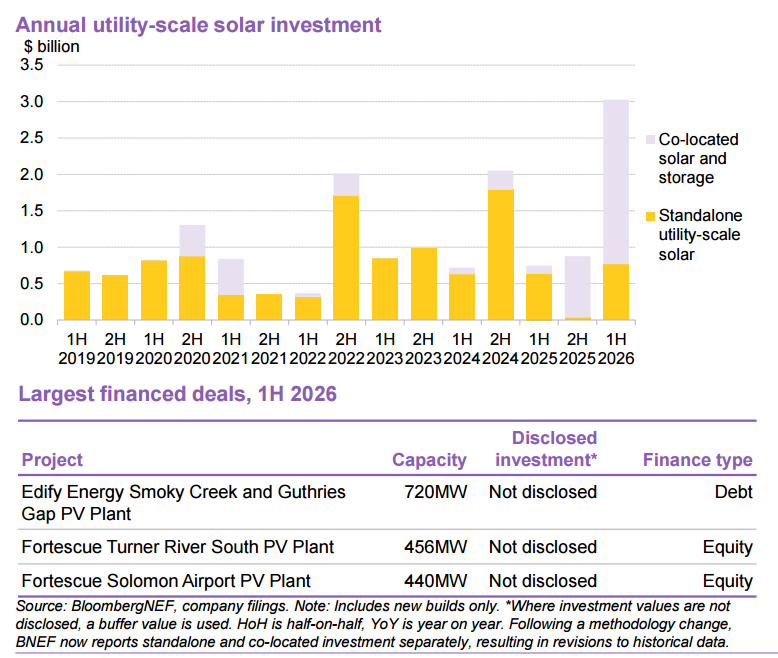
Utility-scale solar investments in the first half of 2026 reached $3 billion (USD 2.1 billion) representing an $876 million increase compared to 2H 2025, according to a new half year analysis released by BloombergNEF (BNEF).
One of the biggest drivers has been Sydney-headquartered clean energy developer Edify Energy’s 720 MW Smoky Creek and Guthrie’s Gap (SCGG) solar farm, located in Central Queensland, 75 kilometres south of Rockhampton.
The SCGG solar farm is the largest solar farm ever financed in Australia, and includes a co-located 600 MW, 4-hour battery energy storage system (BESS).
The facility secured debt from a consortium of 14 lenders, signed a power purchase agreement (PPA) with Rio Tinto covering 90% of its capacity, as well as securing a Capacity Investment Scheme (CIS) agreement, providing government backing.
Co-located utility-solar farms captured 75% of overall investment and include the 456 MW Fortescue Turner River South solar farm and 440 MW Fortescue Solomon Airport solar farm.
Standalone projects accounted for five of the eight solar projects financed in the half year period, all of which are located in Western Australia (WA), and represent approximately 25% of overall investment.
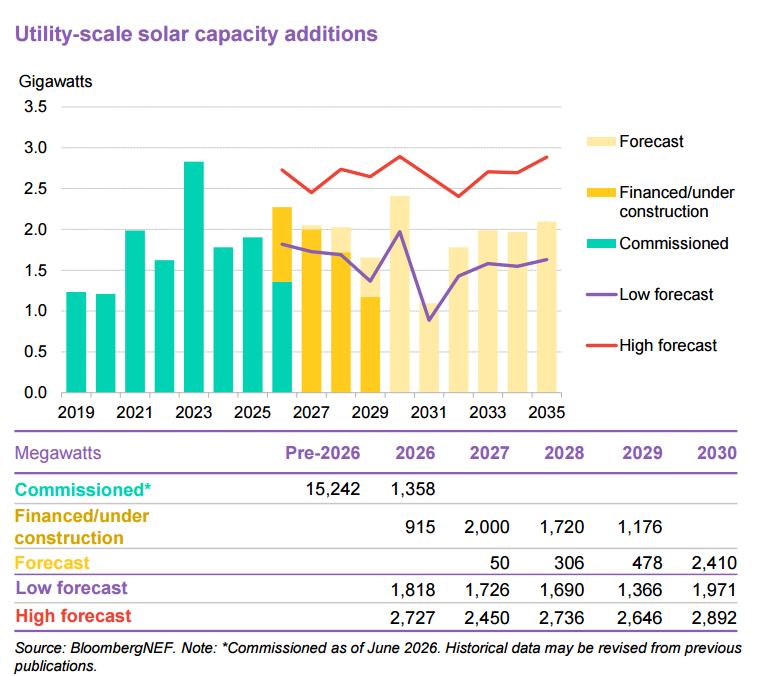
The BNEF Australia Energy Transition Outlook 2H 2026 forecasts a further 9 GW of utility-scale solar will be commissioned by 2030, which is 17% more than projected six months ago.
“The cumulative outlook for 2035 has also increased by 32%, with 35 GW now expected to be operational by then. The case now sees 42 GW by 2035,” the Outlook states.
82% renewable target not in reach
Lengthy permitting and grid connection processes however, along with social license challenges, continue to cause delays and costs overruns, and without improvements to these key areas, BNEF projects only 31 GW of capacity would be installed by 2035.
Consequently, BNEF says Australia’s 82% renewable energy target by 2030 is unattainable on the current path, despite three states that will carry the bulk of the solar capacity load by 2035.
Despite the country’s toughest permitting and social licence challenges, New South Wales (NSW) is expected to have the largest operating solar fleet by 2035, at 14 GW, bolstered by a retiring coal fleet, strong policy support for clean energy and storage, and a growth in data centre development.
Likewise, growth of data centre capacity in Victoria appears higher than BNEF expected, wind generation is anticipated to slow, and operational solar capacity is consequently forecast to reach 7 GW by 2035, up from 2 GW today.
Small-scale solar
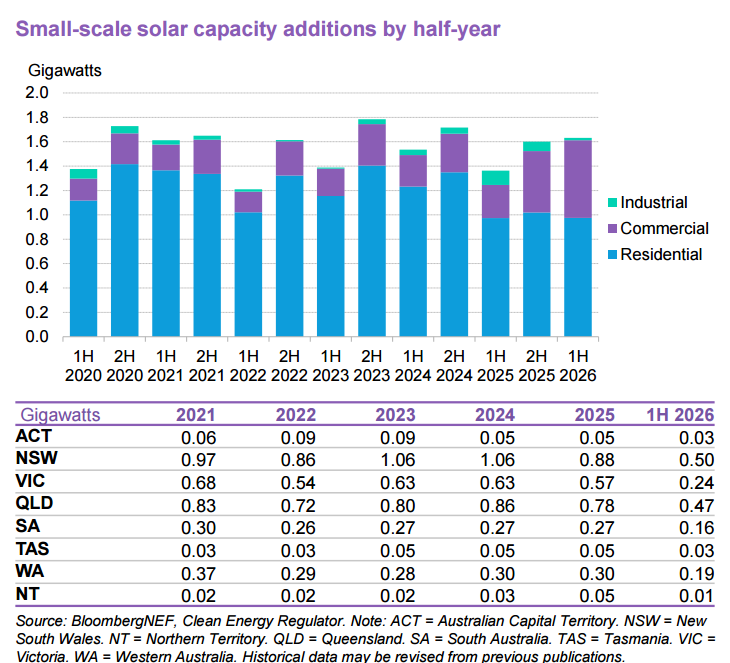
In the first half of 2026, approximately 1.6 GW of residential rooftop solar was installed, an increase of 7% on the previous six months and taking the cumulative capacity beyond 30 GW, the BNEF Outlook reports.
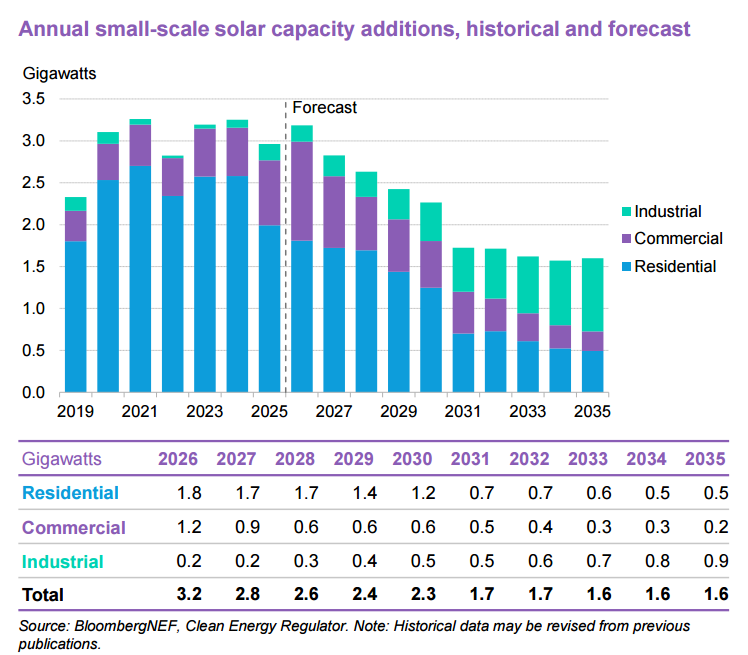
BNEF forecasts residential rooftop solar to grow 8% across 2026, with 3.2 GW of new capacity installed nationwide, and where total capacity is expected to reach 51 GW by 2035.
Residential rooftop solar now has a cumulative capacity of 24.5 GW, commercial rooftop solar, 5.5 GW and industrial, 0.9 GW.
The Outlook says commercial installations reached a record 0.6 GW in 1H 2026, which is the highest level recorded in any half-year period to date, and an increase of 9% over the next 10 years is also forecast.
Overall, the BNEF Outlook showed 1H 2026 investments increased across solar, wind and hydro by 341% compared to the same period the previous years forecasting 35 GW of utility scale solar capacity to be operational by 2035, up from 17 GW today.
This content is protected by copyright and may not be reused. If you want to cooperate with us and would like to reuse some of our content, please contact: [email protected].

Please login to comment
Sorry Bloomfield, but those projections for future industrial and residential rooftop solar installs will look ridiculous in the future. Residential rooftops are consistently installing 3Gw+ a year, average install size is growing, and now the Australian Government is promoting more installs on factories and offices and providing big subsidies. Plus, the 2,000+ residential batteries being installed every week is encouraging people to go bigger on solar. Between factory and office rooftops and residential ones, and panels becoming more powerful, cheaper and lighter, a figure of 5 Gw+ in 2031 is more likely than 1.7 Gw a year as Bloomfield predicts.
How is that 5 decades of research, as outlined in PV Magazine International today, shows that solar installs have been consistently underestimated, and Bloomfield, IEA etc, haven’t yet woken up to that fact?