Western Australia needs 40 GW generation, 125 GWh storage by 2035: report


A new report from independent industry think-tank Beyond Zero Emissions (BZE) has found that shared infrastrucutre in Western Australia (WA) is falling short of a needed 40.5 GW of renewable generation and 125 GWh of storage by 2035.
The report says barriers to achieving the targets include a lack of mandatory rules for engaging communities or sharing benefits from energy projects and, that existing industry is being left behind by emerging clean industries.
It recommends the WA government set clear emission reduction targets, being the only Australian state without one, provide existing industry decarbonisation with the same support as emerging clean industry, and improve community engagment and share benefits.

Kwinana and Port Hedland
Analysing the state’s major industrial regions of Kwinana and Port Hedland against the National Action Plan, BZE measured industry decarbonisation, enabling infrastructure, social licence, and policy and governance, which showed gaps between intent and delivery.
BZE Chief Researcher Matt McKee said Kwinana and Port Hedland have the workforce, ports and renewable energy resources to build a globally competitive clean industry.
“An extraordinary amount of work is already underway, but both regions face a common bottleneck: the construction of transmission isn’t keeping pace with demand, putting thousands of jobs and billions in investment at risk.”
Clean Energy Link (CEL)-North is under construction but two contracted wind farms will use nearly three-quarters of new capacity.
The grid could become a constraint if CEL-East and further South West Interconnected System (SWIS) upgrades do not pick up the pace.
“Kwinana’s industrial base is already worth $15.7 billion (USD 11.2 billion) a year but is contracting faster than new clean projects are arriving,” the report says.
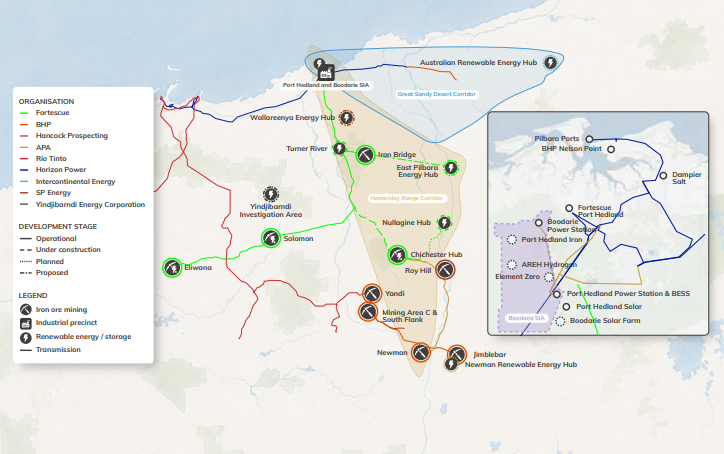
For Port Hedland a shared transmission could unlock the Pilbara’s portion of a national green iron export opportunity worth up to $386 billion a year by 2060 – triple current ore export value.
“Nationally, green exports could be worth $333 billion a year by 2050, building on a Pilbara that already supplies more than 90% of Australia’s iron ore exports,” the report says.
McKee said for WA it’s clear that existing industries need a pathway to decarbonise and for regions to retain skilled workers in the industry, investors need certainty to make long-term decisions, and communities need to be partners in the benefits from the start.
“Unlocking these levers across the state – not just the Lego wins we see here right now – is essential.”
BZE calls on the WA Ggovernment to deliver CEL–North on time, accelerate the next SWIS transmission projects, and put firm delivery timelines behind the Pilbara Energy Transition Plan.
Powering Up Western Australia also identifies other key policies, including, legislated climate and renewable energy targets, statewide community benefit-sharing, independent oversight of renewable delivery, and a Commonwealth agreement to support North West Interconnected System (NWIS) investment as critical to sequencing delivery across WA’s industrial regions.
This content is protected by copyright and may not be reused. If you want to cooperate with us and would like to reuse some of our content, please contact: [email protected].

Please login to comment