Australia funds Pacific clean energy commissioner amid coal mine backlash


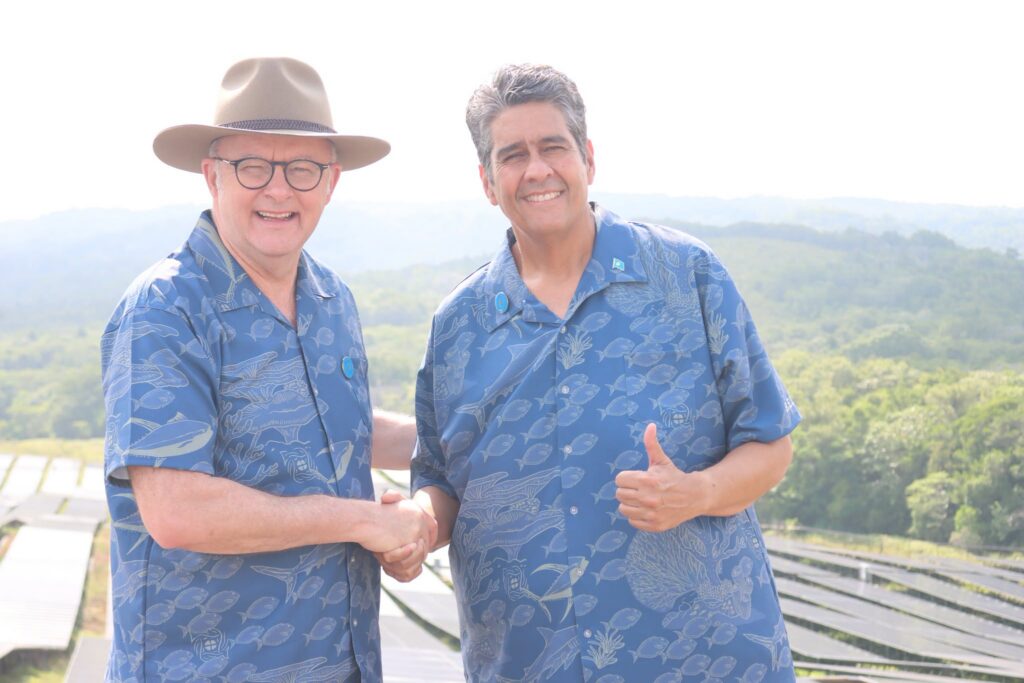
At the 55th Pacific Islands Forum (PIF) Leaders’ Meeting in Palau, Australian Prime Minister Anthony Albanese allocated $1.89 million (USD 1.3 million) funding package to create a Pacific Renewable Energy Commissioner in support the region’s path to 100% renewables.
Federal Minister for Climate Change and Energy Chris Bowen said a renewable energy commissioner for the Pacific will support investment in renewable energy, strengthens energy security and help lower power costs across the region.
“The Commissioner will help turn ambition into action by bringing together governments, investors and development partners to accelerate renewable energy projects and deliver lasting benefits for Pacific communities,” Bowen said.
Located north of Papua New Guinea, and west of the Philippines in the Philippines Sea, Palau is the Oceania’s most westerly Pacific island nation.
During the leaders forum, Albanese visited Palau’s first large-scale 15.28 MW solar and12.9 MWh battery power plant at Ngatpang on Babeldaob.
The solar power plant has been financed by a $31.4 million package through the Australian Infrastructure Financing Facility for the Pacific (AIFFP) and is delivering 23,000 MWh per year.
PIF attendees marked the delivery of additional battery storage, a key milestone in a further $16.4 million AIFFP investment to upgrade Palau’s electricity grid.
The upgrade will double energy storage capacity at the facility, increase renewable energy to 25 % of Palau’s total electricity generation and displace more than one million litres of diesel consumption annually.
Prime Minister Anthony Albanese said the solar power plant demonstrated Australia and Palau’s close collaboration to deliver tangible benefits by helping provide cleaner, more reliable energy for homes, businesses and schools.
“Australia is committed to partnering with our Pacific family on climate action as we prepare to deliver the Pre-COP Leaders’ event in Fiji and Tuvalu later this year,” Albanese said.

Simultaneously at home however, the federal government approved expansion of the Saraji coal mine in Central Queensland, as part of BHP’s Grevillea Pit Continuation Project.
Climate Council Chief Executive Officer Amanda McKenzie said the approval of 55 million tonnes of coal extraction to 2055 countered the Prime Minister’s own comment that the entry fee for credibility in the Pacific was taking climate change seriously.
“We cannot tackle climate change while approving more fossil fuels. Pacific countries are going under water, while Australians insurance costs are going through the roof as we are all more exposed to extreme weather. It is crazy to pour more fuel on the fire by allowing fossil fuel projects to expand.”
“More than four million Australian families have put solar on their roofs and are doing their bit to cut climate pollution, while coal and gas corporations free ride on that effort and pocket record profits,” McKenzie said.
Greenpeace Australia joined the criticism branding the coal mine’s expansion an affront to Pacific leaders and communities grappling with climate disasters, citing the latest UN report warning of dangerous climate overshoot, and just months before Federal Minister Bowen taking the reins of UN climate negotiations at COP31.
Greenpeace Australia Pacific (GAP) COP31 Lead Dr Simon Bradshaw said there should be no more double talk.
“Australia must get squarely behind longstanding Pacific leadership on climate change, fight to protect the all-important goal of limiting warming to 1.5°C, and ensure that COP31 builds further momentum in the global transition away from fossil fuels,” Bradshaw said.
GAP Head of Pacific Shiva Gounden said Australia must hold the line on returning warming to 1.5°C as our legal and moral obligation.
“This means doing everything possible to accelerate the global transition away from fossil fuels, starting at home,” Gounden said.
Vanuatu Minister of Climate Change, Adaptation, Meteorology and Geo-Hazards, and Energy, Ralph Regenvanu said to maintain a high ambition scenario, an urgent climate action on transitioning away from fossil fuels is needed.
“Pacific leaders also call for a 1.5 degree line pathway in the Pacific that includes a 100% renewable energy future for the Pacific small island developing states,” Regenvanu said.
Tuvalu Minister for Home Affairs, Environment and Climate Change Dr. Maina Talia added that climate change falls disproportionately on the Pacific countries.
“The message is very clear from the UN report that we need to do more. And that’s why we are hosting the Second International Conference on Transitioning away from Fossil Fuels in the Pacific next year with the whole idea not just to bring leaders across, but to demonstrate that these are the impacts that we are going through,” Talia said.
“We need the political will to transition away from fossil fuels. That’s my message for all the oil-producing countries and fossil fuel countries.”
This content is protected by copyright and may not be reused. If you want to cooperate with us and would like to reuse some of our content, please contact: [email protected].

Please login to comment