C&I storage the ‘sleeping giant waking up’, says WoodMac

The global energy storage market is entering a new phase of scale and complexity, according to Wood Mackenzie’s latest outlook. Cumulative capacity is forecast to grow to more than 7 TWh by 2035. Demand growth in 2026 alone is close to 30%.
But growth at that rate and capacity is no longer the most interesting part of the story. The composition is.
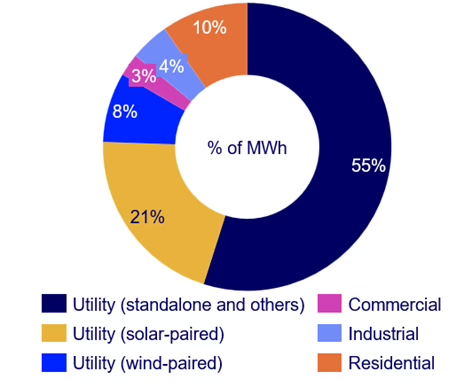
Global energy storage outlook by segment (% of total MWh installed in 2026)
Regional competition: the running order is changing faster than the totals suggest
While China and the United States (US) are still the two biggest global energy storage markets, in 2026, for the first time, Europe’s annual installation overtook annual US energy storage capacity and took second place after China.
In the utility segment, government-led tenders remain the main market drivers, having globally cleared over 80 GW (de-rated) capacity, with India the single largest contributor. Poland has become the global number-one emerging market, on the back of capacity-market auctions and a grid short of flexibility.
In mature utility markets, the demand signals behind the forecast are also firm. Contracted offtake for storage has passed 130 GW, with utility power purchase agreements and tolling deals together accounting for more than three-quarters of all contracts signed, according to our global offtake tracker.
In the residential landscape, the centre of gravity has shifted south: Australia has overtaken Germany as the world’s leading residential energy storage market, with more than half a million installations under its Cheaper Home Batteries subsidy, while the US market contracts this year as tax credits become less available.
Commercial and industrial storage is the sleeping giant now waking
Wood Mackenzie forecasts commercial and industrial storage capacity separately. The split shows industrial demand is materially larger in some regions.
A single “utility” line no longer tells the story: standalone still leads, but some regions need pairing far more than others
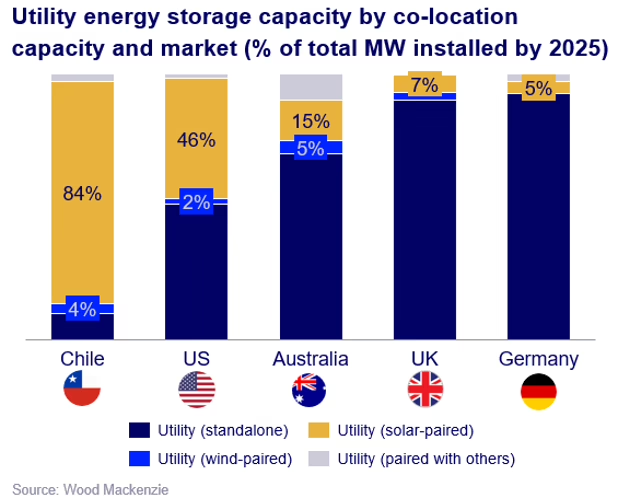
In the latest market outlook update, Wood Mackenzie changes how the utility energy storage market is measured. The utility segment is now reported in three parts: standalone, solar-paired and wind-paired, instead of one, because the three are growing for different reasons, at different speeds and in different places.
Standalone projects still dominate and will keep doing so through 2035. But paired capacity is no longer a rounding error: close to a third of the storage expected online by 2035 will sit alongside a wind or solar plant.
The new breakdown exposes how little the regions resemble one another, given their different policy and economic parameters.
Europe is the most standalone-heavy market in the world, with the overwhelming majority of its utility pipeline unpaired. Yet it is also poised for the fastest growth in paired capacity, as worsening economics for standalone solar push developers towards co-location. That makes Europe the market most likely to shift quickly towards co-location as an economic solution for stranded solar projects in markets such as Spain or Germany.
The Americas sit at the opposite end, where, for example, in the US, close to half of utility storage additions are solar-paired — a legacy of the ITC pairing requirement in the early days and now poor solar capture rates in key markets like CAISO. That share is expected to fall as storage spreads into lower solar-penetration states, where standalone economics work better.
Data centre-linked battery projects are also taking shape in the US, though not all of them are paired with wind or solar: gas-plus-storage pairings are the new co-location favorites for emerging data center projects.
Asia Pacific sits in between, with solar pairing the fastest-growing utility category, driven largely by India, which has overtaken Australia as the region’s largest utility-scale market. Regulatory changes are central to this: India’s new rules will require solar and wind projects commissioned after July 2027 to include co-located storage equal to at least 10% of capacity, rising to a four-hour minimum duration from 2029.
The replacement cycle and repowering appear in the energy storage market at last
Aging storage assets will only start to come offline and be replaced at scale after 2030, adding 40 GWh of repowered capacity by 2035, led by the US, Japan and Germany. This is the first sign of a market old enough to need replacing, which has earned a reporting line in our latest energy storage outlook.
Wood Mackenzie is hosting a global energy storage outlook webinar on 3 November to discuss which markets and segments are shaping the future of global energy storage.
Anna Darmani is a research director on the Wood Mackenzie Power & Renewables team, heading the EMEA energy storage team. She previously worked at EIT InnoEnergy, developing innovation and technology roadmaps and contributing to EU research and advisory projects.
The views and opinions expressed in this article are the author’s own, and do not necessarily reflect those held by pv magazine.
This content is protected by copyright and may not be reused. If you want to cooperate with us and would like to reuse some of our content, please contact: [email protected].
Please login to comment