Large-scale solar sets annual financial investment decision record at 3.5 GW+


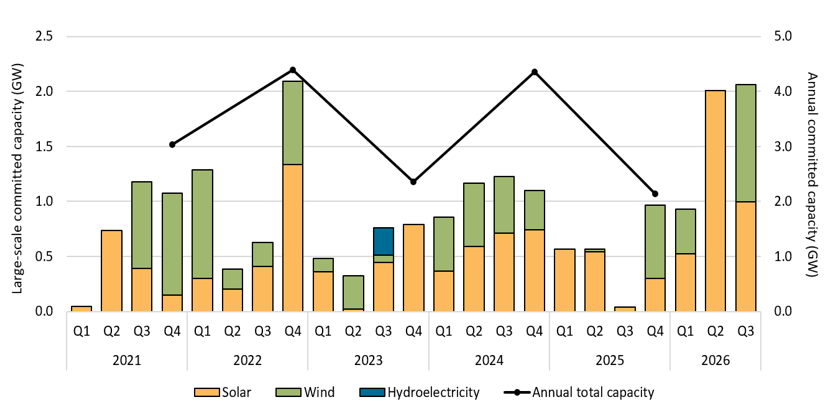
The latest Clean Energy Regulator (CER) data shows investment in solar is setting a new annual record with final investment decisions (FID) for the September quarter sitting at 1 GW, following 2 GW in Q2, adding to the year’s already tallied 3.5 GW, and is approximately 30% above the previous annual solar FID record.
2.1 GW of total large-scale renewable capacity reached FID in the September quarter, which is an equal highest quarterly result, and brings total renewable FID to October 2026 to 5 GW.
That is higher than the previous full-year record of 4.9 GW and brings large-scale FID totals to almost 17 GW since 2022.
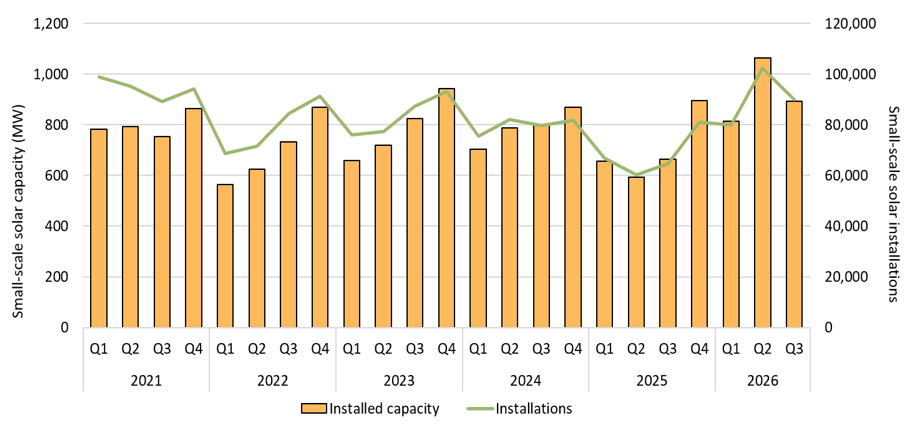
Rooftop solar added 90,042 installations and 894 MW of capacity in the September quarter, which is 35% higher than in Q3 2025, and year-to-date rooftop solar capacity is 45% higher than at the same point in October 2025.
Rooftop solar installations in Q3 were 39% higher than Q3 2025, and has so far added 2.8 GW in 2026, which almost matches the whole of 2025, with three months to go.
Q2 2026 was the biggest rooftop solar capacity quarter on record at 1 GW, and over 13 GW of small-scale solar has been installed since 2022.
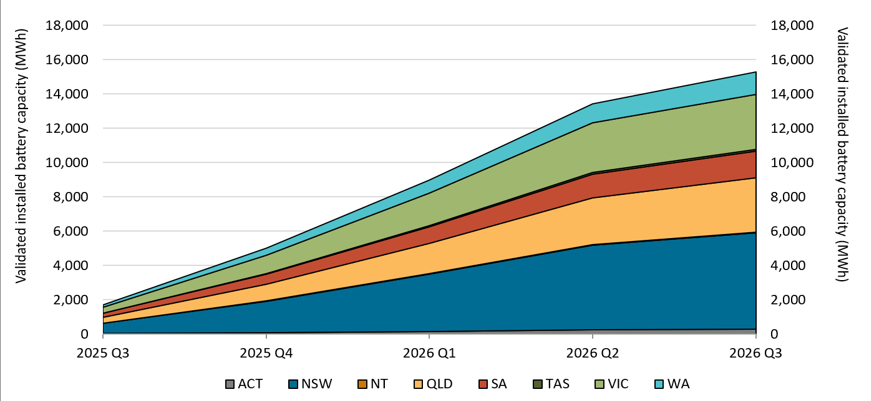
Approved capacity under the Cheaper Home Batteries Program (CHBP) reached 15.3 GWh by the end of September, up 1.9 GWh in Q3, and up from less than 2 GWh at the same time in 2025, with total home battery capacity in Australia now more than 5 times greater than when the scheme began on 1 July 2025.
Cheaper Home Batteries approved capacity has more than tripled during 2026, growing from 5 GWh at the end of 2025 to 15.3 GWh at the end of Q3. With total home battery capacity, including that installed before the scheme, around 19 GWh, it is more than 5 times greater than when the scheme began.
New South Wales (NSW) has 5.6 GWh of approved home battery capacity, followed by Victoria and Queensland at about 3.2 GWh each.
The data shows about half of approved battery installations are retrofits to existing solar, while about half are going in with new or upgraded rooftop solar.
Federal Minister for Climate Change and Energy Chris Bowen said more renewable energy reaching final investment decision is “what progress looks like”.
“Renewable investment has already broken the annual record with three months still to go. And it isn’t just investment; last month renewable energy generated more electricity in the national grid than fossil fuels,” Bowen said.
“Investors, as well as Australian households and small businesses, are backing Australian renewable energy because they see a government with a clear policy that is working and we’ll continue to get on with the job.”
This content is protected by copyright and may not be reused. If you want to cooperate with us and would like to reuse some of our content, please contact: [email protected].

Please login to comment