60% of home battery installs rated ‘substandard’ by regulator


More than 60% of batteries and about 23% of solar systems installed under the Small-scale Renewable Energy Scheme (SRES) during the 2025–26 financial year were rated as “substandard” while less than 1% of both were deemed “unsafe,” according to a new report from the Clean Energy Regulator (CER).
The CER has published its annual inspection report for the 2025–26 financial identifying installation trends, risks and common areas of non-compliance.
Across the reporting period, the CER completed a record 6,554 inspections, including 3,425 solar battery systems and 3,129 solar inspections.
Just 23.11% of the inspected solar systems were rated as substandard – that is, the installation contains faults that need to be rectified – and 0.93%, or 29 of the 3,129 inspected installs were found to be unsafe – not safe to remain in operation as is.
Of the battery energy storage systems (BESS) inspected, 61.19% were found to be substandard while 0.95% were rated as unsafe.
Critically, the report reveals the common areas of non-compliance identified are almost entirely the result of poor workmanship rather than faulty products.
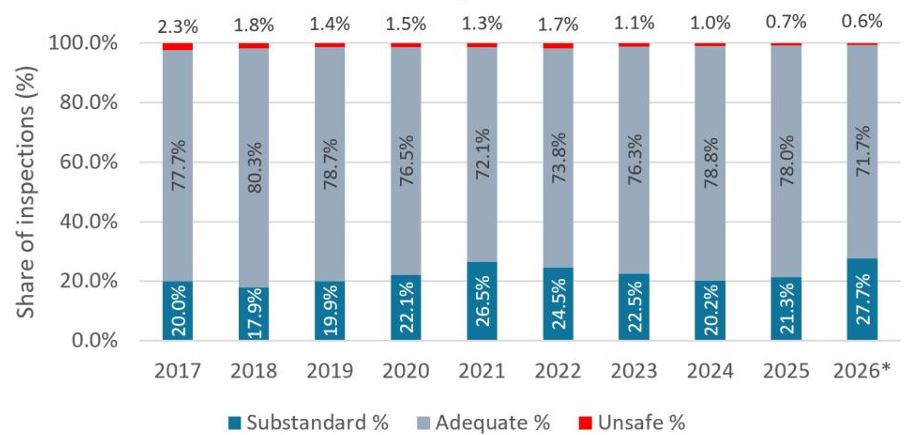
The most common issues leading to a solar system being rated substandard included incorrectly sized or fitted cabling and conduits, improper bonding or earthing of solar panel frames and other equipment, incompatible or incorrectly installed DC connectors, and improperly fitted mounting structures.
Out of the 29 solar systems deemed unsafe under the 2025–26 inspection program, 16 were due to unsafe installation work, 12 were due to a third-party incident such as weather damaging the system, and one was attributed to a product recall.
The main causes for a battery system being rated substandard included missing or incorrect labelling, incorrectly configured or missing wiring, insufficient rated circuit protection, and inadequate physical protection for cables and the battery.
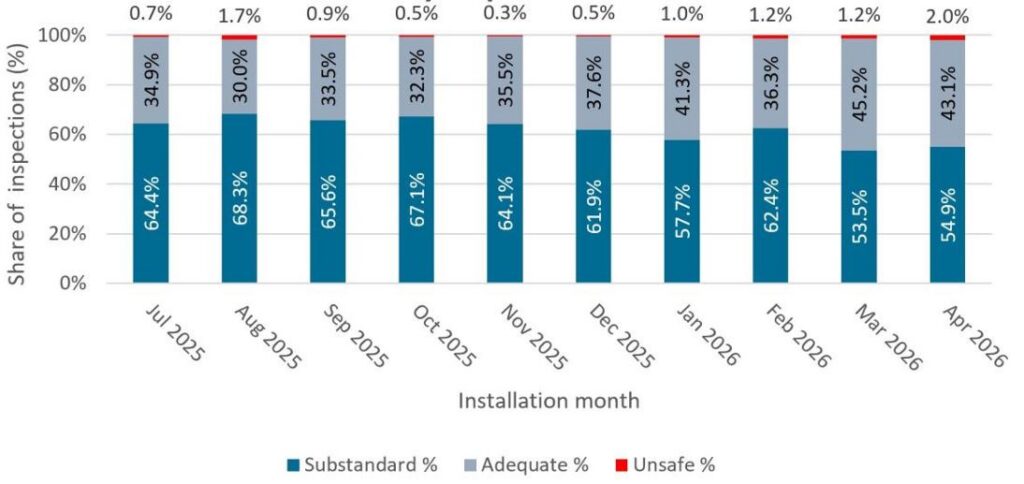
Of the 32 battery systems rated unsafe, 23 related to unsafe installation work including loose connections, eight were due to a product recall, and one related to a third-party incident.
The CER said the inspection results are being used to support early intervention, targeted education and compliance actions against installers demonstrating ongoing non-compliance.
The regulator said since 1 July 2025 it has communicated with more than 830 installers regarding adverse inspection outcomes and their obligations under the scheme. This includes 716 initial advisory letters to installers for first time non-compliance, and 121 warning letters to installers with repeated non-compliance.
“Our message to installers is simple – do it once and do it well,” the regulator said. “There are serious consequences for repeated non-compliance. We can suspend installers from participating in the scheme if they have three or more inspection reports with adverse findings, or three or more written statements containing false or misleading information.”
This content is protected by copyright and may not be reused. If you want to cooperate with us and would like to reuse some of our content, please contact: [email protected].

Please login to comment