Renewables investors say market heading in wrong direction as challenges mount


New data released by the Clean Energy Investor Group (CEIG) shows most major renewables energy investors agree Australia remains an attractive destination for capital but the market is heading in the wrong direction with that support dropping from 69% to 58% in the last year.
The third annual CEIG Clean Energy Investor Outlook report shows that 77% of Australia’s largest renewable energy investors believe the investment landscape has deteriorated over the past 12 months with delays in transmission buildouts, planning approvals and other grid-side constraints proving the biggest roadblocks.
The CEIG, which represents developers and investors overseeing a combined portfolio value of more than $41 billion (USD 28.4 billion) in renewables assets, said the findings highlight a significant gap between Australia’s renewable energy ambitions and investor confidence, with only 8% of respondents believing that under current settings Australia is on track to reach the federal government’s target of 82% renewable energy in the grid by 2030.
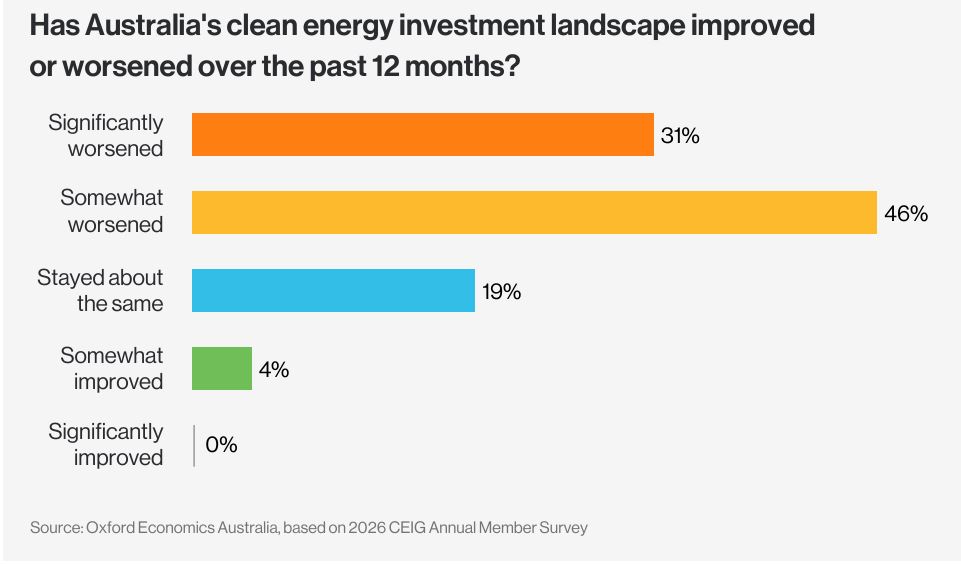
“Australia has been a top clean energy investment destination but that confidence in our country is waning and trending down,” CEIG Chief Executive Officer Richie Merzian said. “Over three quarters of our clean energy investors say the Australian landscape has worsened in the last year. This needs to be addressed with action.”
Merzian said investors are looking for clear signals from Australian governments on faster transmission, coal closures, streamlined approvals, and competitive tax settings.
“Investors are ready – the handbrake is the system,” he said. “Without coordinated action to address project delivery bottlenecks and restore certainty, Australia risks losing available clean energy capital to competing markets.”
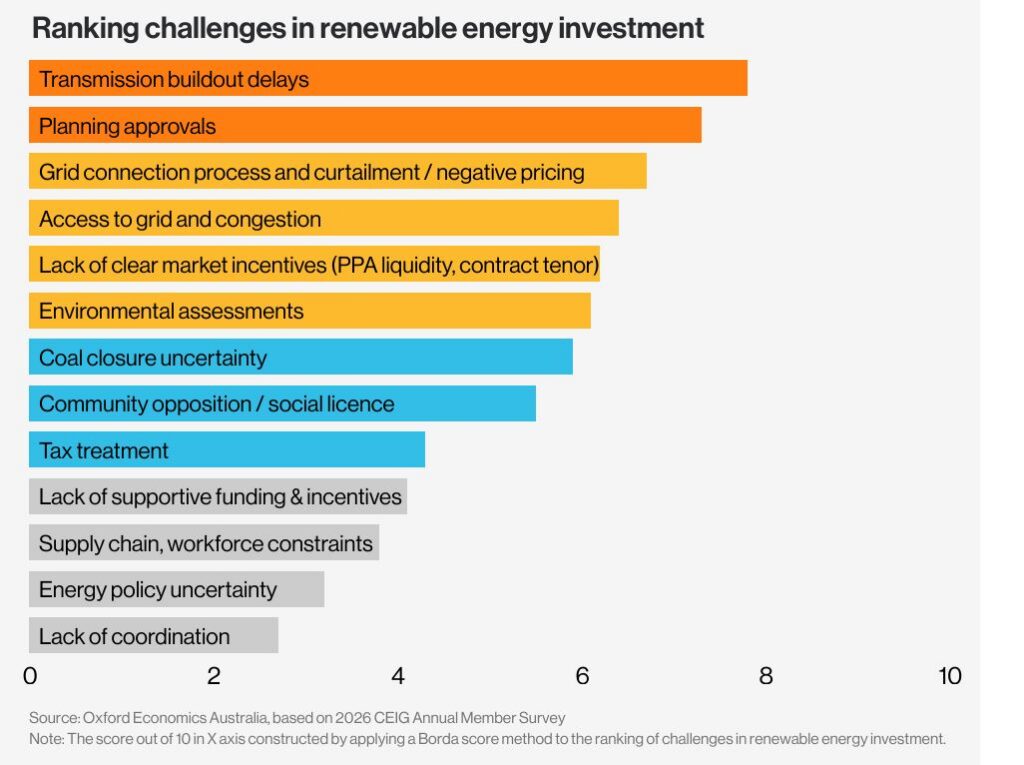
Transmission buildout delays top the list of investment barriers with planning approvals ranked the second biggest challenge to renewable energy investment while grid-side constraints, including connection delays, curtailment and congestion remain major roadblocks for project delivery.
Tax changes, including the recent foreign resident capital gains tax (CGT) reforms, were also rated as a significant challenge by the majority of investors.
In the state stakes, New South Wales (NSW) once again topped the list as the most attractive destination for renewable energy investment while Queensland remained in second spot with its appeal impacted by energy policy, including coal closure, uncertainty. Western Australia moved into third due to its greater transmission certainty while Victoria slipped to fourth place as market conditions and curtailment concerns prevail.
“NSW has topped the list of states for renewable investment given it is moving in the right direction, despite higher planning fees and longer approval timeframes,” Merzian said, pointing to the recent NSW legislation to prioritise renewable energy projects through the planning system.
While the survey captured the key policy uncertainties affecting investment, data centres were rated an emerging opportunity with 92% of investors believing growing demand from data centres will have a positive impact on unlocking clean energy investment. Long-term power purchase agreements from data centres are seen as critical to turning demand growth into additional clean energy capacity.
“Data centres present a real opportunity for unlocking a new wave of clean energy investment, with nine in 10 investors backing the new demand it brings,” Merzian said. “However, data centres must not be used as an excuse to delay coal power closures, which investors want to see retired on time.”
This content is protected by copyright and may not be reused. If you want to cooperate with us and would like to reuse some of our content, please contact: [email protected].

Please login to comment