TrinaTracker launches solar panel installation and cleaning robots

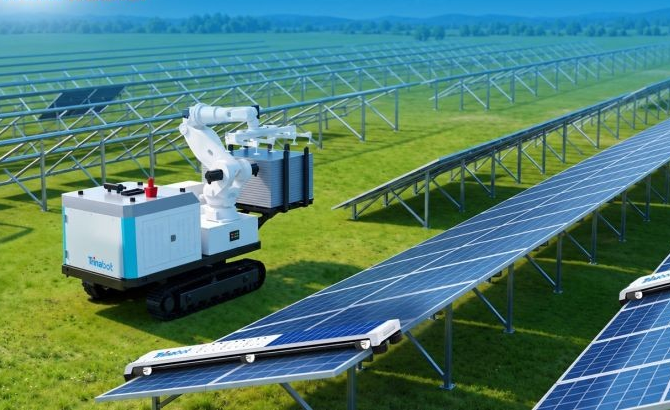
TrinaTracker, a business unit of Chinese manufacturer Trinasolar, has announced the launch of two self-developed robotic solutions aiming to improve operational efficiency in utility-scale solar PV systems. The Buildex robot is designed for the installation of solar modules, while the Aurora robot focuses on cleaning.
TrinaTracker said the Buildex PV module installation robot autonomously completes module picking, transportation, alignment and placement, and utilises AI vision positioning and industrial 3D cameras to adapt to complex terrain and different tracker layouts.
According to the company, it can install up to 90 modules per hour, which is three to four times faster than manual labour. TrinaTracker said the height-adjustable robotic base has 17° platform levelling capability and works with fixed and tracking brackets as well as 1P and 2P modules. The company said the Buildex is capable of operating around-the-clock, helping to shorten installation cycles and reduce manpower and construction costs.
The Aurora solar panel cleaning robot is designed to perform unattended cyclic cleaning. TrinaTracker said the self-powered robot utilises high-performance hardware and proprietary self-correction algorithms to keep modules clean, safeguarding energy yield and lowering long-term operations and maintenance (O&M) costs. The company said the Aurora can overcome height offsets of up to 50 mm to sustain continuous cleaning on complex sites.
TrinaTracker said the rollout of AI robotic products is a practical extension of its tracker system. It is also closely linked to the company’s view that future levilised cost of electricity (LCOE) reduction will depend increasingly on automation.
“Solar costs have already fallen sharply over the past decade, leaving less room for conventional cost reduction,” it said. “Further optimisation must come from AI-assisted design, reduced operating expenses, more efficient O&M, faster construction and lower execution risk.”
TrinaTracker said it will continue expand its robot portfolio and deepen AI integration as it works to enhance its solar tracker ecosystem.
“TrinaTracker’s investment in AI and robotics is not merely hardware iteration, but a strategic upgrade of its full-stack tracker smart energy ecosystem,” the company said.
“By integrating high-reliability trackers, AI algorithms, installation and cleaning robots, as well as engineering and intelligent operations services, the company delivers a full lifecycle solution for PV power plants by optimising plant design, improving construction and O&M quality, and reducing operational costs.”
This content is protected by copyright and may not be reused. If you want to cooperate with us and would like to reuse some of our content, please contact: [email protected].

Please login to comment