FTC Pioneer tracker design a good match for emerging module placement robotics


US-based FTC Solar has designed its Pioneer Tracker to be compatible with emerging robotics, the advent of which Vice President Software Andrew Morse told pv magazine is an historical opportunity for EPCs. developers, and the workforce.
Morse has worked at FTC Solar on tracker yield optimisation, PV monitoring and controls, and the growing role of robotics and automation in utility-scale solar construction, mindful that the solar sector is undergoing transformational change with the advent of robotics, automation and artificial intelligence, but remains optomistic it is change for the better.
The Australian Renewable Energy Agency’s latest Solar Sunshot funding round specifically identifies robotics, automation and innovation as a way forward. What challenges can these solve?
There’s a lot of discussion right now about the concept of speed to power, and that energy prices in general are going up, that supply needs to catch up to demand and solar especially over the last few years or decade has been the fastest energy source to deploy.
The challenge is still that we need to continue to build out more energy production and with solar being fast, we continue to want to try to do better. Automation, I would say is one of the critical aspects of our ability to do this.
The other challenge I’ve heard about and seen from EPCs in the US, and now in Australia, is the ability to source labour that will stick around for the entirety of a project.
Labour scarcity in some respects is driving us toward complimenting the workforce that is available. Using tools such as automation and robotic systems can add productive capacity to the existing labour force.
Also, when you have remote projects, there’s additional cost in bringing in temporary workers, housing them, feeding them, that makes it very challenging, and there’s no guarantee those labourers are going to stay for the duration of the project, as there can be a high turnover rate.
How is the FTC Pioneer tracker robot friendly?
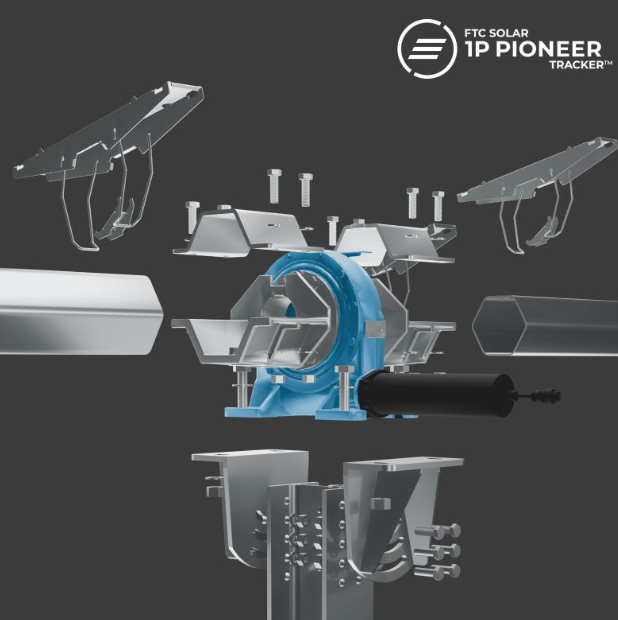
One of the things that differentiates Pioneer Tracker, both for robotic install and essentially for human install, is that above the torque tube we don’t have any threaded fasteners.
We utilise a python clamp to attach our module rails to the torque tube, and then to attach the modules to the rails we use a cinch clip. That means the speed with which those portions of the structure can go together is much faster than other trackers on the market.
When we go to a customer, an EPC, and they’re evaluating the FTC tracker versus other competitors, we typically see something like a 15% to 20% reduction in mechanical install cost for the tracker because of those differentiating aspects.
It’s because of those aspects that we’ve been talking to several robotic vendors that are focussing mainly on module placement, and in line with the fastening techniques and design choices we’ve made with Pioneer, the feedback has been that it’s much easier to train a robotics system to install those components in that way, than it is with other solutions that require threaded fasteners. Not to say we have no threaded fasteners, but the quantity is significantly reduced.
What are the challenges of partnering across the robotics ecosystem?
Because we are not picking one horse in this race, we want to work with all sorts of vendors focussed on very different tasks, or even the same task as in the case of module placement.
I think the challenge is when you do that, you have less influence over design decisions on the robotics front, but I think we’re willing to trade that for the ability to say that the FTC system is compatible with a wide array of vendors.
Ultimately, it’s the EPC’s decision to choose which robotics companies or solutions they want to move forward with on their project. FTC is then able to say, bring the pile automation system you want to choose, bring structure or module automation you want and we can support that. It leaves the power in the hands of our typical customer, which is the EPC.
FTC hosted an inaugural Robo Day in July 2026 in the US, how could Australia benefit from the same type of event held here?
Yes, in July, we had what I believe is the first type of this event at least in the US, where we brought together seven different robotic solution providers at our test facility outside of Austin, Texas.
We had them showcase their capabilities on the FTC Pioneer tracker, and the audience consisted of about 20 EPCs and developers who were able to get up close and personal with these robotics solutions, ask questions, see live demos, etc.
From our position, this is so much better as an event than looking at a robot sitting still on a tradeshow floor or not being able to actually interact with the solution in a hands-on way.
So, we would love to host a similar event again, and certainly we would love to do something like this for the Australian market to basically showcase the capabilities of vendors operating here.
Are robotics and automation job replacement tools?
I’m sure it’s been said multiple times in many different ways but the fact of the matter is that when there’s transformational change in the economy driven by technology, like the advent of AI, or the internet, we tend to not even be able to conceptualise what jobs or skills will be important in the next five or ten years.
At this time, in the world’s history, it’s that kind of time. I’m more of the optimistic opinion that it represents an opportunity for people rather than the pessimistic view that’s it the end of the world. That at least is my opinion.
With that said, I think it represents an opportunity also for the makers of this type of robotics solutions technology, and AI solutions, to support the training of the workforce of tomorrow.
One great example that I’ll give you is already happening in the US, where a module placement robotics company called Cosmic Robotics has already developed a training and certification program for crews and key team members, like mechanical and solar EPCs to get trained on using their robotic placement system.
I tend to think this is why robotics has focused very much on model placement specifically first in solar. I think the ergonomic strain that can be relieved by introducing tools for that particular activity is well worth it for the workforce.
I also think there’s opportunity here for labourers that are in those roles, to upskill and for the makers of this technology to facilitate that and provide opportunities for crews that can learn it and get certified on that type of technology.
This content is protected by copyright and may not be reused. If you want to cooperate with us and would like to reuse some of our content, please contact: [email protected].

Please login to comment