New flywheel design could eliminate power converter for grid connection

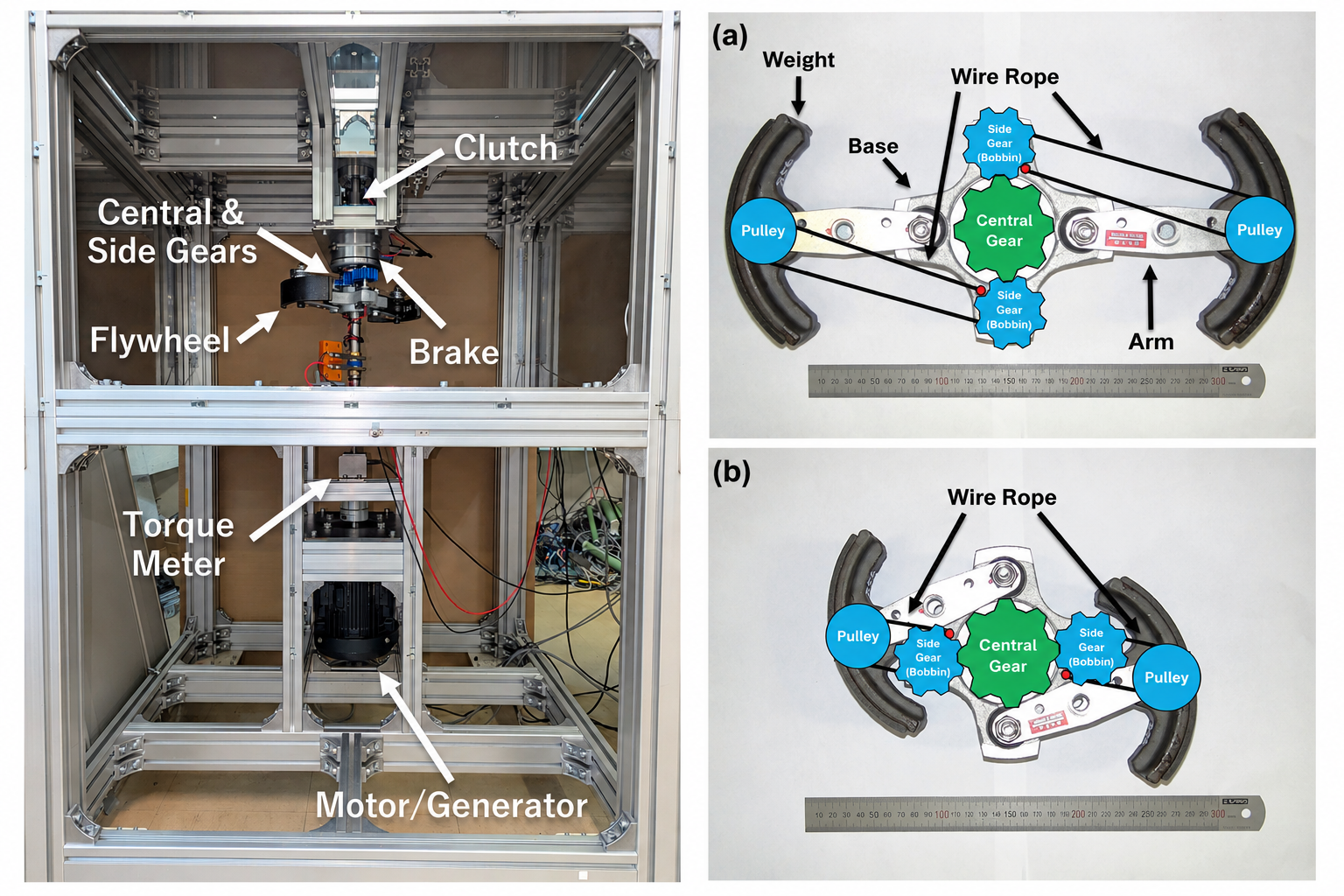
Aresearch team at Tokyo University of Science in Japan has developed and tested a prototype fixed-speed flywheel energy storage system (FESS). Flywheels store energy as rotational motion and suit short-duration applications that require rapid charging and discharging, such as grid frequency regulation. Conventional systems use a power electronic converter to vary the flywheel’s speed while exchanging electricity with the grid. The proposed system moves weights within the flywheel instead of changing its speed, potentially eliminating the converter and reducing costs.
“The main novelty is the development and experimental evaluation of a flywheel mechanism that enables charging and discharging through active changes in its moment of inertia while maintaining an approximately constant rotational speed,” corresponding author Ryoga Sugata told pv magazine. “To our knowledge, experimental studies of such mechanisms remain limited, particularly those that deliberately reduce the moment of inertia to extract stored rotational energy.”
The researcher added that his team developed the design to address losses in their earlier winch- and ball-screw-based mechanisms. “A potential future application is to add controllable active-power storage capability to synchronous condensers. Our longer-term objective is to investigate whether a synchronous condenser can combine its usual reactive-power and inertial support with fast, controllable active-power exchange enabled by the variable-inertia flywheel,” he added.
To test the concept, the researchers built a prototype using a modified centrifugal brake as the flywheel, with two 0.856 kg weights attached to pivoting arms. They added wire ropes, pulleys, bobbins, gears, an electromagnetic clutch, and a brake to control the weights’ position. A shaft connected the flywheel to a 0.75 kW, three-phase induction machine that acted as both a motor and a generator.
The team tested charging and discharging at synchronous speeds of 400, 450, and 500 rpm using a regenerative variable-frequency power supply, with voltage and frequency held constant during each test. For charging, they released the clutch, allowing centrifugal force to move the weights outward. For discharging, they activated the brake to drive the reeling mechanism and pull the weights inward.
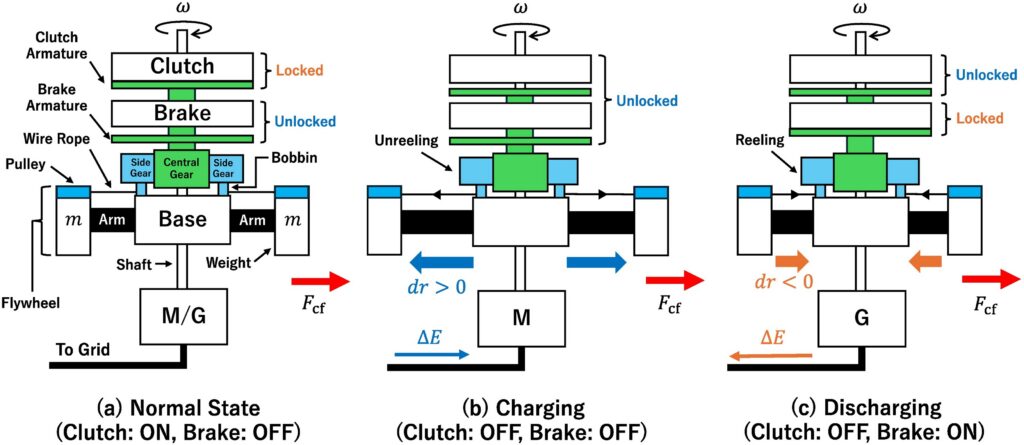
They measured voltage, current, shaft torque, rotational speed, and clutch and brake voltages, and calculated electrical and mechanical power and energy. They then compared the results with theoretical values, subtracting steady-state power consumption to isolate the energy associated with moving the weights. The analysis excluded the energy consumed by the clutch, brake, and control circuitry.
“The most surprising finding was that charging and discharging efficiencies showed different trends as rotational speed increased,” Sugata said. “Over the tested range of 400–500 rpm, charging efficiency decreased slightly, whereas discharging efficiency increased. For example, after subtracting the steady-state mechanical power input, mechanical charging efficiency decreased from approximately 51% to 49%, while mechanical discharging efficiency increased from approximately 40% to 53%.”
The team attributed the difference to the distinct loss characteristics of the two operations, the academic said. During charging, frictional losses increase with centrifugal force, limiting the benefit of higher speeds. During discharging, the main losses appear to increase more slowly than the available stored energy, reducing their relative impact. The researchers said that improving efficiency would require addressing the specific loss mechanisms of both operations.
More according to the results, at 500 rpm, the researchers calculated a theoretical storage capacity of 36.61 J. After subtracting steady-state power consumption, the prototype consumed 84.1 J during charging and discharged 16.4 J, corresponding to electrical efficiencies of 43.3% and 45.1%, respectively.
“We demonstrated electrical power delivery to the grid without a power electronic interface for frequency conversion, although steady-state losses still prevented net electrical energy discharge over the complete discharge operation,” Sugata added. “In follow-up research, we plan to improve the mechanical design to reduce friction and losses associated with clutch and brake operation. We also plan to investigate replacing the induction machine with a synchronous machine and evaluate the effects on electrical losses and charging and discharging performance.”
The article “Charging and discharging performance of a fixed-speed flywheel energy storage system with a reeling-type inertia control mechanism” has appeared in the Journal of Energy Storage.
From pv magazine Global
This content is protected by copyright and may not be reused. If you want to cooperate with us and would like to reuse some of our content, please contact: [email protected].

Please login to comment