Predicting power output from artistic BIPV pixel by pixel

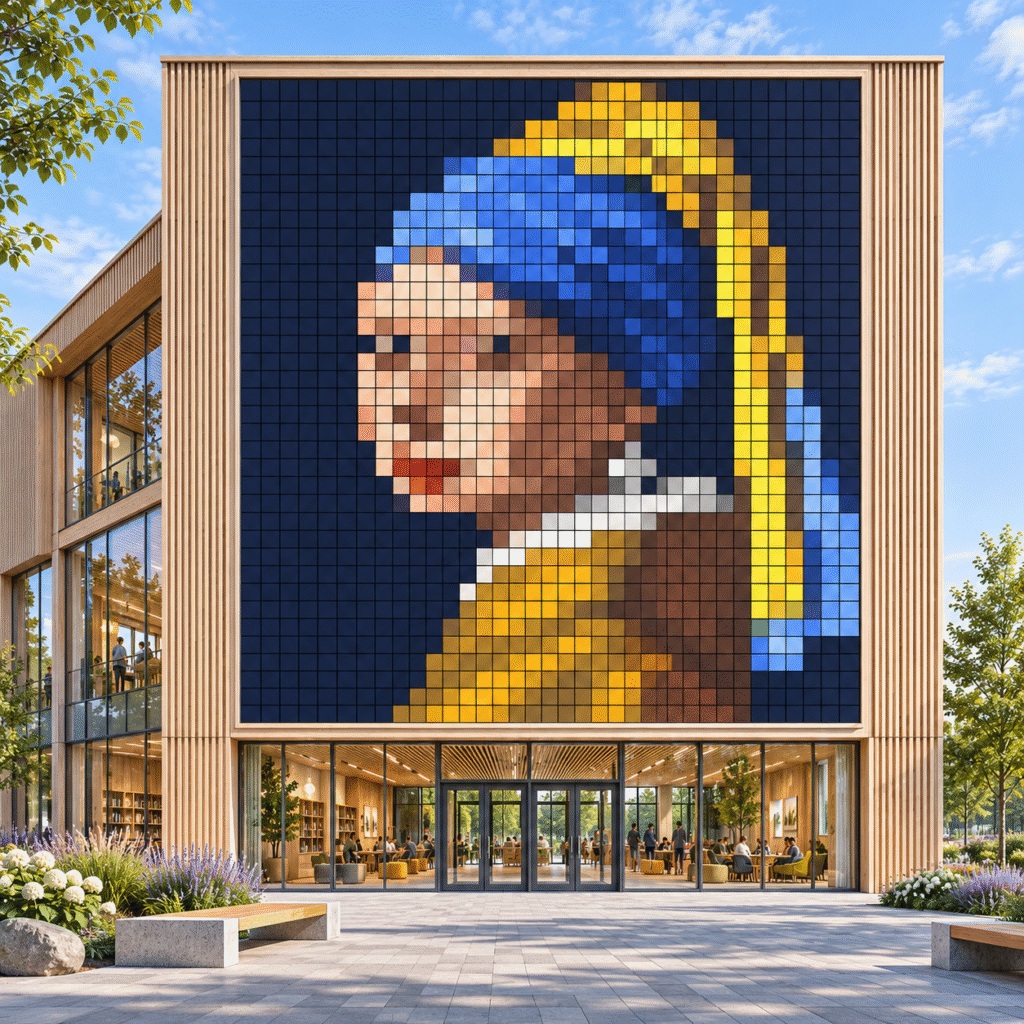
ASouth Korean research team has developed a novel model to predict power output and hot-spot risk in colored building-integrated PV (c-BIPV) systems featuring artistic images.
The researchers modeled PV arrays displaying 50 masterpieces, including Johannes Vermeer’s Girl with a Pearl Earring and Vincent van Gogh’s Café Terrace at Night.
“Unlike a uniformly colored module, an image-based array contains many differently colored cells. Because each color requires a different optical reflection profile, the photocurrent generated by each cell can vary across the array,” corresponding author Hyung-Jun Song told pv magazine.
“This spatial mismatch can reduce power output and, under certain bypass-diode configurations, expose cells to reverse bias and hot-spot risk.”
The novelty of the research, Song added, lies in directly linking the visual characteristics of a candidate image to the electrical performance and reliability of the entire PV array.
“For every pixel, we estimated the minimum-loss selective-reflection spectrum needed to reproduce its color and calculated the resulting photocurrent. We then used equivalent-circuit simulations to evaluate the series-connected array under different bypass-diode configurations,” he explained.
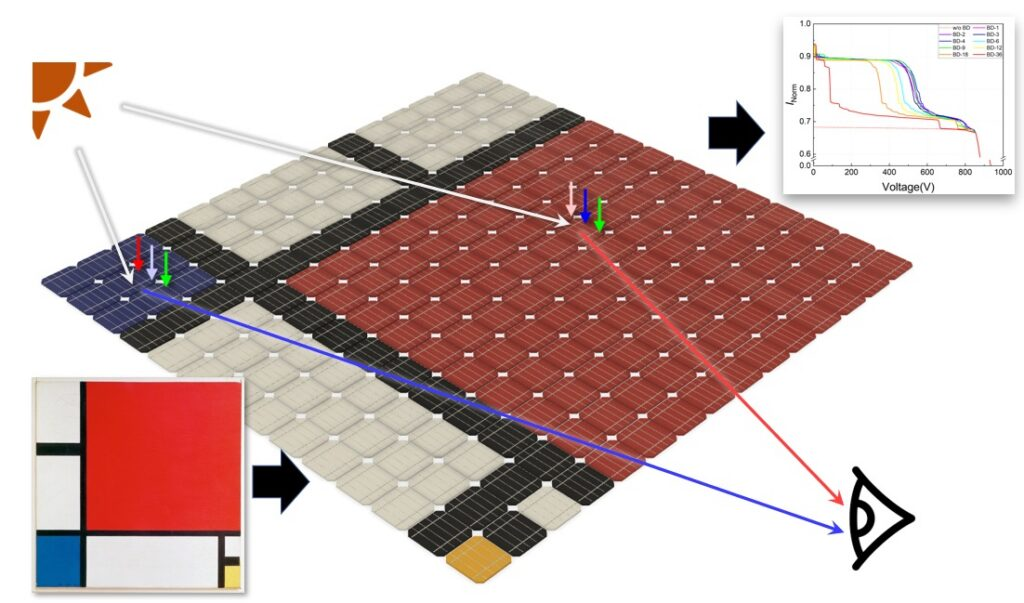
In its work, the group has converted each of the 50 artworks into a 36 × 36-pixel mosaic, with each of the 1,296 pixels representing an individual series-connected PV cell.
They assigned each pixel the average color of its corresponding image region. For each color, they calculated an ideal dual-band selective-reflection spectrum, selecting the reflection-band parameters that most closely reproduced the target color.
They then calculated the photocurrent generated from the sunlight transmitted through the colored layer, accounting for the underlying cell’s wavelength-dependent internal quantum efficiency.
Using a single-diode equivalent circuit calibrated to commercial TOPCon cells, they modeled each cell’s current-voltage characteristics at 300 K. They simulated the fully series-connected array in LTspice.
The simulations compared configurations without bypass diodes and with one diode protecting between one and 36 cells, assessing maximum power output and the number of cells operating under reverse bias at the maximum power point as an indicator of potential hot-spot risk.
“One of the most surprising findings was that the overall brightness or colorfulness of an image does not necessarily determine its photovoltaic performance. Instead, the spatial distribution of brightness plays a much more important role,” Song said about the results.
For example, the simulated array displaying Café Terrace at Night achieved 91.7% of the power output of an equivalent black reference array without bypass diodes, compared with 74.3% for Girl with a Pearl Earring.
“We found that even a small number of extremely bright pixels can limit the power output of an entire series-connected PV array,” the researcher added.
“We also identified an interesting trade-off associated with bypass diodes: installing more diodes can improve power output, but it may simultaneously increase reverse-bias conditions and the associated hot-spot risk.”

For Girl with a Pearl Earring, installing one bypass diode per cell increased normalised power from 74.3% to 84.4% of the black reference array’s output, a 13.6% relative improvement.
However, 24 of the 1,296 cells entered reverse bias at the maximum power point. Selectively darkening those 24 pixels instead raised normalised power to 84.8% without bypass diodes, while avoiding reverse-biased cells under the simulated conditions.
“Based on these findings, we developed a screening framework that classifies artistic images according to their expected power performance and hot-spot risk, using only two image-derived parameters: the brightest pixel and the overall brightness variation,” the academic added.
“The framework was further examined using additional images, demonstrating its potential to assess the electrical suitability of candidate artwork without requiring a full circuit-level simulation for every image.”
Concluding, Song said that his team is planning a few follow-up studies. These include incorporating measured reflectance spectra into a more realistic optical model, expanding the image database, and developing an AI-assisted tool to assess uploaded images and suggest modifications that improve power output and reduce hot-spot risks while preserving their appearance.
The article “Prediction Model for Power Output and Hot-spot Risk in Colored Photovoltaic Arrays with Artistic Image” has appeared in Energy. Researchers from South Korea’s Seoul National University of Science and Technology and Gachon University have participated in the study.
This content is protected by copyright and may not be reused. If you want to cooperate with us and would like to reuse some of our content, please contact: [email protected].

Please login to comment