Helping homeowners understand practicalities of battery backup
Australia’s growing fleet of small-scale batteries is changing the dynamics of electricity generation and demand but some confusion about just what individual energy storage systems provide for consumers remains.
One homeowner messaged us in August to ask whether the 42 kWh battery we had quoted came with blackout backup. When we said it did not, the next message was: “I thought having a larger battery installed would cover the entire house during a black out?”
It was a fair assumption. Battery offers are sold almost entirely on kWh, and backup is usually a separate line, or a footnote. We wanted to know how often our own enquiries started from the same place.
We went back through 192 Facebook Messenger conversations with South East Queensland homeowners from mid-June to early November 2026. We re-read every conversation that mentioned backup, blackouts, outages, whole-home supply or changeover switching. After removing supplier spam, off-grid enquiries and keyword false matches, 30 remained: 29 before a sale and one from an existing customer after installation. This is one installer’s enquiries, so the numbers show direction rather than market share. A conversation can also fall into more than one group.
The most common question was simply whether backup was in the price. Thirteen of the 30 asked it in some form. One said the system “should include blackout backup without extra fee.”
In Sunny Energy quotes, and in the one competitor quote a homeowner shared with us in detail, backup was a separate optional item, priced after an electrician had looked at the switchboard. So two quotes for “28 kWh installed” could describe two different jobs, and the homeowner had no easy way to tell.
Three people gave us a budget ceiling that included backup, for example a fixed figure “including blackout points X2”. That is a sensible way to buy, but it only works if every installer prices backup the same way.
Two groups, one word
The rest of the conversations fell into two groups that used the same words.
Nine people wanted a short list. Freezers, the internet, TV, or, lights, the fridge and the internet. “A minimum of one light and one power circuit.” For them, backing up two or three chosen circuits was the right answer.
Eight wanted the whole house, or assumed that was what backup meant. Six asked for it directly. One, quoted above, linked it to battery size. The eighth was an existing customer who contacted us after a power cut, surprised that only one room was getting battery power.
Capacity is not the limit people think it is
Battery capacity, in kWh, decides how long backup lasts. The inverter’s backup output, in kW, and the circuits wired to it decide what can run at the same time. Start-up current from air conditioners, pumps and ovens is often what trips the system first.
A 42kWh battery behind a backup output of a few kW can keep a fridge, lights and the NBN going for a long time. It will not run ducted air conditioning, an oven and a pool pump together. We had one request to back up air conditioning, a pool pump, a fridge and a stove at the same house. Another homeowner wanted every power point except the oven, air conditioning and EV charger. Neither request is unreasonable, but both need an answer in kW, not kWh.
Three people asked whether their solar would keep running in an outage. One said that was the main reason they wanted backup. The honest answer depends on the design. In many AC-coupled retrofits the existing solar inverter stays off during an outage unless the system is built to let it run. Panels connected to a hybrid inverter can usually keep charging the battery while the house is off the grid. For someone worried about a three-day outage after a storm, this matters more than another 10 kWh of storage.
What automatic switching looks like
Two homeowners asked whether changeover was automatic or needed a manual switch. Both answers exist, so it is a fair question.
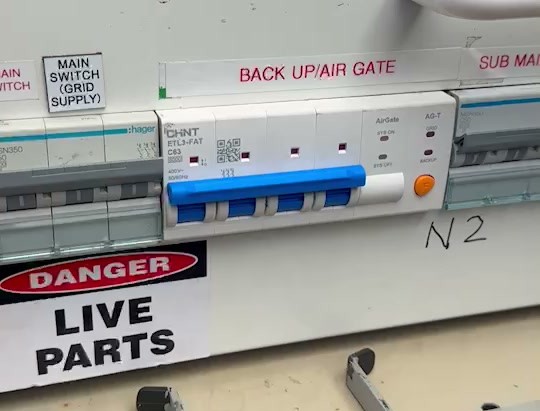
Our installer recorded a short demonstration of a whole-home backup gateway at a switchboard. He turns the grid supply off, and within a few seconds the house is running on the battery. When he turns the grid back on, the gateway waits to confirm the supply is stable before switching back. He counts 13 seconds on camera. Counting from a slightly different point in the footage, it is closer to 18. The manufacturer quotes about 20.
Two practical points come out of that. Automatic changeover is not the same as an uninterruptible power supply, so a desktop computer or some modems may still restart. And the wait on the way back is deliberate. A homeowner who has been told the switchover is “seamless” may think something is wrong when the lights stay on battery for another 20 seconds.
Five things a backup quote should say
Whole-home gateways from several battery manufacturers now make whole-house backup a practical, separately priced option. That makes it more important, not less, for a quote to say which kind of backup is being sold. From these conversations, I think a quote that mentions blackout protection should state five things in writing before anyone signs:
- Whether backup is included, and if not, its price or a capped range.
- Whether it covers selected circuits or the whole home, with any selected circuits named in plain language, such as “kitchen power” or “upstairs lights”.
- The continuous backup output in kW, and which appliances should not run together during an outage.
- Whether changeover is automatic or manual, and roughly how long it takes in each direction.
- Whether the solar keeps generating and recharging the battery while the grid is down.
None of this needs new technology. It needs the backup scope to be decided, or at least capped, before the contract is signed, rather than discovered at handover. The homeowners in our sample were already asking these questions.
Author: Richard Liu, owner, SUNNY Energy
The views and opinions expressed in this article are the author’s own, and do not necessarily reflect those held by pv magazine.
This content is protected by copyright and may not be reused. If you want to cooperate with us and would like to reuse some of our content, please contact: [email protected].
Please login to comment