AI-assisted method maps PV module losses from a single luminescence image

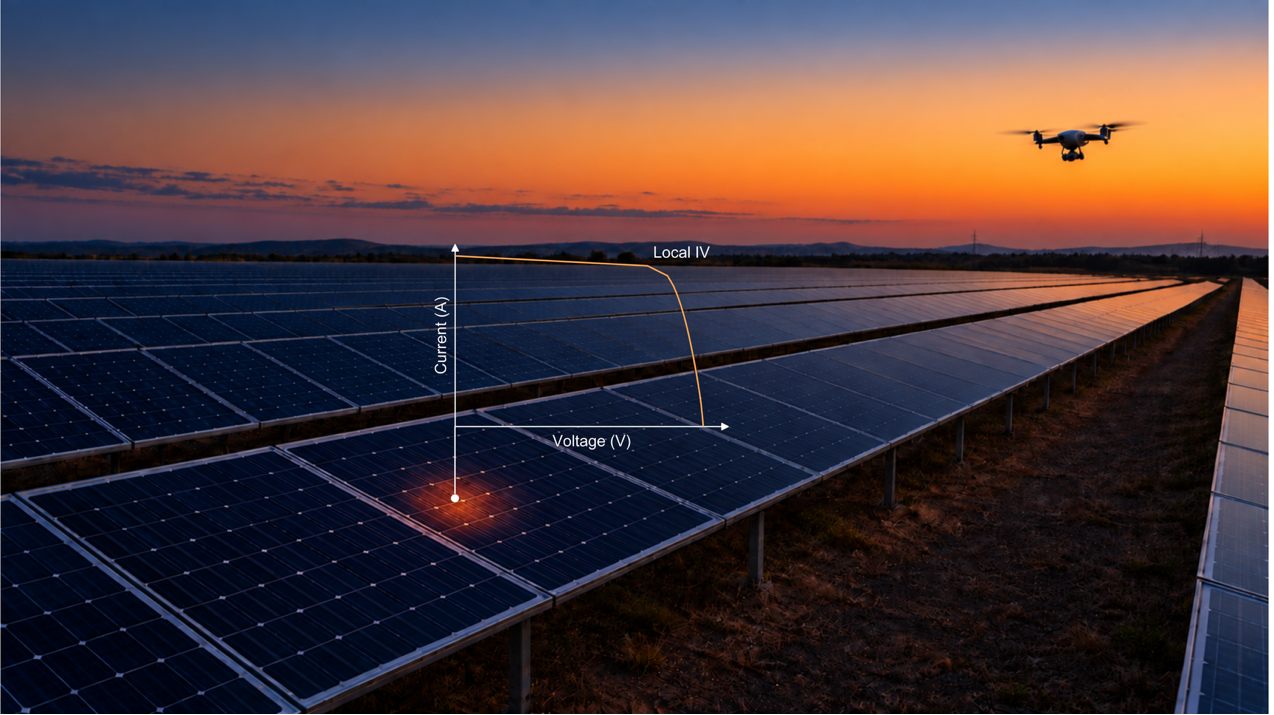
An international research team, including scientists from the University of New South Wales, has developed a diagnostic framework that can quantitatively reconstruct PV module performance from a single luminescence (EL) image.
“The key novelty of the framework is that from just one luminescence image, we can quantify local power loss down to the pixel level, greatly increasing the throughput of photovoltaic diagnostics,” corresponding author Dongchen Lan told pv magazine. “Conventional quantitative luminescence diagnostics usually require multiple images taken under different conditions, whereas our approach needs only one.”
The one-shot quantitative luminescence diagnostic system combines AI-assisted identification of dominant degradation pathways with a physics-based iterative reconstruction model grounded in carrier transport and recombination.
Lan said the researchers validated the method on 300 field-retrieved solar modules and further demonstrated it at a utility-scale solar farm using drone-based imaging.
“With that, we are moving the technology beyond a powerful tool in laboratories and industrial production lines toward high-throughput inspection and maintenance of large-scale solar farms,” he said.
The framework starts by acquiring a single EL image of a PV module at a fixed injection current of 0.22 times its short-circuit current density. A lightweight machine-learning classifier first determines whether the observed degradation is dominated by recombination losses – such as light-induced degradation (LID) or potential-induced degradation (PID) – or by resistive losses associated with defects such as cell cracks and broken grid lines.
This classification provides the physical constraint needed to interpret parameters from a single image. A physics-based inversion model then relates spatial variations in luminescence intensity to the relevant electrical parameters, reconstructing recombination-current or series-resistance maps and pixel-resolved current-voltage characteristics.
The local characteristics are then combined according to the module’s electrical configuration to calculate its current-voltage (I-V) curve, maximum power, and spatial power-loss distribution.
The researchers validated the system on 300 field-retrieved crystalline silicon modules rated at 575 W. The modules came from different manufacturing batches and operating environments and exhibited different degradation mechanisms and failure patterns.
Each module was imaged once at a constant injection current of 0.22 times its short-circuit current density, and its maximum power was reconstructed from the resulting EL image. The researchers then compared the predictions with conventional I-V measurements performed under controlled indoor conditions.
“In the field-retrieved module dataset, the reconstructed power agreed closely with conventional I-V measurements, with an overall error of only around 0.5% and most module-level errors within 1.5%,” Lan said. “The one-shot approach can actually be more accurate than multi-image methods, while dramatically reducing measurement time and allowing a much larger area to be inspected in a single drone pass.”
The researchers also tested the method at a 186 kW solar farm comprising 342 modules, using nighttime drone-based EL imaging to map power losses at the cell, module, and string levels.
In a representative group of 24 modules, the method measured an average power loss of 7.53%, with losses in some severely degraded cell regions reaching approximately 25%. The researchers also used the approach to compare three 28-module strings affected by mild cracking; severe cracks and grid breaks; and light-induced degradation, respectively.
“We are currently working to make our field diagnostic approach faster and more cost-effective for routine photovoltaic operation and maintenance, while translating the degradation information into practical decision support,” Lan concluded. “This includes helping prioritize repair and replacement, improving performance forecasting, and providing more objective evidence for assessing operational risk and long-term asset value. We are also exploring its application to emerging solar technologies such as perovskite and tandem photovoltaics.”
The article “One-shot luminescence diagnostics for field-scale photovoltaics” appeared in Matter & Light. Researchers from China’s Zhejiang University, Quantified Energy (Nanjing), Zhejiang Provincial Key Laboratory of Optoelectronic Functional Materials and Devices, and teh University of New South Wales contributed to the study.
This content is protected by copyright and may not be reused. If you want to cooperate with us and would like to reuse some of our content, please contact: [email protected].

Please login to comment