




The Australian Energy Market Commission’s (AEMC) latest independent Residential Electricity Price Trends report report, aligned with AEMO’s Integrated System Plan projections, projects residential electricity per unit prices (not bills), will fall by around 5% over the next five years, supported by new renewable generation growth.
However, those prices risk rising by 13% from 2030–2035, unless new renewable generation, battery and transmission projects are delivered faster than currently projected.
AEMC Chair Anna Collyer said increasing momentum in renewable deployment and batteries now and through to 2030’s will be crucial to keeping prices affordable.
“Our price outlook highlights a critical five-year window: residential electricity prices are projected to fall through 2030 as renewable generation and batteries ramp up, but then rise through 2035 if the pace of new investment doesn’t keep ahead of growing electricity demand and planned coal retirement.
“Our analysis clearly shows renewable energy and batteries drives prices down, we see this in the first five years. The risk of prices rising after 2030 only emerges if we slow down renewable deployment just as coal plants retire. This is a timing challenge, not a technology cost issue. With the right pace of investment, we can manage the energy transition while keeping prices stable,” she said.
The scenario analysis found:
- Delays to wind and transmission projects could increase annual household electricity prices as much as 20%.
- Poor coordination of consumer energy resources could add up to 13% to electricity prices.
- Prolonging the life of existing coal plants to meet future demand growth could pose significant price risks, with increased outages potentially adding up to 5% to prices.
- Conversely, faster wind and transmission delivery could reduce prices by up to 10%.
Electrification offers significant household savings
The report also finds that many households can significantly reduce their ‘energy wallet’ – their total spending on electricity, gas and petrol – by electrifying their energy use, with savings typically exceeding upfront costs within 10 years.
The analysis shows households that electrify could see:
- Electric vehicles: an approximate 40% reduction in annual vehicle running costs (around $1,400 per year in fuel and maintenance savings).
- Gas appliance electrification: an approximate 60% reduction in heating and cooking costs (around $1,400 per year for a household currently only using gas for these purposes).
- Solar panels: approximately $1,000-$1,200 (USD 660-1,321) per year in electricity savings for typical households.
- Home batteries: additional $600-$900 per year in savings when combined with solar.
“A household that fully electrifies could reduce total energy costs by up to 90%, with typical payback periods of 4 years,” Ms Collyer said.
Smart use of consumer energy resources critical
Beyond grid-scale infrastructure, the report highlights the growing importance of storage, such as home batteries and other consumer energy resources, in managing peak demand and reducing system costs for all consumers.
“Well-coordinated consumer energy resources, like charging electric vehicle’s during the middle of the day when there is plentiful solar, and using batteries to reduce evening demand when prices are higher, can lower costs and reduce network investment. However, poor coordination could add to household electricity costs,” Ms Collyer said.
“This is why the AEMC has made rule changes to make it easier for customers to benefit from their price-responsive resources, and why our Pricing Review is examining how retail and network pricing can better reward customers for taking action that supports efficient use of the grid.”
Three actions to ensure affordable, equitable transition
The report identifies three priority areas for policymakers:
- Reduce barriers to new renewable and transmission buildout:
- Implement credible mechanisms to ensure sufficient renewable generation and firming capacity.
- Speed up planning and approvals processes.
- Continue building social license for new transmission projects.
- Encourage coordinated uptake of consumer energy resources:
- Continue to support home battery uptake while ensuring systems help smooth, not increase, peak demand.
- Implement consistent national standards for consumer energy resources.
- Ensure visibility of these resources to the system operator.
- Enable all households to electrify:
- Address the barriers that households face, including upfront costs, rental and apartment constraints, and EV charging access.
- Provide efficient pricing for both electricity and gas services.
- Give consumers clear information to support long-term energy decisions.
“The energy transition requires action on multiple fronts. governments, industry, the AEMC and other market bodies all have roles to play. The AEMC’s rule changes and ongoing policy reviews are focused on the coordination and equity challenges,” Ms Collyer said.
“But the fundamental message remains consistent: with the right pace of renewable investment and enabling households to electrify, we can deliver an affordable energy transition,” she said.
Regional trends
Electricity price trends vary by jurisdiction, with New South Wales (NSW) and the Australian Capital Territory (ACT) prices projected to be stable or fall, while Victoria, Queensland, South Australia (SA) and Tasmania are projected to see increases, primarily in the latter half of the outlook period as electricity demand grows and the supply-demand balance tightens.
Total energy cost savings from electrification are projected across all regions: 16-21% in NSW, the ACT, Victoria and SA, and more modest savings of 6-7% in Queensland and Tasmania, reflecting lower current gas usage.
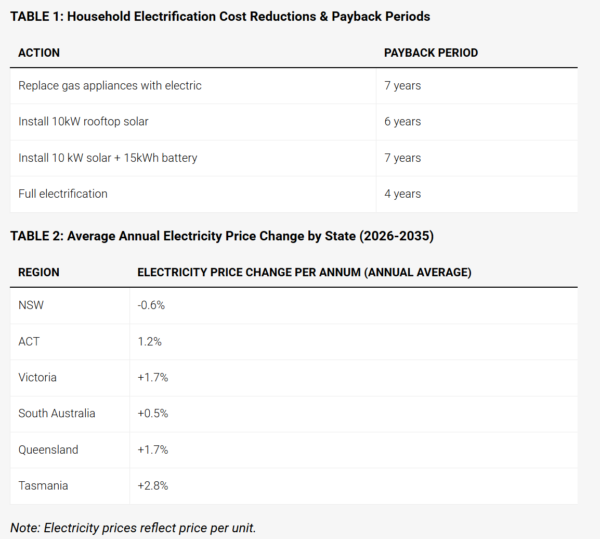
Note: Electricity prices reflect price per unit.
A Note on terminology: Prices, bills and energy costs
This report uses three related but distinct terms:
- Electricity prices refer to the per-unit cost of electricity (measured in cents per kWh). This is the rate that retailers charge for each unit of electricity consumed.
- Electricity bills refer to the total amount a household pays, which is a product of both the price per unit and the quantity of electricity consumed.
- Total energy costs refer to a household’s total expenditure on energy across electricity, petrol, and gas.


By submitting this form you agree to pv magazine using your data for the purposes of publishing your comment.
Your personal data will only be disclosed or otherwise transmitted to third parties for the purposes of spam filtering or if this is necessary for technical maintenance of the website. Any other transfer to third parties will not take place unless this is justified on the basis of applicable data protection regulations or if pv magazine is legally obliged to do so.
You may revoke this consent at any time with effect for the future, in which case your personal data will be deleted immediately. Otherwise, your data will be deleted if pv magazine has processed your request or the purpose of data storage is fulfilled.
Further information on data privacy can be found in our Data Protection Policy.