




New research from iSelect analysed solar panel prices, government rebates, local solar exposure data from the Bureau of Meteorology, average retail electricity and feed-in tariff rates – giving a clear picture of the greatest returns across the country.
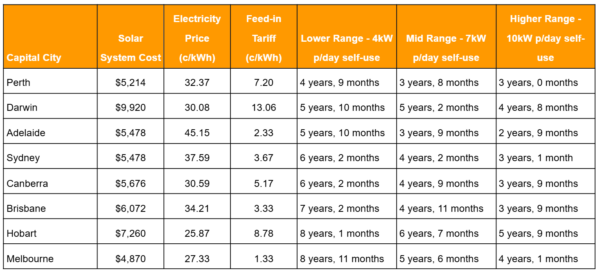
Indicative payback period for a 6.6 kW Solar (PV) System without battery
The time it takes for solar panels to pay for themselves varies depending on system size, cost of installation, power usage, and the energy plan. Across Australia’s capital cities, Perth delivers the fastest return on investment for solar panels. For households using 4 kW per day, systems pay for themselves in around 4 years and 9 months.
The payback period shortens with higher consumption, as homes using 7 kW per day can expect repayment in 3 years and 8 months, while those consuming 10 kW per day can see a return in just 3 years. This is due to a relatively low solar system cost, high electricity prices and feed-in tariff rates.
However, when it comes to those using a large amount of electricity per day (10 kW), Adelaide takes the lead. For 10kW per day, solar can pay for itself in as little as 2 years and 9 months, with Perth close behind at 3 years.
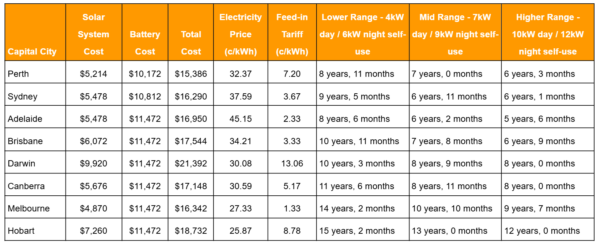
Indicative payback period for 6.6 kW Solar (PV) System with 12kW battery
Batteries can have a significant impact on the payback period; as battery capacity increases, the installed cost per kWh generally decreases. For households with low energy use, Adelaide offers the quickest payback, with solar systems taking around 8 years and 6 months to cover their costs. Perth follows with 8 years and 11 months.
Adelaide leads across all usage levels, with payback dropping to 6 years and 2 months for medium users, and just 5 years and 6 months for high-energy households. Sydney and Adelaide lead for payback with batteries, due to high electricity prices, which they avoid paying by storing solar power for evenings.
How much can Aussies save with solar?
-
Solar systems without a battery can offer substantial long-term savings. Darwin comes out on top with households saving up to $2,143 (USD a year at the higher usage range. Adelaide follows with potential savings of $2,000 per year. Melbourne sees the lowest returns, with even high-usage homes saving just $1,186 annually.
-
Solar systems with a battery, while more costly, have greater long-term rewards, offering more than double the savings of a solar-only setup. Adelaide tops the list, with households saving up to $3,019 per year on average. Even at the lowest usage range, Adelaide homes could save around $2,001 annually. Darwin also performs strongly, with savings between $2,057 and $2,611 annually.
Julia Paszka, General Manager – Utilities at iSelect, comments:
“Solar panels can be a great way to cut your power bills, but to really maximise the benefits, it’s important to use as much of your solar energy as possible during the day. Any excess power you don’t use will usually be sent back to the grid, but the rate you’ve paid for this feed-in is typically much lower than what you pay for electricity from the grid”
“Other ways to make the most of your solar include timing energy-heavy activities, like running your washing machine, dishwasher, or charging your EV during daylight hours. Even small adjustments, like using smart plugs or timers, can help you maximise self-consumption and speed up your savings.”


By submitting this form you agree to pv magazine using your data for the purposes of publishing your comment.
Your personal data will only be disclosed or otherwise transmitted to third parties for the purposes of spam filtering or if this is necessary for technical maintenance of the website. Any other transfer to third parties will not take place unless this is justified on the basis of applicable data protection regulations or if pv magazine is legally obliged to do so.
You may revoke this consent at any time with effect for the future, in which case your personal data will be deleted immediately. Otherwise, your data will be deleted if pv magazine has processed your request or the purpose of data storage is fulfilled.
Further information on data privacy can be found in our Data Protection Policy.