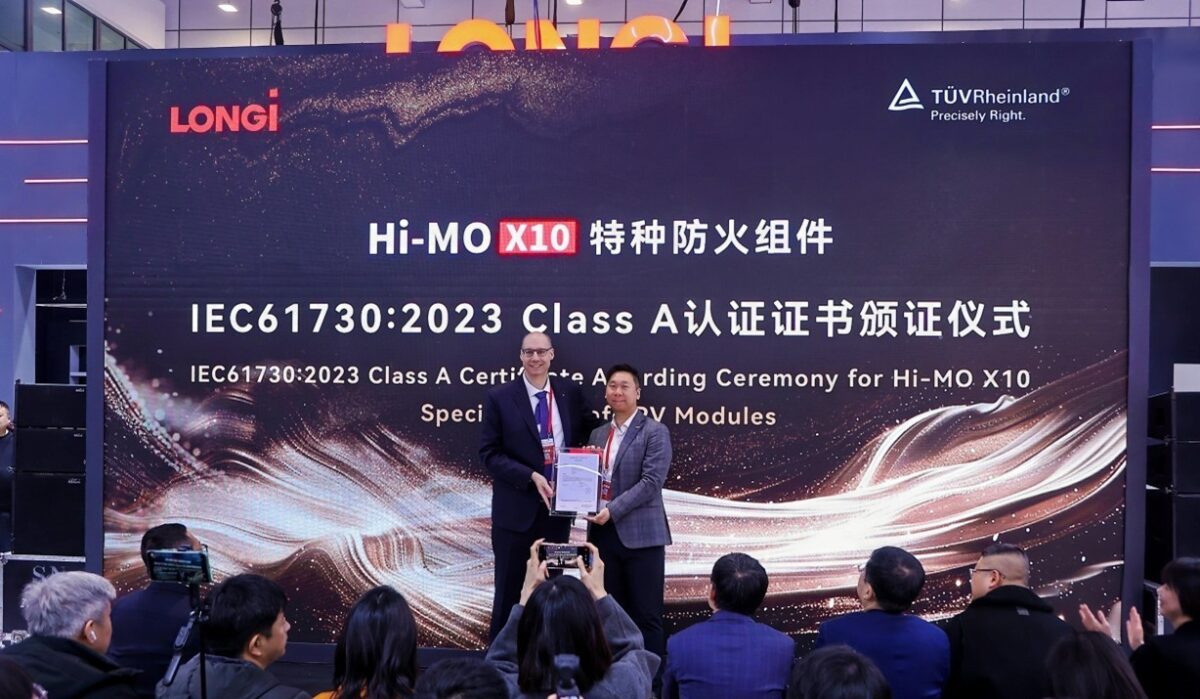





Chinese solar module manufacturer Longi launched a fire-resistant version of its Hi-MO X10 module at the 19th China International Solar Utilisation Conference and Exhibition (SUCE).
According to the company, the module is based on LONGi’s Hi-MO X10 platform, which uses its second-generation hybrid passivated back contact (HPBC 2.0) cell technology.
The Hi-MO X10 portfolio features a peak module efficiency of 24.8%, a power temperature coefficient of -0.26%/C, and a 30-year product and power warranty. The series is primarily marketed for distributed PV applications.
The new fire-resistant version is designed to address a concern that has become increasingly prominent in China’s rooftop PV segment: module-driven fire risk linked to hot spots and DC arcing.
According to Longi the product is intended not only to reduce the probability of ignition but also to slow or prevent flame spread in the event of an external fire.
The company says the module retains the Hi-MO X10 family’s “three-defense” positioning — anti-ignition, anti-shading, and anti-dust — while adding a dedicated fire-resistance package. It previously announced that the Hi-MO X10 series received Class A certification for shadow resistance from TÜV Rheinland, highlighting its focus on controlling localised overheating under partial shading.
The fire-resistant version uses 108 half-cells, supports 1,500 V DC system architecture, and is offered in a power range of 580 W to 630 W. Longi says the module achieves a maximum conversion efficiency of 24.8%, with average mass-production efficiency above 24.5%. The operating temperature range is listed as -40 C to +85 C.
Longi describes the safety architecture as combining cell-, string-, and module-level protection. Features include a honeycomb-style current-diversion structure intended to limit hot-spot formation, a reinforced junction box sealing and welding design aimed at reducing arcing risk, and the use of flame-retardant materials in encapsulation and junction box components. The company also says the module incorporates a high-temperature-resistant front glass designed to withstand prolonged flame exposure longer than conventional PV glass.
The product has obtained Class A fire certification from TÜV Rheinland at the full-module, mass-production level. The company says it has also undergone performance and safety verification by China’s National Center of Supervision and Inspection on Solar Photovoltaic Products Quality (CPVT), in addition to international standard testing under IEC 61215 and IEC 61730.
The launch reflects a broader shift in China’s distributed PV market, where product differentiation is increasingly moving beyond module efficiency toward application-specific design. Manufacturers are focusing more on features such as anti-dust performance, lightweight structures, shading tolerance, and fire-resistant configurations.
This content is protected by copyright and may not be reused. If you want to cooperate with us and would like to reuse some of our content, please contact: editors@pv-magazine.com.

By submitting this form you agree to pv magazine using your data for the purposes of publishing your comment.
Your personal data will only be disclosed or otherwise transmitted to third parties for the purposes of spam filtering or if this is necessary for technical maintenance of the website. Any other transfer to third parties will not take place unless this is justified on the basis of applicable data protection regulations or if pv magazine is legally obliged to do so.
You may revoke this consent at any time with effect for the future, in which case your personal data will be deleted immediately. Otherwise, your data will be deleted if pv magazine has processed your request or the purpose of data storage is fulfilled.
Further information on data privacy can be found in our Data Protection Policy.