




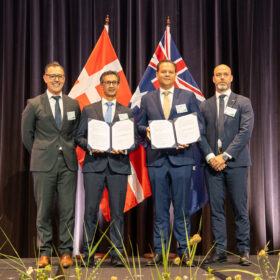
This collaboration forms part of Technology Commercialisation Challenge (TCC), an initiative facilitating India-Australia technology collaboration to diversify renewable energy supply chains and accelerate the energy transition. The TCC forms part of the India-Australia Renewable Energy Partnership supported by the government of India and the Australian government.
The TCC is funded by the Australian government’s Department of Climate Change, Energy, the Environment and Water, and delivered by CSIRO, Australia’s national science agency.
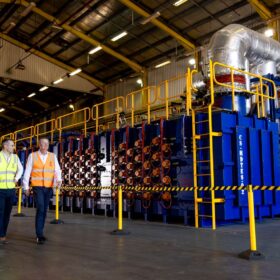
As a part of the project, RAYZON was glad to host distinguished team of Professor Bram Hoex, Dr Michael Nielsen and Mark Sterbic from UNSW on 25 November for lab as well as line visit, followed by detailed discussion on the scope as well as deliverables of this project with timelines.
This partnership which started with one project has a tremendous potential of scaling further by putting together UNSW’s research capabilities, CSIRO’s facilitation under Dave Fleming, and Rayzon Solar’s robust lab infrastructure as well as manufacturing capability.
For stakeholders this translates into more durable, high performing solar modules meeting global standards, reinforcing Rayzon’s reputation.
On a broader scale, this partnership exemplifies how bi-lateral engagement can strengthen supply chains, accelerate technology adoption, and support India’s clean-energy ambitions under TCC said Amit Barve, CEO of Rayzon Solar.

By submitting this form you agree to pv magazine using your data for the purposes of publishing your comment.
Your personal data will only be disclosed or otherwise transmitted to third parties for the purposes of spam filtering or if this is necessary for technical maintenance of the website. Any other transfer to third parties will not take place unless this is justified on the basis of applicable data protection regulations or if pv magazine is legally obliged to do so.
You may revoke this consent at any time with effect for the future, in which case your personal data will be deleted immediately. Otherwise, your data will be deleted if pv magazine has processed your request or the purpose of data storage is fulfilled.
Further information on data privacy can be found in our Data Protection Policy.