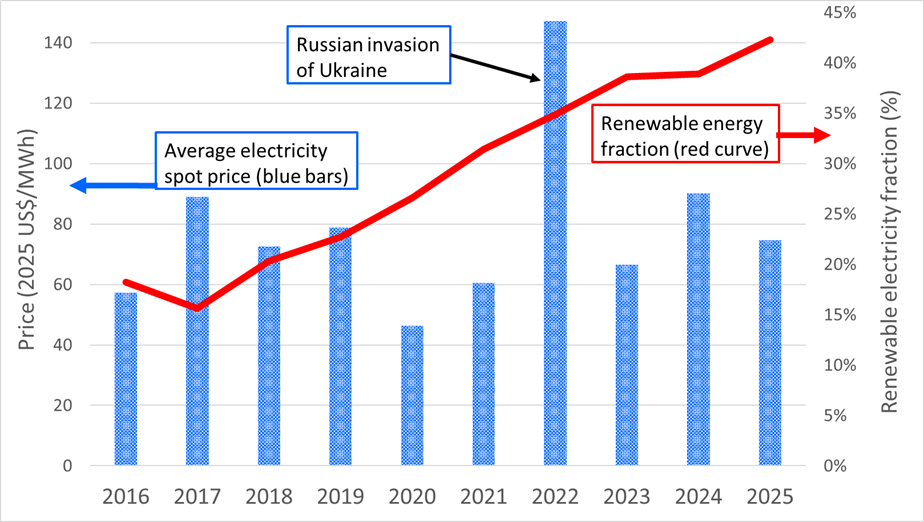





The wholesale electricity price in Australia’s National Electricity Market is unchanged since 2016, when solar and wind deployment in Australia took off. Solar and wind do not cause price increases.
This matters, because Australia is a global renewable energy pathfinder. Australia generates substantially more solar electricity per capita than any other country, and is also a large producer of wind energy.
It is tracking towards 82% renewable electricity in 2030, mostly from solar and wind. By then, it will have 18 kWh per person of rechargeable energy storage (pumped hydro and home/utility batteries), amongst the highest in the world.
Australia is an economically developed and physically isolated country that must balance electricity supply and demand without assistance from neighbors (unlike in Europe). There is no nuclear or geothermal energy, and hydro only provides 6% of total electricity.
Solar and wind generation climbed from 14 to 77 TWh per annum over the past decade. They are rapidly displacing coal and gas and are meeting all growth in demand.
This same trend is observed in the total world electricity production, where solar has surpassed nuclear in 2017, wind in 2022, hydro in 2023, natural gas in 2024 and will surpass coal by the end of this year. By 2023, there will be more solar PV installed on Earth than the sum of all the other electricity generation technologies combined.
The figure shows inflation-adjusted wholesale market price (blue bars) and renewable energy fraction (red curve). The grid is very stable. Months with higher solar and wind fraction have lower prices.
The spike in price caused by high gas prices following Russia’s invasion of Ukraine in 2022 is unlikely to recur because solar, wind and storage are eliminating gas from electricity generation.
Three quarters of the global population live in the sunbelt at low-mid latitudes, like Australia. The good news is that the rapid deployment of solar and wind does not increase wholesale prices.
Even better news is that wholesale prices are likely to fall substantially in the next few years. This is because of the declining cost of renewable energy equipment, and also because the price-setting role of expensive fossil gas is rapidly diminishing. Gas now only provides 5% of annual generation.
Rooftop solar
One third of Australian houses have rooftop solar, which is the highest rate in the world. This is expected to double in the coming years. At times, rooftop solar meets the entire electricity demand of some regions. The grid remains very stable.
Rooftop solar provides the cheapest and most resilient domestic energy in history. A fully installed 10 kW system in Australia costs approximately $9,000 (USD 6,000) and lasts 20 years.
For many homeowners, the required rate of return on capital invested in a rooftop solar system is the house mortgage interest rate minus the inflation rate, which is about 2%. Real-world annual electricity output is 1200-1400 kWh per kW.
This translates to 4.5 cents (USD 0.03) per kWh, which is well below the retail tariff. This is the driving force behind the widespread adoption of rooftop solar. Rooftop solar is now the default option for new houses.
An all-electric solar home has zero gas and petrol bills. Large energy storage is available in hot water tanks and EV and home batteries. Simple timers can move the operation of storage-charging, dishwashers, clothes washing and drying and house pre-heating & cooling to daytime.
Strangely, Australian rooftop solar costs less than half compared with a similar system in the United States. There is almost zero administrative friction or marketing costs to install rooftop solar. Typical new systems are 8-10 kW and are often installed within a few weeks of the initial request for quote.
Solar is available nearly everywhere forever at both small and large scale, and in cities and remote areas. If grid power fails, then the all-electric homeowner can carry on indefinitely with nearly normal house operation. There are no greenhouse emissions or smog; it is impossible to run out of silicon and glass and sunlight; and it confers high resilience against grid disruption, war, trade war and pandemic.
Authors: Prof. Ricardo Rüther (UFSC),rruther@gmail.com; Prof. Andrew Blakers /ANU, Andrew.blakers@anu.edu.au
ISES, the International Solar Energy Society is a UN-accredited membership NGO founded in 1954 working towards a world with 100% renewable energy for all, used efficiently and wisely.
The views and opinions expressed in this article are the author’s own, and do not necessarily reflect those held by pv magazine.
This content is protected by copyright and may not be reused. If you want to cooperate with us and would like to reuse some of our content, please contact: editors@pv-magazine.com.

By submitting this form you agree to pv magazine using your data for the purposes of publishing your comment.
Your personal data will only be disclosed or otherwise transmitted to third parties for the purposes of spam filtering or if this is necessary for technical maintenance of the website. Any other transfer to third parties will not take place unless this is justified on the basis of applicable data protection regulations or if pv magazine is legally obliged to do so.
You may revoke this consent at any time with effect for the future, in which case your personal data will be deleted immediately. Otherwise, your data will be deleted if pv magazine has processed your request or the purpose of data storage is fulfilled.
Further information on data privacy can be found in our Data Protection Policy.