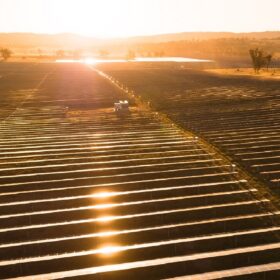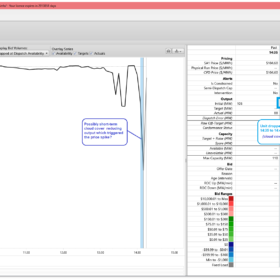
Price spike in SA – (perhaps) because of sudden drop in output at Bungala Solar Farm?
Today in South Australia, the market appears to have received a reminder that National Electricity Market Dispatch Engine (NEMDE) is technology agnostic, and that all types of technologies can experience their own challenges leading to price volatility.
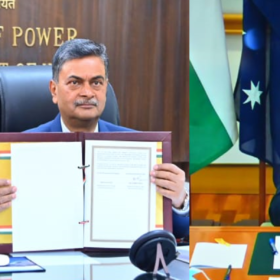
India and Australia sign letter of intent on solar, ‘clean’ hydrogen
India and Australia have signed a letter of intent to cooperate on scaling up the manufacture and deployment of ultra-low-cost solar and “clean” hydrogen.

100MW of modules detained in the US under Hoshine WRO released
Shipping containers storing roughly 100MW of LONGi solar modules have been released, reports ROTH Capital Partners in an industry note, while Trina has had the vast majority of its detained product released, if not all of it entirely.
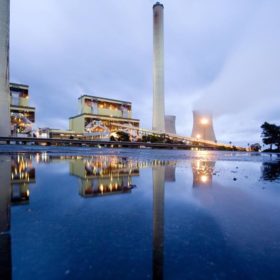
The battle for AGL heralds a new dawn for Australian electricity
Two events in the past week mark a watershed for Australia’s electricity industry.
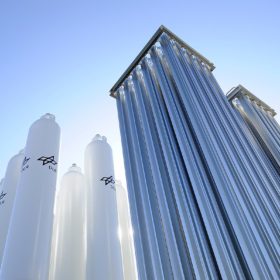
India introduces green hydrogen policy
The Green Hydrogen Policy is designed to promote green hydrogen and green ammonia projects with provisions like a 25-year waiver of inter-state transmission system (ISTS) charges and ISTS connectivity priority for renewable energy capacity set up for the purpose.
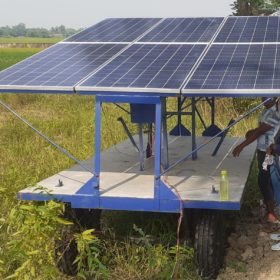
Mobile solar pump for remote areas
Researchers at the Indian Institute of Technology Bhubaneswar have developed a solar power system that can be easily moved between farms to pump water for irrigation. The kit comprises solar panels and an inverter to power a surface-mounted pump.

Work begins on world’s largest PV system on a stadium roof
The stadium of German football club SC Freiburg will host a 2.4MW rooftop solar array that will be built with heterojunction modules provided by Swiss manufacturer Meyer Burger.
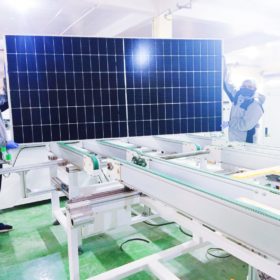
Indian manufacturer doubles module capacity to 1GW with new fab
Indian solar company Saatvik Solar’s new facility in Haryana is equipped to make mono PERC, half-cut, multi-busbar technology, to produce high-efficiency PV modules with 530-610Wp of power output.
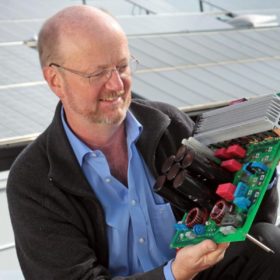
Fraunhofer ISE reaches legal settlements with seven inverter manufacturers who infringed its patent
In 2002, the Fraunhofer ISE patented the HERIC circuit for highly efficient inverters. Since then, the institute says, it has recorded out-of-court settlements in seven patent infringement lawsuits against companies from China, Taiwan and Germany.
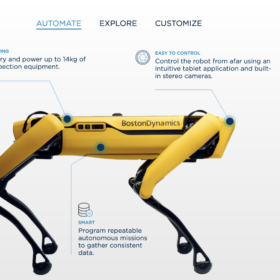
Robot dog for PV plant monitoring
Spanish renewable energy company Acciona is using a robot dog, instead of drones, to monitor a solar park in northern Chile. The device has a built-in thermal vision system that generates thermographic reports on the status of the different PV plant components, as it walks between the panel rows following a programmed route.