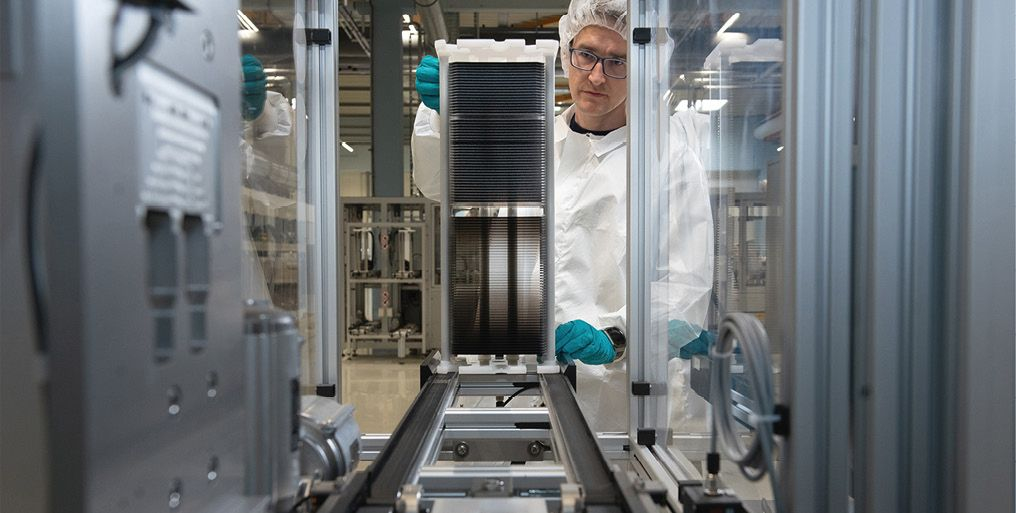





A researcher from the University of Oxford has investigated the impact of transparent conducting electrodes (TCEs) on the performance of perovskite-silicon tandem solar cells and has found that these can significantly reduce device efficiency.
TCEs are expected to play a decisive role in determining whether tandem cells can close the remaining gap from today’s 34% efficiency to the anticipated 37%–38% efficiency frontier.
“Our study provides the first framework to quantify these losses in tandem PV, showing how the performance of even the best tandem designs can drop by more than 2.5% due to TCE-related effects,” the research’s lead author, Sebastian Bonilla, told pv magazine.
“These insights are crucial for manufacturers and researchers aiming to scale tandems from laboratory cells to commercial modules.”
“The use of transparent conductive electrodes (TCEs), while often assumed to be ideal, can introduce electrical resistance and optical losses that significantly lower the real-world efficiency of tandem modules,” he went on to say. “Their practical deployment still faces underappreciated barriers.”
In the paper “The impact of transparent conducting electrodes on tandem solar cell efficiency,” published in Joule, Bonilla explained that current optical modeling is not able to quantify the lateral resistance of TCEs, especially in bifacial or front-illuminated configurations.
Moreover, the geometric interdependence between TCE sheet resistance, finger spacing, and metal shading creates trade-offs that fundamentally limit power output but are rarely reflected in practical efficiency calculations.
With this in mind, Bonilla outlined a unified optical–electrical model that accounts for these factors in two-terminal perovskite–silicon tandem solar cell designs. Different TCE stacks were considered to assess potential transmission losses, while antireflection coatings, sputtered buffer layers, and optimised finger spacing were also included.
Using PySpice, which is a Python-based simulation framework for electronic circuits, the scientist implemented a circuit model that enables flexible parametric sweeps of material properties, including saturation current densities, recombination diode parameters, and resistive losses.
“This modeling is valid for any two solar absorbers, but I apply it to perovskite-silicon tandem cells due to their maturity and commercial relevance,” said Bonilla.
The analysis showed that tandem devices with just one TCE can suffer from an efficiency loss of up to 2%. Tandem cells, however, usually adopt mid- and rear-TCEs, which further reduce performance.
These losses, according to Bonilla, are consistent with experimental findings showing that minor adjustments in indium tin oxide (ITO) deposition, antireflection coatings, or atomic layer–deposited barrier layers directly lead to measurable performance improvements in state-of-the-art tandem cells.
“These insights are crucial for manufacturers and researchers aiming to scale tandems from laboratory cells to commercial modules,” Bonilla concluded.
“The findings also highlight opportunities for material innovation and design co-optimisation to ensure that future high-efficiency tandems deliver their full potential in real-world applications.”
From pv magazine Global
This content is protected by copyright and may not be reused. If you want to cooperate with us and would like to reuse some of our content, please contact: editors@pv-magazine.com.







By submitting this form you agree to pv magazine using your data for the purposes of publishing your comment.
Your personal data will only be disclosed or otherwise transmitted to third parties for the purposes of spam filtering or if this is necessary for technical maintenance of the website. Any other transfer to third parties will not take place unless this is justified on the basis of applicable data protection regulations or if pv magazine is legally obliged to do so.
You may revoke this consent at any time with effect for the future, in which case your personal data will be deleted immediately. Otherwise, your data will be deleted if pv magazine has processed your request or the purpose of data storage is fulfilled.
Further information on data privacy can be found in our Data Protection Policy.