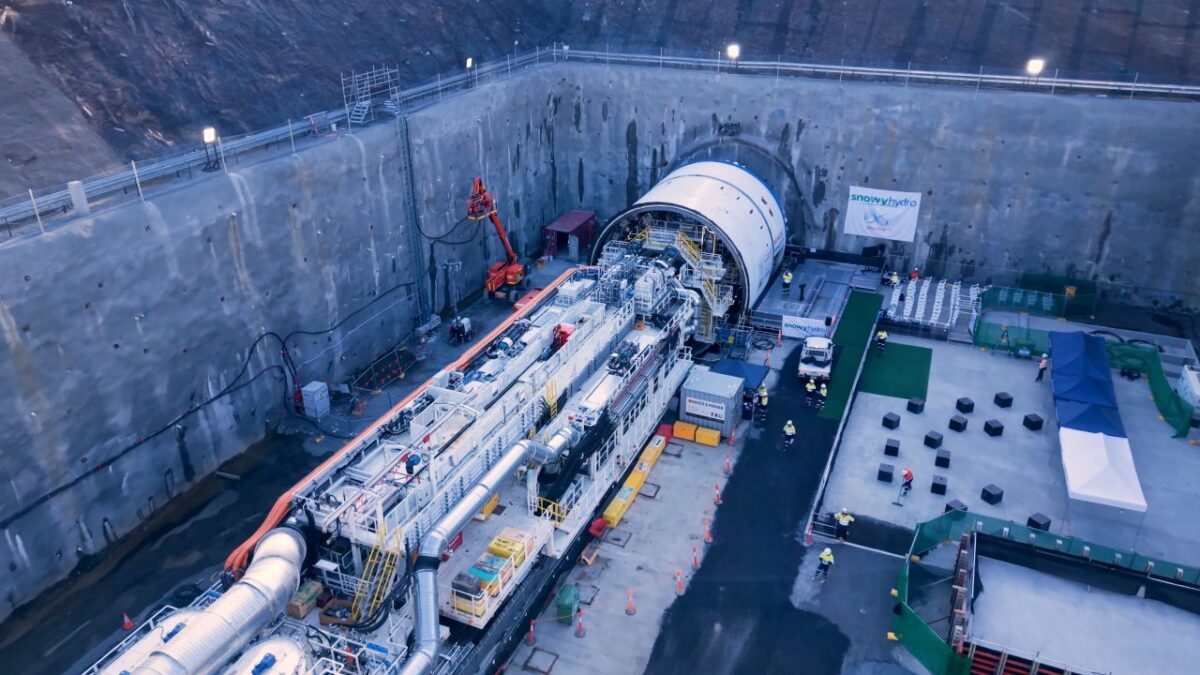





The Commonwealth government-owned Snowy Hydro says construction of its Snowy 2.0 pumped hydro project is now more than 70% complete with the multi-billion-dollar project on track to deliver power by the end of 2028.
“We are continuing to make great progress on Australia’s largest renewable energy project,” Snowy Hydro said.
“With construction now more than two thirds complete, the infrastructure is really starting to take shape.”
The expansion of the existing 4.1 GW Snowy pumped hydro scheme, set to provide an additional 2,200 MW of fast-start energy and large-scale storage capability to the National Electricity Market (NEM), was originally due to be operational by 2021 but it has been plagued by time and budget blowouts.
When first announced in 2017, Snowy 2.0 was forecast to cost about $2 billion (USD 1.39 billion) but the cost of the project is now expected to exceed $12 billion and is scheduled to be complete in December 2028.
Snowy Hydro said the launch of a fourth tunnel boring machine (TBM) will expand tunnelling capacity and add momentum across the project’s four major workfronts.
The 12-metre-diameter hard rock TBM, named Monica, was officially powered up on Friday and is set to begin full-scale excavation in the coming weeks.
Purpose-built for the Snowy Mountains’ highly variable geology, the TBM will excavate part of Snowy 2.0’s 17-kilometre-long headrace tunnel, a key conduit that will channel water from Tantangara Reservoir to the underground power station.
The launch of the new TBM comes just days after principal contractor Future Generation Joint Venture (FGJV) announced that construction of the transition tunnel crown at the Tantangara intake had been completed.
The structure forms the entry point where water from Tantangara Reservoir will enter the hydropower system before being conveyed through underground tunnels to the project’s power stations.
FGJV, a partnership between Australian engineering and construction business Clough, Italian engineering firm Webuild and construction company Lane, said the newly completed crown incorporates about 450 cubic metres of concrete, 160 square m of formwork, and 80 tonnes of steel reinforcement. The structure is 3.7 m thick and has been designed to withstand the high hydraulic pressures associated with large-scale pumped storage operations.
The largest committed renewable energy project in Australia, Snowy 2.0 will provide an additional 2,200 MW of dispatchable, on-demand generating capacity and approximately 350,000 MWh of large-scale storage to the NEM.
Snowy Hydro Chief Executive Officer Dennis Barnes has described the project as the lynchpin of Australia’s energy transition.
“Snowy 2.0 will be a cornerstone of Australia’s transition to renewable energy, providing more than half of the long-duration storage the grid needs by 2050,” he said.
“It will enable the introduction of more wind and solar by acting like a giant battery, storing and delivering enough excess energy to power around 3 million homes for a week.”
This content is protected by copyright and may not be reused. If you want to cooperate with us and would like to reuse some of our content, please contact: editors@pv-magazine.com.


By submitting this form you agree to pv magazine using your data for the purposes of publishing your comment.
Your personal data will only be disclosed or otherwise transmitted to third parties for the purposes of spam filtering or if this is necessary for technical maintenance of the website. Any other transfer to third parties will not take place unless this is justified on the basis of applicable data protection regulations or if pv magazine is legally obliged to do so.
You may revoke this consent at any time with effect for the future, in which case your personal data will be deleted immediately. Otherwise, your data will be deleted if pv magazine has processed your request or the purpose of data storage is fulfilled.
Further information on data privacy can be found in our Data Protection Policy.