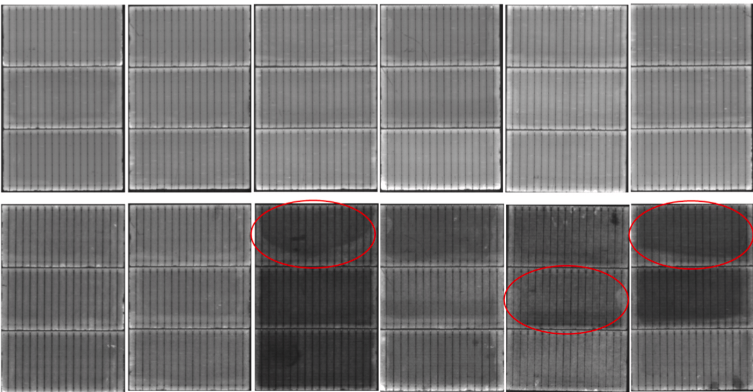





Researchers at the U.S. Department of Energy’s National Laboratory of the Rockies (NREL) have quantified performance loss from ultraviolet (UV) light in TOPCon solar cells and have found that cells with high UV-induced degradation (UVID) exhibit injection-dependent effective carrier lifetimes and large variability within a cell, indicating possible processing inconsistencies.
“Degradation under UV exposure is of particular interest, both because it results in this interesting phenomenon of recoverable versus non-recoverable losses in TOPCon, but also because UV light exposure is severely under-represented in existing qualification tests,” the research’s lead author, Dana Kern, told pv magazine. “That means that UV sensitivity could go undetected for PV products that pass other typical accelerated testing sequences. This has been widely recognised in our community, resulting in global efforts to standardise UV aging tests on PV cells and modules.”
Kern also explained that UV aging tests should take into account the mechanisms of UVID and associated metastability, in order to recover the dark-storage related power loss before characterization in accelerated testing environments.
“Only the field-relevant loss should be considered, and the dark-storage loss is rapidly recovered in sunlight, which limits how much this metastability would impact modules operating outdoors,” she emphasiaed. “Module degradation severity could be severely over-estimated by letting the modules sit in the dark after UV aging, or even if modules sit in the dark waiting for characterization after removing them from outdoor aging if the modules have been impacted by UVID outdoors.”
In the paper “UV-Induced Degradation and Associated Metastability in TOPCon Photovoltaic Modules: Understanding Kinetics and Cell Variance,” published in Progress in Photovoltaics, Kern and her colleagues investigated the metastability to gain more information on what chemical mechanisms could be underlying the TOPCon modules’ sensitivity to UVID.
“We applied a non-destructive approach at the module level,” Kern went on to say. “With in-situ electroluminescence (EL) imaging, we watched the modules degrade during dark storage for up to 500 hours, and then we turned on UV LED flood lights and saw the modules rapidly recover within seconds to minutes. Importantly, we saw a wide distribution of how severe the dark-storage degradation was for each cell within the same module. However, all the cells had a similar time dependent response, even if the maximum severity varied from cell to cell.”
By fitting the EL kinetics of each cell, the research group also found that the slow dark-storage degradation and fast recovery under light exposure were consistent with known metastability of charge trapping in aluminum oxide (Al2O3).
“Assuming that the passivation quality and carrier lifetime are both dominated by the Al2O3 field effect, we could directly relate EL intensity to the Al2O3 fixed charge density,” Kern said. “From this, we suggested that charge de-trapping in the dark can decrease the effectiveness of Al2O3 field-effect passivation, while light-induced charge trapping can help maintain negative charge density and a better field effect passivation quality, improving carrier lifetime when the modules are in the light.”
After noticing that the extent of UVID and the metastability varied across cells within the same module, the scientists further questioned whether there is non-uniformity of UV sensitivity even within a given cell. To address this, they performed intensity-dependent photoluminescence (PL) and EL imaging, which revealed that cells with more severe dark-storage loss have both higher severity of trap-assisted recombination and higher non-uniformity in their dark-storage condition.
The researchers concluded that non-recoverable UVID of 2.3% to 3.2% after a one-year equivalent UV dose represents severe degradation that would exceed typical module warranty limits. They added that, while recoverable dark-storage metastability is unlikely to be field-relevant, it offers insight into degradation mechanisms and could help differentiate samples if it scales with non-recoverable UVID.
This content is protected by copyright and may not be reused. If you want to cooperate with us and would like to reuse some of our content, please contact: editors@pv-magazine.com.



By submitting this form you agree to pv magazine using your data for the purposes of publishing your comment.
Your personal data will only be disclosed or otherwise transmitted to third parties for the purposes of spam filtering or if this is necessary for technical maintenance of the website. Any other transfer to third parties will not take place unless this is justified on the basis of applicable data protection regulations or if pv magazine is legally obliged to do so.
You may revoke this consent at any time with effect for the future, in which case your personal data will be deleted immediately. Otherwise, your data will be deleted if pv magazine has processed your request or the purpose of data storage is fulfilled.
Further information on data privacy can be found in our Data Protection Policy.