




From pv magazine Global
Researchers from Sweden’s Mälardalen University have proposed two new single-axis solar tracking strategies aimed to improving crop yield in agrivoltaic projects.
“We embedded crop light demand directly into tracker control, enabling dynamic prioritisation of food production when crops need light and energy conversion when they do not,” the research’s corresponding author, Sultan Tekie, told pv magazine.
“Unlike most of the existing agrivoltaic tracking strategies that rely on static shading thresholds or empirical rules, our new strategies leverage the crop’s light response curve to regulate panel orientation based on the onset of photosynthetic saturation, linking photovoltaic operation to plant physiology.”
The proposed two strategies, called Daily Light Integral Tracking (DLIT) and Knee-Point Tracking (KPT), are aimed at ensuring that crops receive sufficient, but not too much light.
“We use both strategies to respond to cumulative light requirements and adapt tracker operation to real-time environmental variability, offering a systematic pathway to balance energy yield and crop performance under changing climatic conditions,” Tekie went on to say.
The DLIT strategy adjusts solar tracker operation to meet crop-specific daily light integral (DLI) requirements, using active tracking (AT) until the target is met, then tilt tracking (TT) for the rest of the day.
With AT, the tracker follows the sun continuously to maximise light on the crops, prioritising plant growth until the daily DLI target is met. After the crop’s light requirement is satisfied, the tracker shifts to maximise solar energy capture with TT for electricity, rather than following the sun precisely for the crop.
The KPT strategy identifies the optimal photosynthetically active radiation (PAR) on the light-response curve (LRC) to select the solar panel tilt angle that maximises photosynthesis. LRCs, modelled using a temperature-dependent non-rectangular hyperbola, generate 35 curves for 0–35 °C, with the knee point representing the PAR where photosynthesis starts to plateau.
Optimal PAR values are interpolated hourly and compared to ground irradiance to dynamically select the tilt angle, providing an adaptive, temperature-driven tracking strategy. To reduce mechanical stress and abrupt movements in tilt adjustments, a Gaussian filter smooths hourly tilt angles, balancing crop growth and energy efficiency.
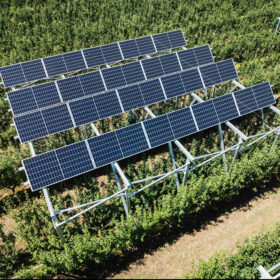
The scientists evaluated the performance of the two strategies with three conventional tracking methods, namely time-based tracking (TT), active tracking (AT), and static tilt (ST). The analysis was based on the operation of a 26 kW agrivoltaic system located in Västerås, Sweden.
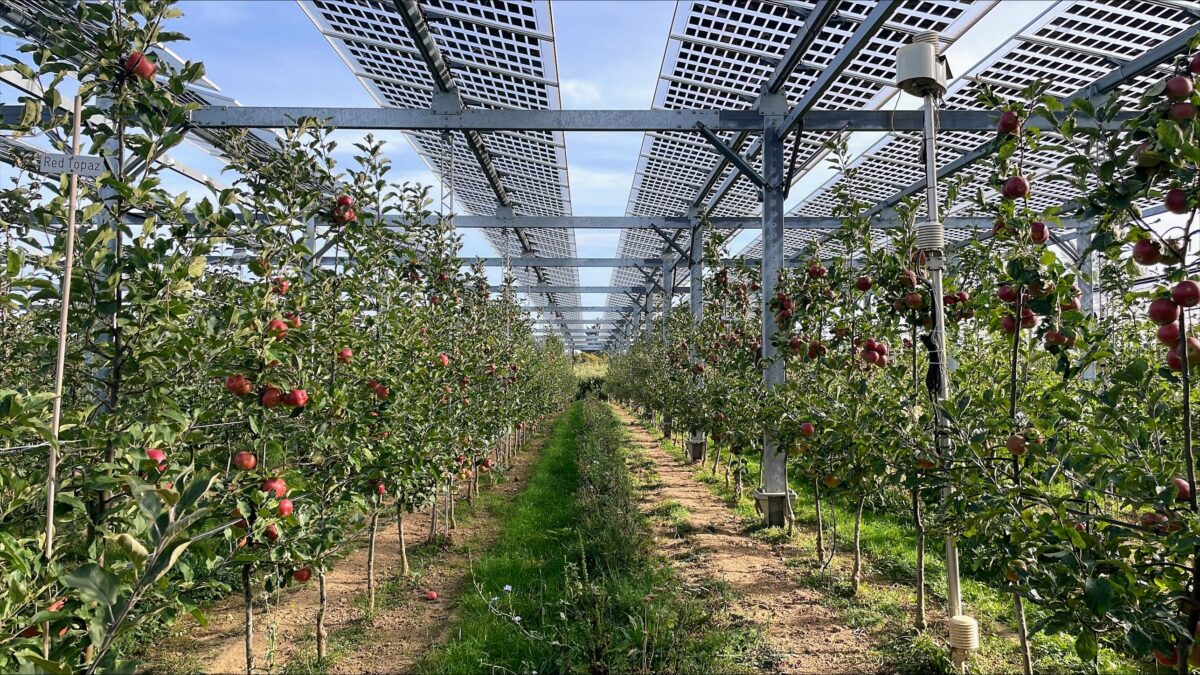
The system consists of three rows of PV modules, each 20 metres long and spaced 10 metres apart, mounted at a hub height of 1.8 meters. It employs 45 silicon monocrystalline bifacial PV modules, each rated at 580 W with a bifacial factor of 0.85. To maximise light transmission for optimal crop growth, the solar tracker’s rotation is limited to 90°.
The measurements showed that TT maximises energy yield but has the lowest biomass, while AT maximises biomass at the expense of energy. By contrast, ST was found to provide a balanced trade-off, while KPT maintains high biomass with moderate energy, and DLIT prioritises energy after DLI targets are met.
Overall, all strategies show trade-offs between energy and crop productivity, with KPT and ST offering balanced performance, and DLIT favoring energy once crop light needs are satisfied.
“DLIT maintained energy conversion within approximately 1% of TT while reducing biomass by about 10%, indicating that daily crop light constraints can preserve energy output with limited agronomic penalties,” the academics said.
“KPT further improved this balance by limiting biomass losses to around 2% relative to AT while retaining more than 85% of the energy yield achieved by TT.”
“The analysis also revealed that smoothing tilt-angle trajectories reduced biomass yields by more than 20% across all strategies, underscoring the importance of dynamic and responsive tracker operation for crop performance,” they concldued.
“Overall, the key advantage of the proposed DLIT and KPT frameworks lies in their physiological grounding and operational flexibility. By directly linking tracker control to cumulative and instantaneous crop light requirements, these strategies move beyond fixed schedules and empirical thresholds, offering a robust pathway toward improved dual-use land efficiency in agrivoltaic systems.”
Their findings are available in the study “Novel Operational Strategies to Maximize Crop and Electricity Production in Single Axis Agrivoltaic Systems Based on Light Response Curve and Daily Light Integral,” published in Results in Engineering.
This content is protected by copyright and may not be reused. If you want to cooperate with us and would like to reuse some of our content, please contact: editors@pv-magazine.com.



By submitting this form you agree to pv magazine using your data for the purposes of publishing your comment.
Your personal data will only be disclosed or otherwise transmitted to third parties for the purposes of spam filtering or if this is necessary for technical maintenance of the website. Any other transfer to third parties will not take place unless this is justified on the basis of applicable data protection regulations or if pv magazine is legally obliged to do so.
You may revoke this consent at any time with effect for the future, in which case your personal data will be deleted immediately. Otherwise, your data will be deleted if pv magazine has processed your request or the purpose of data storage is fulfilled.
Further information on data privacy can be found in our Data Protection Policy.