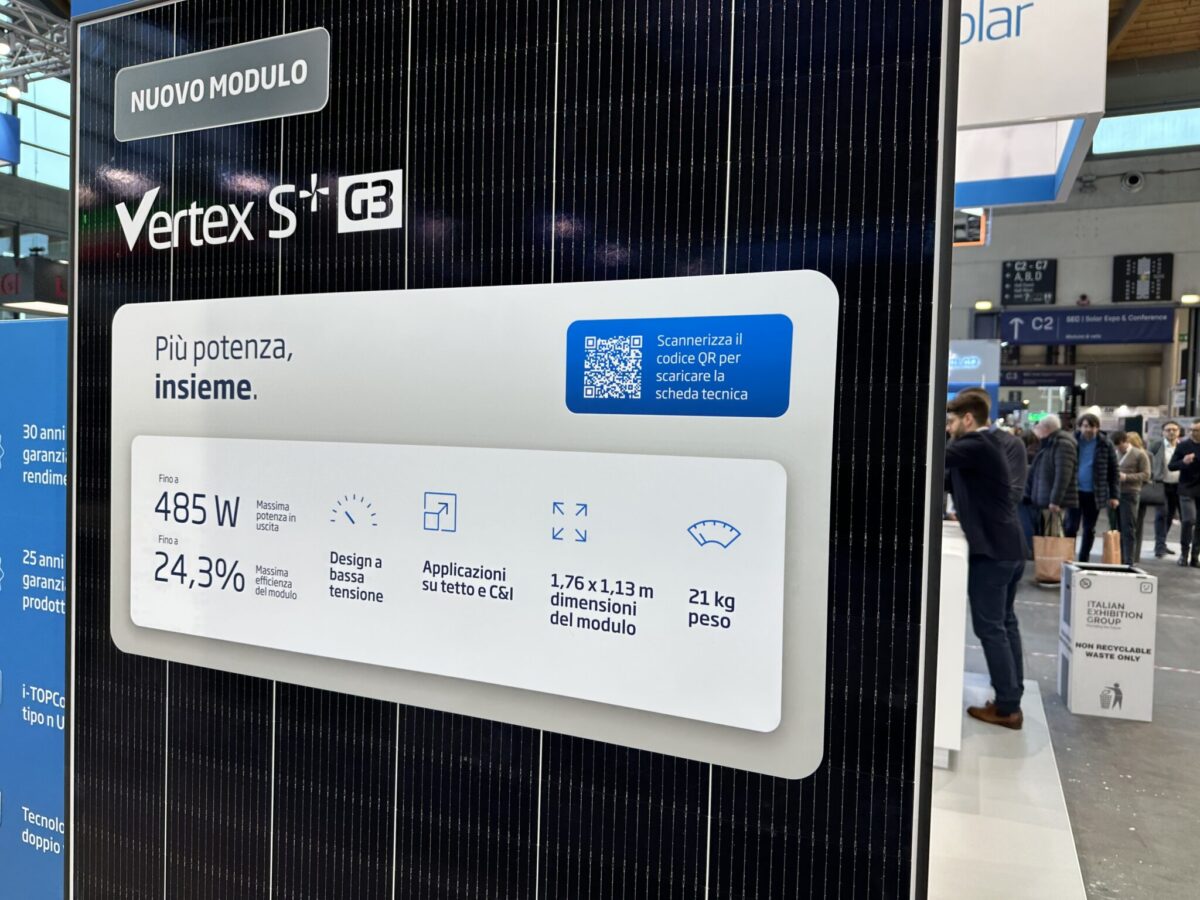





Chinese PV module manufacturer Trina Solar has unveiled a new dual-glass TOPCon module for residential and commercial applications at the Key Energy trade show in Rimini, Italy.
“The launch marks the third generation of the company’s TOPCon technology, which had already been introduced for larger utility-scale modules, namely the NEG19 and NEG21 series,” Antonino Coccia, strategic key account manager at Trina Solar, told pv magazine.
“We implemented a series of improvements not only to cell technology but also to overall module architecture. The focus has been on optimising the voltage-to-current ratio to enhance system-level performance.”
“Beyond a further incremental increase in module efficiency, the new generation also introduces improvements in degradation coefficients,” Coccia said.
“Both annual and temperature-related degradation rates have been reduced. In terms of solar cell design, there are no radical changes compared to the previous Vertex generation. Rather, we carried out incremental refinements year after year. The most significant advancements lie not in the cell itself, but in the overall construction and architecture of the module.”
Trina Solar is offering five versions of the Vertex S+ G3 modules, with power output ranging from 465 W to 495 W and power conversion efficiencies between 23.3% and 24.3%. Open-circuit voltage ranges from 37.1 V to 37.9 V, while short-circuit current is between 15.96 A and 16.08 A.
The panels measure 1,762 mm x 1,134 mm x 30 mm and weigh 21.1 kg.
They can be deployed in systems with a maximum voltage of 1,500 V and feature IP68-rated junction boxes. The temperature coefficient is -0.26% per C, with an operating temperature range of -40 C to 85 C.
The modules are backed by a 15-year product warranty and a 30-year performance warranty. First-year degradation is specified at less than 1.0%, with 30-year end-of-life output guaranteed at no less than 88.5% of nominal power.
The Vertex S+ G3 is part of a broader product portfolio that Trina Solar plans to roll out in the near term. It includes a 480 W Vertex S+ G3 Full Black module, targeting residential rooftop applications, and a 485 W Vertex S+ G3 Shield module, designed for enhanced mechanical strength and hail resistance.
For utility-scale projects, the company is also promoting its bifacial dual-glass NEG21 module, which delivers up to 760 W with a module efficiency of 24.5%. Based on G12 210 mm wafers, the product features a low-voltage design that enables higher string power, helping to reduce balance-of-system (BOS) costs and levelised cost of electricity (LCOE) by 2% to 6%, according to the manufacturer.
The NEG19 module, meanwhile, offers up to 670 W and an efficiency of 24.8%. It has been optimised for one-in-portrait (1P) tracker systems. Trina Solar said its low-voltage architecture can reduce BOS costs and LCOE by 1% to 5%, while maintaining system compatibility.
This content is protected by copyright and may not be reused. If you want to cooperate with us and would like to reuse some of our content, please contact: editors@pv-magazine.com.



By submitting this form you agree to pv magazine using your data for the purposes of publishing your comment.
Your personal data will only be disclosed or otherwise transmitted to third parties for the purposes of spam filtering or if this is necessary for technical maintenance of the website. Any other transfer to third parties will not take place unless this is justified on the basis of applicable data protection regulations or if pv magazine is legally obliged to do so.
You may revoke this consent at any time with effect for the future, in which case your personal data will be deleted immediately. Otherwise, your data will be deleted if pv magazine has processed your request or the purpose of data storage is fulfilled.
Further information on data privacy can be found in our Data Protection Policy.