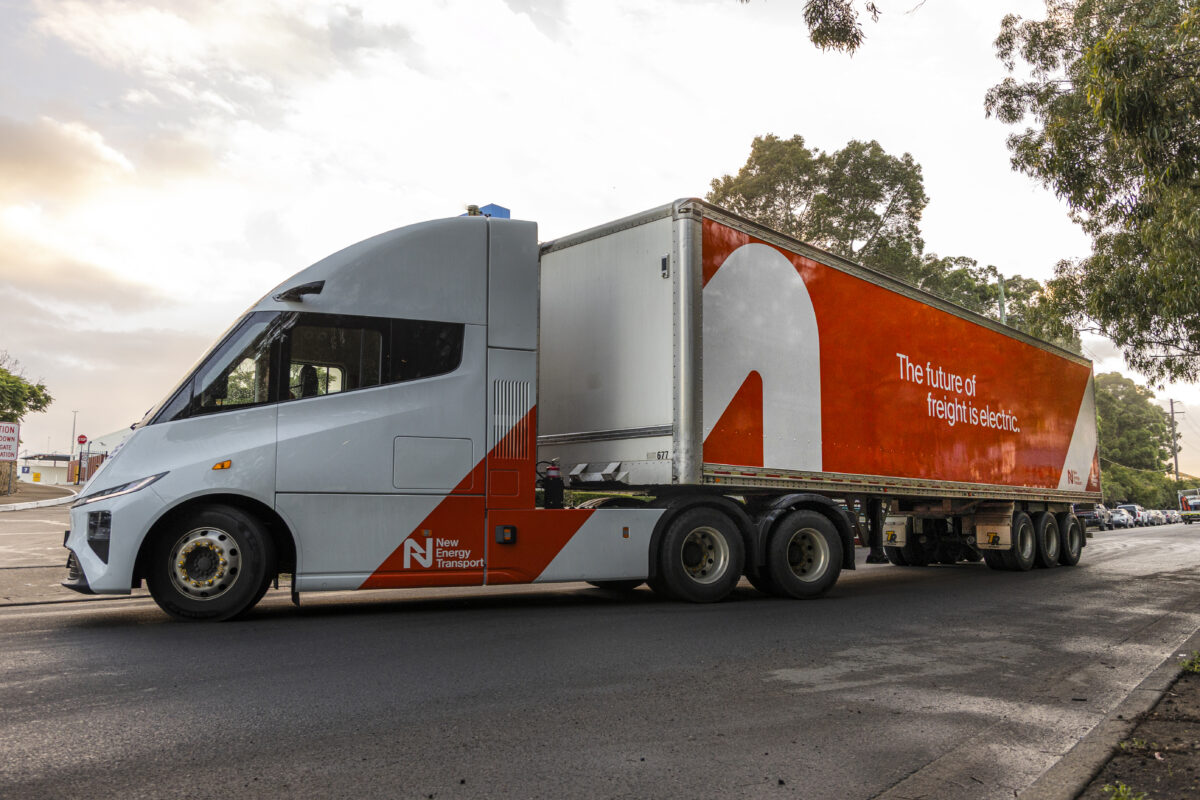





Australian trucking outfit New Energy Transport has delivered goods from a distribution centre in Sydney to Canberra, about 300 kilometres away, on a single charge of the electric long-haul truck manufactured by Belgium-based Windrose. After arriving in Canberra, the freight was transferred to electric vans for delivery to end customers.
New Energy co-Chief Executive Officer Daniel Bleakley said the fully electric end-to-end delivery proves that the transition to electric vehicle (EV) trucking fleets isn’t just a future goal but is possible right now.
“This delivery ushers in a new era for Australian road freight where electric heavy trucks are not just cheaper and faster, they unshackle Australia from volatile global oil markets, dramatically strengthening our supply chain resilience,” he said, noting that the trucks are already available and the economics work.
New Energy said the Windrose electric truck – fitted with a 700 kWh battery that has a range of up to 670 km at 49 tonnes combined mass and capable of one-hour fast charging – delivered an 84% reduction in energy costs compared to a diesel prime mover on the same route.
The journey was also made 25 minutes faster than usual due to the electric truck’s ability to maintain high speeds across all sections of the route, including uphill climbs.
With transport shaping up as one of Australia’s biggest carbon challenges, and the current fuel crisis tightening its grip on the freight industry, Bleakley said now is the time to accelerate the transition to electric trucks.
Already the nation’s third-largest source of greenhouse emissions, accounting for about 22% of all emissions, the transport sector is on track to become the highest-emitting sector by 2030. Road freight accounts for 40% of all transport sector emissions and heavy vehicles dominate this share.
“Australia must act now and seize this moment to decouple from diesel,” Bleakley said.
“Australia’s major transport buyers, including our supermarket chains who depend on diesel-based trucking to deliver food to millions, have a responsibility to accelerate the transition to resilient road freight.
“Governments at all levels also have a major role to play. By co-investing in charging infrastructure and making electric prime movers more affordable through targeted subsidies and incentives, they can catalyse industry adoption and unlock long-term economic, productivity, and energy security benefits for Australia.”
New Energy said it is now working to establish a pilot fleet of heavy electric trucks in Wilton, southwest of Sydney, by the middle of 2026.
The company says it will be Australia’s largest electric trucking depot, initially housing up to 50 heavy electric prime movers, with plans to grow the fleet to 200 vehicles and expand its service routes to connect Adelaide, Melbourne, Sydney, Canberra and Brisbane by 2031.
The depot will be powered by a mix of grid electricity and up to 5 MW of on-site solar, with high-powered chargers capable of fully recharging the 600 to 700 kWh truck batteries in under an hour.
This content is protected by copyright and may not be reused. If you want to cooperate with us and would like to reuse some of our content, please contact: editors@pv-magazine.com.


By submitting this form you agree to pv magazine using your data for the purposes of publishing your comment.
Your personal data will only be disclosed or otherwise transmitted to third parties for the purposes of spam filtering or if this is necessary for technical maintenance of the website. Any other transfer to third parties will not take place unless this is justified on the basis of applicable data protection regulations or if pv magazine is legally obliged to do so.
You may revoke this consent at any time with effect for the future, in which case your personal data will be deleted immediately. Otherwise, your data will be deleted if pv magazine has processed your request or the purpose of data storage is fulfilled.
Further information on data privacy can be found in our Data Protection Policy.