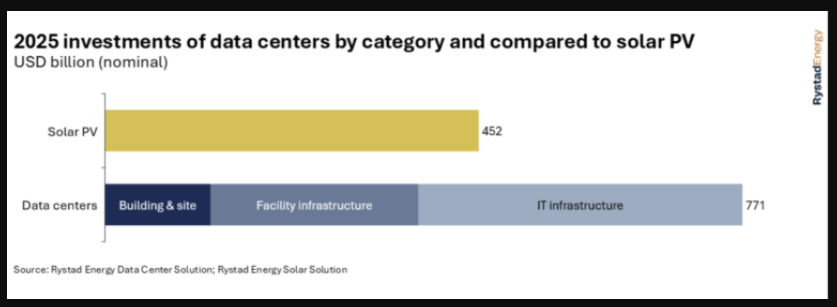





Global investment in data center infrastructure reached $1,086 (USD 770 billion) in 2025, surpassing upstream oil and gas spending and reaching levels comparable to the broader energy sector, according to Rystad Energy.
The analysis highlights a structural shift in global energy investment flows, with data centres emerging as a major new source of demand.
Since 2024, capital expenditure on data centres has exceeded investment in solar, positioning the sector as a capital-intensive asset class with direct implications for power generation, grids, and supply chains.
Rystad said data centre investment is split between IT infrastructure and energy-related systems. Servers and computing hardware account for about 40% of total spending, while energy infrastructure – including cooling systems, power distribution, and thermal management – now represents investment volumes comparable to global PV capex.
The expansion of data centres is also driving additional investment across the energy sector, including power generation, grid infrastructure, and industrial equipment.
This multiplier effect is accelerating at a pace that Rystad said exceeds previous industrial expansion cycles, driven by digitalisation and artificial intelligence (AI).
Large-scale facilities with capacities above 100 MW are becoming the dominant format. These projects require infrastructure-level investment similar to large energy assets, but with significantly shorter timelines for grid connection and commissioning, creating challenges for permitting, grid planning, and equipment availability.
Investment is increasingly concentrated among large technology companies and artificial intelligence developers, mirroring patterns seen in upstream oil and gas, where major firms dominate capital allocation.
Geographically, deployment remains concentrated. The United States accounted for 42% of installed capacity in 2025, roughly double that of China, with India ranking third.
However, Rystad expects broader geographic diversification as power demand from data centres exceeds 10% of national electricity consumption in some markets, creating constraints on grid access, land availability, and infrastructure capacity.
Countries with strong energy resources and stable regulatory frameworks, including Finland, Portugal, and Thailand, are emerging as potential hubs for future data centre investment toward 2030.
Rystad said the impact is already visible across supply chains, with rising demand for equipment such as gas turbines, transformers, and fuel cells supporting growth among original equipment manufacturers.
Artificial intelligence is expected to remain the primary driver of demand in the near to medium term, although Rystad said the market may move toward a more balanced alignment of investment, capacity, and demand as it matures.
This content is protected by copyright and may not be reused. If you want to cooperate with us and would like to reuse some of our content, please contact: editors@pv-magazine.com.


By submitting this form you agree to pv magazine using your data for the purposes of publishing your comment.
Your personal data will only be disclosed or otherwise transmitted to third parties for the purposes of spam filtering or if this is necessary for technical maintenance of the website. Any other transfer to third parties will not take place unless this is justified on the basis of applicable data protection regulations or if pv magazine is legally obliged to do so.
You may revoke this consent at any time with effect for the future, in which case your personal data will be deleted immediately. Otherwise, your data will be deleted if pv magazine has processed your request or the purpose of data storage is fulfilled.
Further information on data privacy can be found in our Data Protection Policy.