David Carroll

ClearVue secures key certification to support global solar tech rollout
ClearVue Technologies has secured international certification for its thermal management junction box, a critical electrical component in the company’s building-integrated PV products, marking a key step in the commercial deployment of its solar facade products.
Ausgrid adds new community battery to share benefits of ‘solar revolution’
New South Wales electricity distributor Ausgrid has added another community battery to its network, extending access to shared energy storage to thousands of households in the state’s Central Coast region.

Australia’s fuel security hedge is electrification. It will only work with long-duration storage
Recent disruptions to the Strait of Hormuz are a reminder of a simple fact: energy markets reprice risk quickly. In Australia, this pain is initially felt in transport and parts of industry that rely on imported liquid fuels, with prices set offshore and supply chains we do not control. Reducing that risk exposure depends on accelerating electrification of those sectors, where it is economic to do so.

BHP teams with Traditional Owners to explore renewable options in Pilbara
BHP has entered a partnership with Yindjibarndi Energy Corporation to explore potential large-scale renewable energy solutions that could help power the mining giant’s iron ore operations in Western Australia’s Pilbara region.
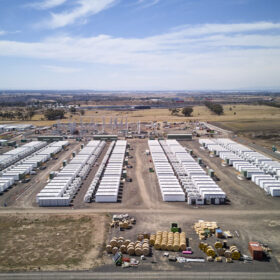
Batteries boom as report reveals challenging times for solar and wind investment
Renewable energy generated close to 43% of Australia’s electricity in 2025 with the country’s rooftop and utility-scale solar installations accounting for more than 21% of that total.
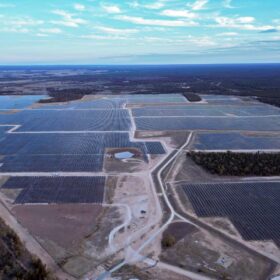
Australia seeks 5 GW renewable generation in new CIS tender
The Australian government has officially launched the latest tender in its Capacity Investment Scheme initiative, a competitive round targeting 5 GW of renewable energy generation capacity in the National Electricity Market.

CleanPeak officially flicks switch on Wangaratta solar farm
Australian renewables developer and operator CleanPeak Energy has added another utility-scale PV power plant to its operational portfolio with the official opening of the Wangaratta Solar Farm in northeast Victoria.
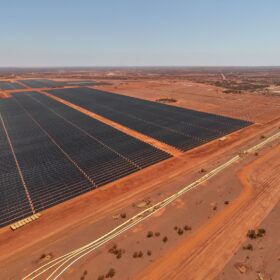
Fortescue begins building 690 MW solar farm and 650 MWh battery system
One of Australia’s biggest miners has commenced construction of a 690 MW solar farm and 650 MWh battery energy storage system in Western Australia as part of plans to eliminate diesel and gas from its iron ore operations.
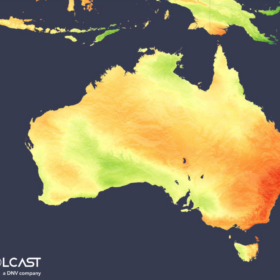
Record-dry April lifts irradiance across Eastern Australia
Solcast, a DNV company, reports that April 2026 was one of Australia’s driest Aprils in recent years, with widespread rainfall deficits driven by persistent high pressure and ENSO returning to neutral, leading to mostly clear skies and above-normal solar irradiance across much of the continent. New South Wales and Victoria saw the strongest sunshine surpluses, while remnants of ex-Tropical Cyclone Maila brought cloud and rain to the north, creating regional contrasts in rainfall and solar conditions.
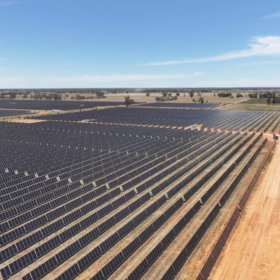
Solar and battery hybrid projects prominent in latest CIS tender
The results of the latest tender under the federal government’s Capacity Investment Scheme have been released with 19 projects successful, aiming to provide a combined 7.8 GW of renewable generation capacity and 7.9 GWh of storage by the end of 2030.