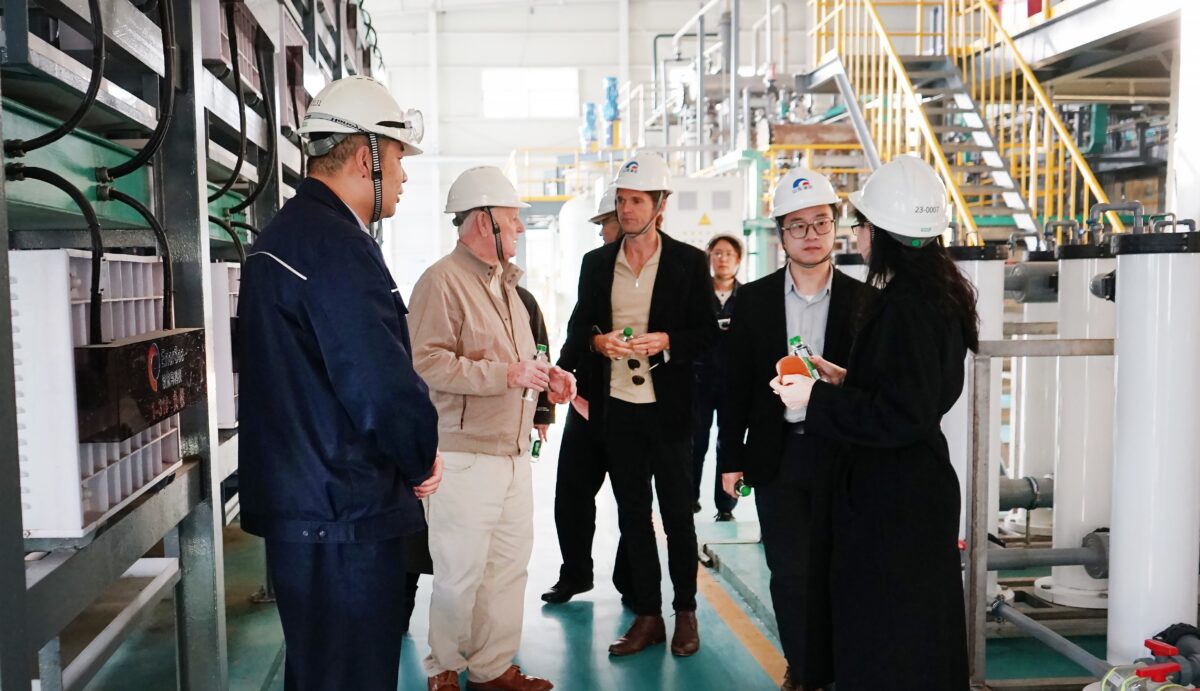





China’s Enerflow, a fast-growing long-duration energy storage developer, has signed a strategic cooperation agreement with Western Australia’s Jenmi Investments to jointly pursue a 350 MW / 1,200 MWh vanadium flow battery project, in what is set to become one of Australia’s largest long-duration storage deployments. No site details have been released.
The agreement, reached mid-November, focuses on jointly developing the market for vanadium flow battery energy storage systems and electrolyte in Australia, and establishing a project development pathway that combines Enerflow’s electrochemical technology with Jenmi’s local market capabilities.
Enerflow, founded in 2022 and backed by Hillhouse Ventures, has rapidly expanded its capabilities across both vanadium and iron-chromium flow battery technologies. The company holds more than 50 invention patents and operates R&D centres in Beijing and Weifang, alongside integrated manufacturing facilities in Shandong and Inner Mongolia.
It has built a full-chain industrial system covering electrolyte production, stack manufacturing and system integration, with several megawatt-scale demonstration projects already in stable operation.
Jenmi Investments, led by founder Michael Johnson, will oversee project development, approvals and operational management of the project, while Enerflow will supply customised flow battery systems, including stack configuration, integration engineering and control strategy design. Enerflow has also committed to establishing a local operations team to deliver full-cycle service.
The two companies plan to accelerate a series of demonstration deployments before scaling up to the 350 MW / 1,200 MWh project cluster.
Australia’s long-duration storage market is expanding rapidly due to its high share of variable renewable energy and the need for firming capacity.
Vanadium flow batteries – designed with decoupled power and capacity, 15,000+ cycle life, non-flammable aqueous electrolytes and deep discharge capability – offer advantages for multi-hour and daily cycling applications. The technology’s performance aligns with Australia’s operational needs, while the country’s own vanadium resources provide potential supply-chain complementarity.
During a site visit to Enerflow’s R&D facilities and automated production lines in China, Jonson said the company’s “strong R&D capability and advanced manufacturing fully meet the expectations for a strategic partner and give us confidence in scaling long-duration storage in Australia.”
Enerflow’s chairman described the partnership as a “key milestone” in the company’s internationalisation strategy, adding that Chinese-developed flow technology “must play a part in global energy transition pathways.”
If executed successfully, the project would be among the most significant flow battery deployments globally. Australia currently lacks large commercial flow battery installations, despite strong policy momentum for long-duration storage.
The partners plan to complete engineering design and initial approvals within the year, aiming to turn the project into a benchmark for long-duration storage as Australia expands renewable generation and seeks higher grid resilience.
This content is protected by copyright and may not be reused. If you want to cooperate with us and would like to reuse some of our content, please contact: editors@pv-magazine.com.

By submitting this form you agree to pv magazine using your data for the purposes of publishing your comment.
Your personal data will only be disclosed or otherwise transmitted to third parties for the purposes of spam filtering or if this is necessary for technical maintenance of the website. Any other transfer to third parties will not take place unless this is justified on the basis of applicable data protection regulations or if pv magazine is legally obliged to do so.
You may revoke this consent at any time with effect for the future, in which case your personal data will be deleted immediately. Otherwise, your data will be deleted if pv magazine has processed your request or the purpose of data storage is fulfilled.
Further information on data privacy can be found in our Data Protection Policy.