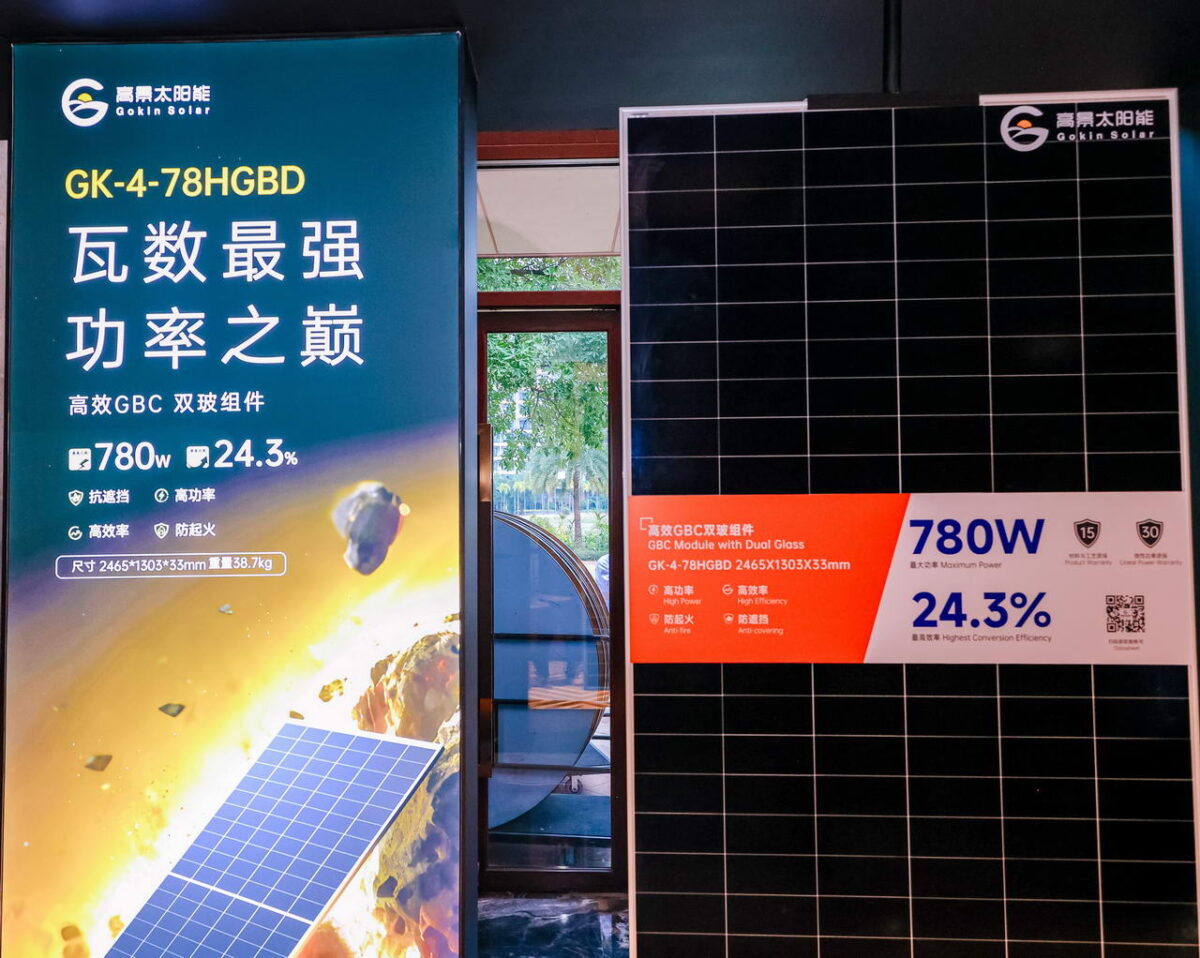





Chinese wafer manufacturer Gokin Solar has introduced a new back-contact (BC) solar module series at its Global BC Eco Summit in China.
The series includes three products: the GK-3-54HGFb for residential applications, the GK-3-72HGF for commercial and industrial (C&I) rooftops, and the dual-glass GK-4-78HGBD for utility-scale projects. All modules are CE certified and designed for 1,500 V DC systems.
The GK-3-54HGFb residential module offers power outputs ranging from 480 W to 500 W, with efficiencies between 23.5% and 24.5%. The 108-cell, all-black, single-glass panel measures 1,800 mm × 1,134 mm × 30 mm and weighs 21.4 kg. It comes with a 25-year product warranty and a 30-year linear performance warranty, with first-year degradation limited to 1% and annual degradation thereafter capped at 0.35%.
For C&I rooftops, the GK-3-72HGF delivers between 650 W and 670 W, with efficiencies of 24.1% to 24.8%. The 144-cell, single-glass module measures 2,382 mm × 1,134 mm × 30 mm and weighs 28.1 kg.
Both GK-3 models use n-type BC cells and feature IP68-rated junction boxes, a maximum series fuse rating of 25 A, and a temperature coefficient of −0.26%/°C.
The flagship GK-4-78HGBD utility-scale module is a dual-glass product rated from 760 W to 780 W, with efficiencies between 23.7% and 24.3%. It uses 156 BC cells in a 2,465 mm × 1,303 mm × 33 mm format and weighs 38.7 kg.
According to the manufacturer, the module achieves a bifaciality factor of up to 75% and supports a maximum fuse rating of 30 A. Its open-circuit voltage is 58.36 V, while the short-circuit current reaches 16.26 A. The module is backed by a 15-year product warranty and a 30-year linear performance guarantee.
Gokin said all modules are certified for static loads of 5,400 Pa on the front side and 2,400 Pa on the rear side and have been tested to withstand hailstones measuring 25 mm at speeds of 23 m/s. The single-glass modules carry an IEC Class C fire rating, while the dual-glass utility-scale product is rated Class A.
“The BC architecture places all busbars on the rear side, eliminating front-side metallisation and increasing the active light-receiving area by around 1.1%,” the company said. “Compared with TOPCon modules of similar size, the design can deliver up to 30 W more output, helping to reduce the levelized cost of energy.”
The manufacturer also cited improved resistance to microcracks and front-side corrosion due to its wafer and encapsulation design, as well as resistance to potential-induced degradation (PID), salt mist and humidity. The modules are rated for operation in temperatures ranging from −40 C to 85 C. Gokin said the 780 W dual-glass module is intended to reduce balance-of-system costs in large-scale projects by lowering string counts and mounting hardware requirements per installed megawatt.
Founded in 2019, Gokin reports annual production capacities of 80 GW for ingots and wafers and 4 GW for modules.
This content is protected by copyright and may not be reused. If you want to cooperate with us and would like to reuse some of our content, please contact: editors@pv-magazine.com.

By submitting this form you agree to pv magazine using your data for the purposes of publishing your comment.
Your personal data will only be disclosed or otherwise transmitted to third parties for the purposes of spam filtering or if this is necessary for technical maintenance of the website. Any other transfer to third parties will not take place unless this is justified on the basis of applicable data protection regulations or if pv magazine is legally obliged to do so.
You may revoke this consent at any time with effect for the future, in which case your personal data will be deleted immediately. Otherwise, your data will be deleted if pv magazine has processed your request or the purpose of data storage is fulfilled.
Further information on data privacy can be found in our Data Protection Policy.