




The Australian arm of France-headquartered renewable energy and storage developer Neoen has announced the start of construction of the 226 MW / 866 MWh Goyder North battery energy storage project in South Australia.
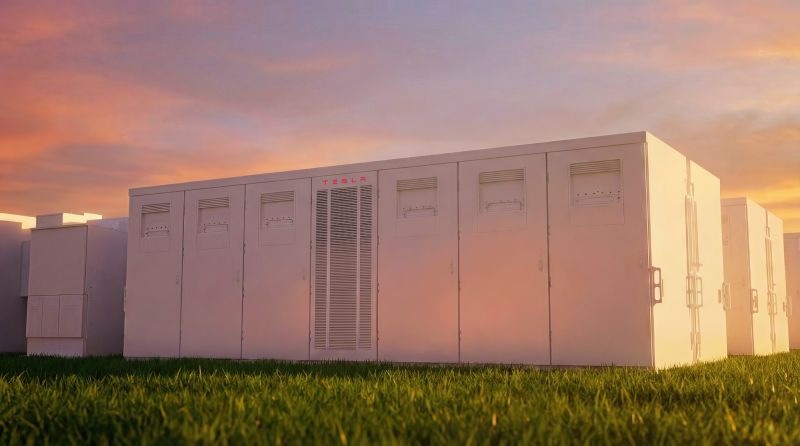
It is expected the project will feature Tesla’s new Megablock technology, marking the world’s first deployment of the grid-scale battery architecture unveiled earlier this year.
The Megablock combines four of Tesla’s new Megapack 3 units into a single pre-engineered, plug-and-play block delivering 20 MWh capacity. According to Tesla, Megablock is optimised for rapid deployment and cost-efficiency, offering 23% faster installation and up to 40% lower construction costs compared to previous systems.
Engineering services company UGL has been selected by Neoen to construct the project. It will prepare the site and deliver the high-voltage infrastructure, including a 275 kV substation, control and switchroom facilities, earthworks, and footings, as well as provide testing and commissioning support.
The Goyder battery, that has planning approval for up to 900 MW of capacity and 3,600 MWh, forms part of Neoen’s Goyder Renewables Zone project, a vast hybrid solar, wind, and storage project being built near the town of Burra, in the state’s Mid North region.
In addition to the Goyder battery, the hybrid project includes the now-operational 412 MW Goyder South wind farm, the future Goyder North wind farm that has planning consent for up to 1 GW of wind generation, and up to 600 MW of solar generation.
The battery is supported by a 10-year renewable energy baseload agreement to supply power to mining giant BHP’s Copper South Australia mines from July 2029.
The agreement will provide BHP with a 24/7 100 MW supply solution that combines output from the first 300 MW of the planned Goyder North wind farm, with storage from the Goyder battery.
Neoen, owned by Canada-headquartered asset management company Brookfield, said the Goyder battery is its third energy storage project to move into construction in the past three months, following the go-ahead for the 305 MW / 1,220 MWh third stage of the Western Downs battery in Queensland, and the 164 MW / 905 MWh Muchea battery in Western Australia.
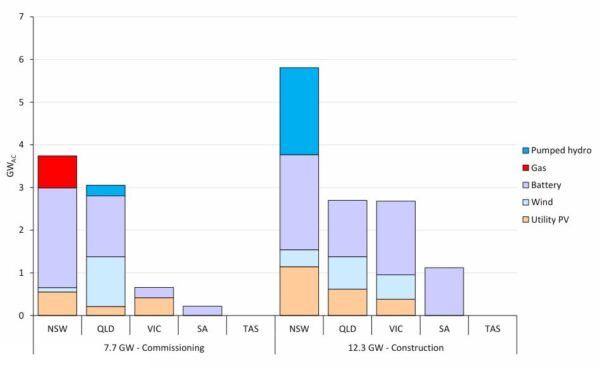
Image: Rystad Energy
David Dixon, senior analyst at independent research company Rystad Energy, said the progress on the Goyder battery has increased the total capacity of big batteries either commissioning or under construction in Australia’s main grid to 10.6 GW.
“The NEM now has 20 GW of utility scale PV, wind, gas, batteries and pumped hydro either commissioning or under construction,” he said. “Incredibly over half of this is associated with utility battery capacity.”
Dixon said the majority of this 20 GW capacity is expected to be online in the next 24 months.
“It is also worth noting that over 10 GW of capacity has been energised on the NEM in a single year for the first time,” he said, adding that batteries and utility and behind-the-meter solar were the two standout technologies with more than 9 GW energised in 2025.
The start of construction of the Goyder battery brings Neoen’s total battery storage capacity in Australia to more than 2.2 GW / 7.2 GWh of capacity currently in operation or under construction, making it the country’s largest owner and operator of big batteries.
This content is protected by copyright and may not be reused. If you want to cooperate with us and would like to reuse some of our content, please contact: editors@pv-magazine.com.


3 comments
By submitting this form you agree to pv magazine using your data for the purposes of publishing your comment.
Your personal data will only be disclosed or otherwise transmitted to third parties for the purposes of spam filtering or if this is necessary for technical maintenance of the website. Any other transfer to third parties will not take place unless this is justified on the basis of applicable data protection regulations or if pv magazine is legally obliged to do so.
You may revoke this consent at any time with effect for the future, in which case your personal data will be deleted immediately. Otherwise, your data will be deleted if pv magazine has processed your request or the purpose of data storage is fulfilled.
Further information on data privacy can be found in our Data Protection Policy.