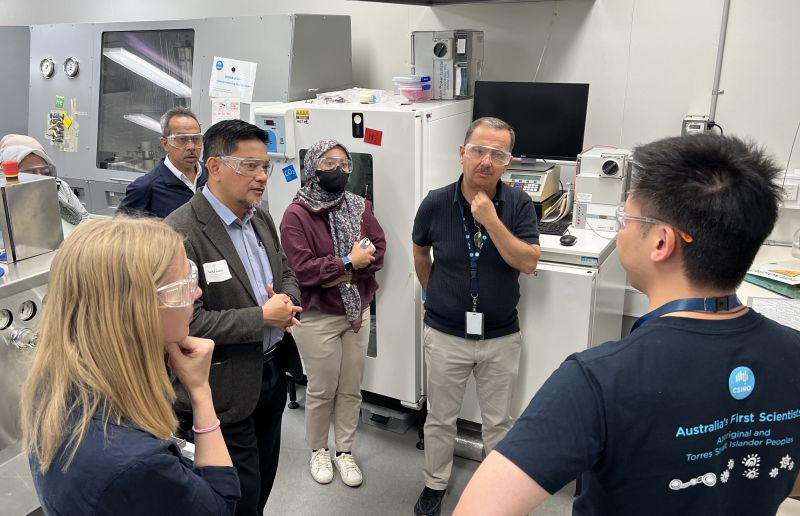





With battery energy storage systems seen as critical to the clean energy transition, Australia’s CSIRO has partnered with Malaysia’s Sustainable Energy Development Authority (SEDA) to examine how different battery chemistries perform and are managed as energy storage under tropical conditions.
CSIRO Energy Systems Program Senior Engineer Mahathir Almashor said much of the global understanding of battery technologies has been developed in cooler climates, leaving limited data on how heat and humidity affect performance, safety and lifespan in tropical environments.
“Most international battery research comes from cooler regions including Japan, China, Europe and the United States,” he said. “This creates a knowledge gap for countries operating in hot and humid climates. Malaysia’s conditions, together with SEDA’s strong interest in the topic, made it a natural partner.”
“The findings are also highly relevant for northern Australia, where similar tropical environments exist.”
The joint study assessed six major battery families, including lithium-ion, sodium-ion, lead-acid, nickel-based, redox-flow and molten salt batteries and evaluated their technical performance, commercial viability and sustainability in Malaysia’s tropical conditions.
The analysis covered stationary applications ranging from residential and community-scale storage to large commercial and industrial applications.
Almashor said the study highlights several factors that shape how storage systems perform in tropical environs, including how high temperatures, humidity and salinity present unique challenges for battery durability and efficiency, and discusses strategies to mitigate these effects.
“Consistently high temperatures can accelerate side reactions leading to shorter life and higher risk of thermal runaway,” he said, noting that Malaysia’s relatively stable temperature range (22-32°C) “avoids the deep seasonal temperature swings that accelerate degradation in colder regions.”
The region’s consistently high humidity, often reaching 80–90%, does however present a challenge.
“Humidity can accelerate corrosion and contribute to failures, even when battery energy storage systems are housed in climate-controlled enclosures,” he said. “This risk is exacerbated by the lack of dedicated studies to the effects of humidity and salinity on specific chemistries.”
The study provides an in-depth appraisal of the effects of the tropical environment on the different battery chemistries, but the researchers said it is not possible to provide a definitive recommendation.
“The optimal solution is dependent on the location of the application and the nature, intensity and availability of the associated renewable energy source,” they said. “It is also sensitive to the characteristics of the application in terms of duration, scale and costs.”
Almashor said the research does however provide a baseline for future battery deployment in tropical environments and has implications beyond Malaysia’s borders.
“These insights aren’t just relevant for Malaysia, they also inform energy resilience in northern Australia, Southeast Asia and the South Pacific where heat and humidity can significantly influence battery performance, safety and lifespan,” he said.
CSIRO noted that the study has already attracted interest from other Southeast Asian technical agencies and research partners beyond Malaysia, reflecting a wider regional appetite for evidence on tropical storage.
“There is interest in exploring a second phase of work, potentially extending the research to other Southeast Asian contexts,” Almashor said.
This content is protected by copyright and may not be reused. If you want to cooperate with us and would like to reuse some of our content, please contact: editors@pv-magazine.com.



1 comment
By submitting this form you agree to pv magazine using your data for the purposes of publishing your comment.
Your personal data will only be disclosed or otherwise transmitted to third parties for the purposes of spam filtering or if this is necessary for technical maintenance of the website. Any other transfer to third parties will not take place unless this is justified on the basis of applicable data protection regulations or if pv magazine is legally obliged to do so.
You may revoke this consent at any time with effect for the future, in which case your personal data will be deleted immediately. Otherwise, your data will be deleted if pv magazine has processed your request or the purpose of data storage is fulfilled.
Further information on data privacy can be found in our Data Protection Policy.