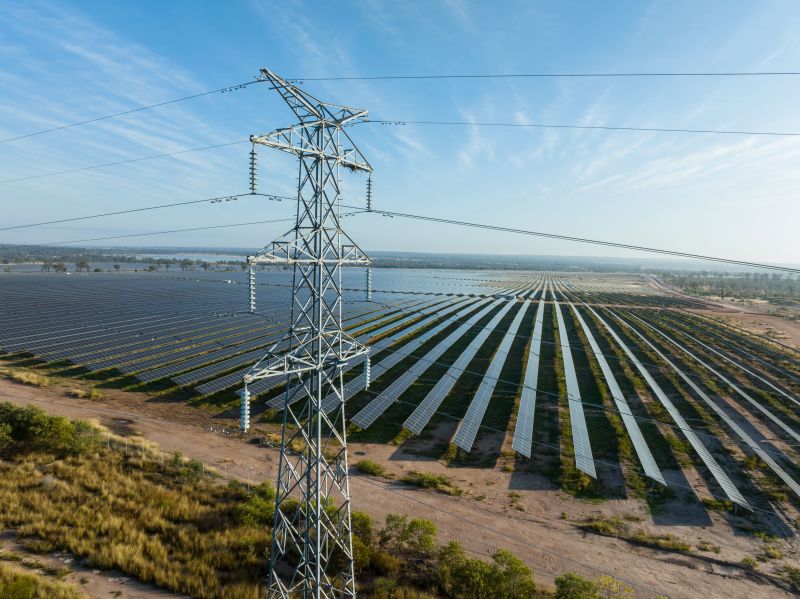





The last few weeks have been an object lesson in the benefits of the transformation of our energy market, dispelling the myths promulgated by fossil fuel vested interests that increased renewable energy means more expensive power and reduced grid reliability. We have seen exactly the opposite of that: with increased extreme weather events including unprecedented heatwaves and devastating fires in southeast Australia, the grid has proven resilient under surging demand and stress, and now the Australian Energy Market Operator (AEMO) confirms that increased renewables correlates with a significant decline in wholesale prices.
Grid reliability over the last decade has been significantly improving. The coincidence of extreme weather events and heatwaves has been matched by record production of variable renewable energy (VRE), particularly solar power.
But the big disruption that we’re seeing – which started profoundly in 2025 and is going to be even more consequential in 2026 – is batteries. AEMO reports that battery discharge nearly tripled in the December quarter. Behind-the-meter and utility scale battery storage capacity underpins reliable and stable energy supply when demand is high and grid transmission capacity is constrained, supplying power instantly during demand peaks, shifting low cost zero-emissions energy from low-demand to high-demand periods and reducing reliance on peaking gas plants.
The economics are unbeatable. We’ve seen the price of batteries plummet by 90% in the last decade and decline by 50% in the last three years. In a brilliant policy initiative, the federal government capitalised on the economic case to establish Cheaper Home Batteries scheme. We’ve now seen 200,000 batteries installed in just over six months, 4.7 GWh of batteries behind the meter in homes, supporting solar production in which Australia excels as we lead the world in rooftop solar installations. And Treasurer Jim Chalmers upscaled funding of this program to $7.2 billion last month.
But we’re also seeing a profound deployment of battery energy storage systems (BESS) at the utility scale. Australia was the third largest installer of batteries in the world in 2025, behind only the USA and China, and will likely repeat this again in 2026. It was important to see Akaysha Energy commission its second BESS near Brisbane this month, five months ahead of schedule, following its now operational 205 MW /410 MWh Brendale battery, which will play a key role in Queensland’s grid. As we continue this rapid build out into 2027, this allows an even greater share of renewable energy infrastructure to be deployed, leveraging the existing grid infrastructure. 2026 will be another year of record highs for renewables share in Australia. Non-solar households are set to be able to opt-in to benefit from the Solar Sharer three free hours of energy daily from July 2026.
The imperative of grid system reliability means at present we need as many solutions that are economically viable as possible, while focussing on transitioning as quickly as possible to a low-cost, clean, firmed renewables powered energy system. Gas currently plays an important but small and rapidly declining role in stabilising the grid. We are not going to run the Australian grid solely on batteries, but the positive impact of batteries operating and price setting is being seen an increasing percentage of the time, as battery energy densities improve phenomenally and two hour-discharge batteries become four-hour batteries, and even potentially eight-hour duration. This trajectory equates to record low use of prohibitively expensive fossil gas, as the AEMO report shows, with big batteries on the brink of making up a greater share of Australia’s electricity grid than gas in 2027.
Coal power is increasingly unreliable as our end-of-life coal clunker fleet is more and more prone to breakdown. The recent announcement of yet more taxpayer subsidies to extend the life of the Griffin Coal mine in WA, and Origin’s decision to delay the closure of its Eraring coal-power plant in NSW, the country’s largest, are timely reminders of the need to even further accelerate the transition by building replacement generation capacity fast, ahead of coal closures.
And for all the nuclear distractions in the 2025 Federal election, we note China just reported a staggering 446 GW of new renewable energy capacity additions and a world record 174 GWh of batteries in 2025. Nuclear additions of 1.7 GW are a rounding error in comparison.
The key point here is that the heatwaves and fires across southeast Australia and the increasing frequency and intensity of extreme weather events are evidence of the rapidly rising externalised cost to all of climate change. This is the very reason we must move away from climate-destroying coal and gas at speed and scale, to firmed renewables.
For all the misinformation and fearmongering of fossil fuel vested interests, the energy system transformation is unstoppable and its strengths increasingly evident to all, as the last few weeks have proven.
Authors: Tim Buckley, Director, Climate Energy Finance; and AM Jonson, Editorial Director, Climate Energy Finance
The views and opinions expressed in this article are the author’s own, and do not necessarily reflect those held by pv magazine.
This content is protected by copyright and may not be reused. If you want to cooperate with us and would like to reuse some of our content, please contact: editors@pv-magazine.com.






By submitting this form you agree to pv magazine using your data for the purposes of publishing your comment.
Your personal data will only be disclosed or otherwise transmitted to third parties for the purposes of spam filtering or if this is necessary for technical maintenance of the website. Any other transfer to third parties will not take place unless this is justified on the basis of applicable data protection regulations or if pv magazine is legally obliged to do so.
You may revoke this consent at any time with effect for the future, in which case your personal data will be deleted immediately. Otherwise, your data will be deleted if pv magazine has processed your request or the purpose of data storage is fulfilled.
Further information on data privacy can be found in our Data Protection Policy.