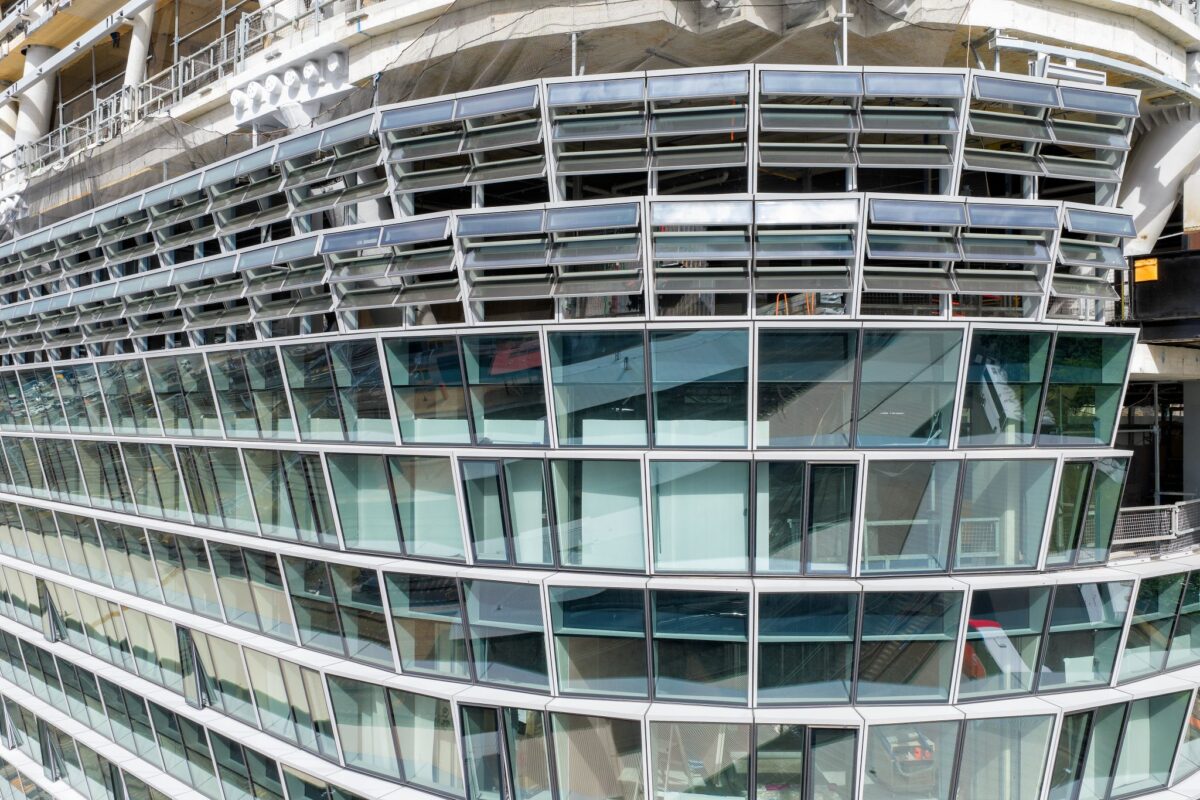





Onyx Solar has partnered with Australian building products supplier Metz to provide a bespoke 247 kWp building integrated PV (BPIV) solution for the Atlassian Central tower currently being built adjacent to Sydney’s Central Station.
The 182-metre-tall Atlassian tower combines a hybrid mass timber structure surrounded by a steel exoskeleton supporting a PV glazed facade featuring 1,794 crystalline silicon solar modules.
“Thanks to Onyx PV facade, the tower turns its skin into a power source,” Onyx said, adding that the solar panels are part of a self-shading system that reduces direct heat gain, enhances energy efficiency, and significantly lowers the building’s carbon footprint.
“Our PV glass, apart from the capacity to be fully adapted to architectural design, can be customised to block the heat that enters the building and to provide the best insulation, thus reducing the use of air conditioning and heating,” the company said.
“It also allows the entry of natural light, which prevents the use of artificial light. Just with these passive measures any building can reduce its energy consumption.”
“The combination of these extraordinary passive properties with the generation of energy in one single building material is what makes our PV glass unique, allowing buildings to generate energy on site without sacrificing comfort and aesthetics.”
Onyx said the BIPV system designed for the Atlassian project features solar panels measuring 2,468 x 351 mm and 2,323 mm x 341 mm. The glass configuration is a 4T+4T mm thickness. Each PV glass piece includes 28 mono-crystalline 6” cells.
Each unit has a peak power of 138 Wp, with the system boasting a total nominal power of 247 kWp.
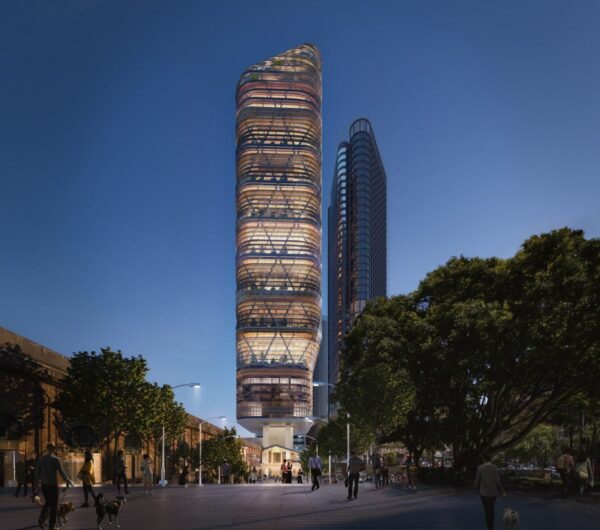
Image: Built Australia
Onyx said its solar glass allows buildings to generate the energy they need, turning them into “vertical generators.”
“Our technology does not sacrifice design: the PV glass can be coloured and semi-transparent, it filters solar radiation, and provides thermal and acoustic insulation,” the company said, adding it can be installed in building facades, skylights, and walkable floors.
“We also offer tailored solutions for existing buildings, including PV glass installations for rooftops.”
The 39-storey Atlassian Central tower is expected to open in 2027. Atlassian has committed to a 100% renewable energy operation on completion.
This content is protected by copyright and may not be reused. If you want to cooperate with us and would like to reuse some of our content, please contact: editors@pv-magazine.com.



1 comment
By submitting this form you agree to pv magazine using your data for the purposes of publishing your comment.
Your personal data will only be disclosed or otherwise transmitted to third parties for the purposes of spam filtering or if this is necessary for technical maintenance of the website. Any other transfer to third parties will not take place unless this is justified on the basis of applicable data protection regulations or if pv magazine is legally obliged to do so.
You may revoke this consent at any time with effect for the future, in which case your personal data will be deleted immediately. Otherwise, your data will be deleted if pv magazine has processed your request or the purpose of data storage is fulfilled.
Further information on data privacy can be found in our Data Protection Policy.