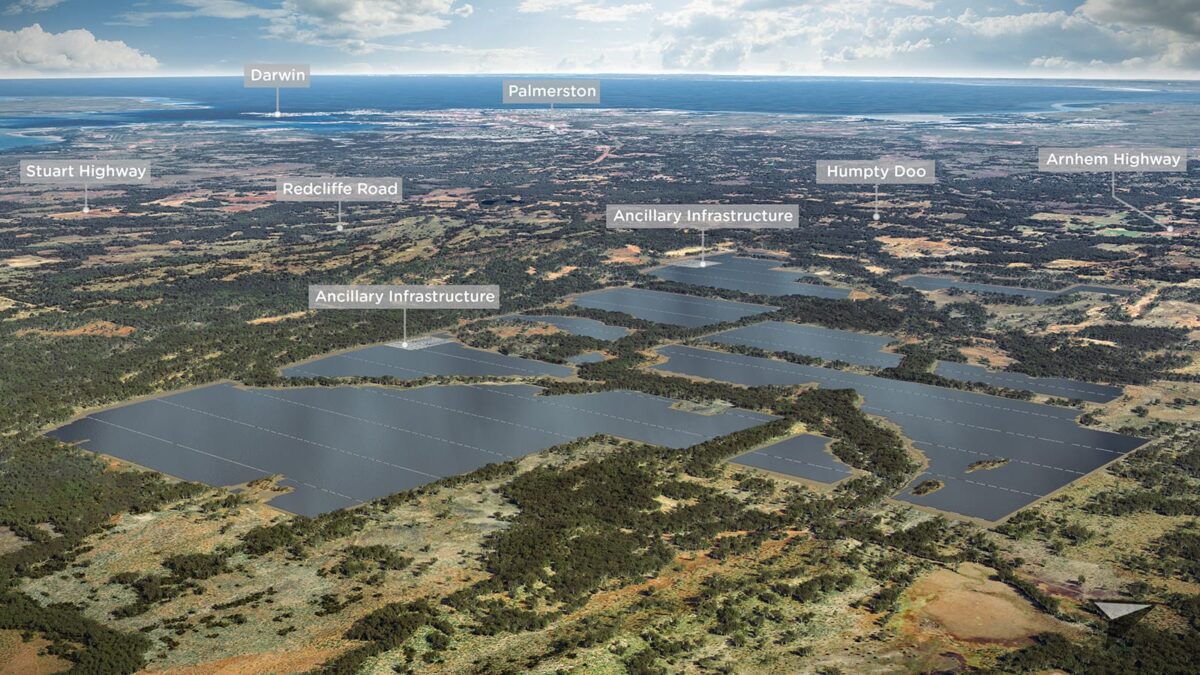





TE H2, a joint venture between French oil giant TotalEnergies and Paris-headquartered renewables producer Eren Groupe, has submitted plans for one of Australia’s largest solar and battery energy storage projects for review under the Environment Protection and Biodiversity Conservation (EPBC) Act.
The federal government-administered EPBC review process aims to protect nationally threatened species and ecological communities.
The $2.8 billion Wak Wak project, proposed for a 3,400-hectare site near Humpty Doo, about 48 kilometres south of Darwin, is to include a 2.7 GW solar farm that would “allow for an optimised, year-round energy supply to the potential electricity off-takers.”
In documents referred for assessment under the federal EPBC Act, TE H2 said the concept design also includes 6 GWh of battery energy storage to “firm up the renewable energy supplied and to balance solar power generation with electricity consumption at downstream facilities, provide local network stability services, and serve as a backup to ensure a secure facility shutdown when needed.”
TE H2 said while “the project is currently at concept design stage,” the objective of the proposal is to generate and store renewable solar energy for both existing industry in the greater Darwin region, and potentially, for the generation of renewable green hydrogen.
“The ultimate end use of the solar energy is as a critical input to produce firm renewables energy supply to existing industrial end users on Middle Arm initially and to power green hydrogen production at the Middle Arm Precinct at a later stage,” TE H2 said.
EPBC referral documents say renewable energy generated at the Wak Wak facility will be sent via a planned high-voltage overhead transmission line to Middle Arm where TE H2 has the Darwin H2 Hub in development, and potentially connect into the Darwin Katherine grid.
TE H2’s proposed Darwin H2 Hub is to include a 1 GW electrolyser capable of producing more than 80,000 tonnes of green hydrogen per annum for national and international markets.
Construction of the Wak Wak solar and battery facility is expected to commence in 2027, pending project approvals, It is likely the solar farm will be developed in stages with the first phase expected to be in the vicinity of up to 900 MW.
TE H2 said power for construction will include a combination of temporary solar and battery storage on site, likely supplemented by diesel generators during the establishment and early works phase.
It is expected the project will generate up to 900 jobs during the construction phase.
This content is protected by copyright and may not be reused. If you want to cooperate with us and would like to reuse some of our content, please contact: editors@pv-magazine.com.




By submitting this form you agree to pv magazine using your data for the purposes of publishing your comment.
Your personal data will only be disclosed or otherwise transmitted to third parties for the purposes of spam filtering or if this is necessary for technical maintenance of the website. Any other transfer to third parties will not take place unless this is justified on the basis of applicable data protection regulations or if pv magazine is legally obliged to do so.
You may revoke this consent at any time with effect for the future, in which case your personal data will be deleted immediately. Otherwise, your data will be deleted if pv magazine has processed your request or the purpose of data storage is fulfilled.
Further information on data privacy can be found in our Data Protection Policy.