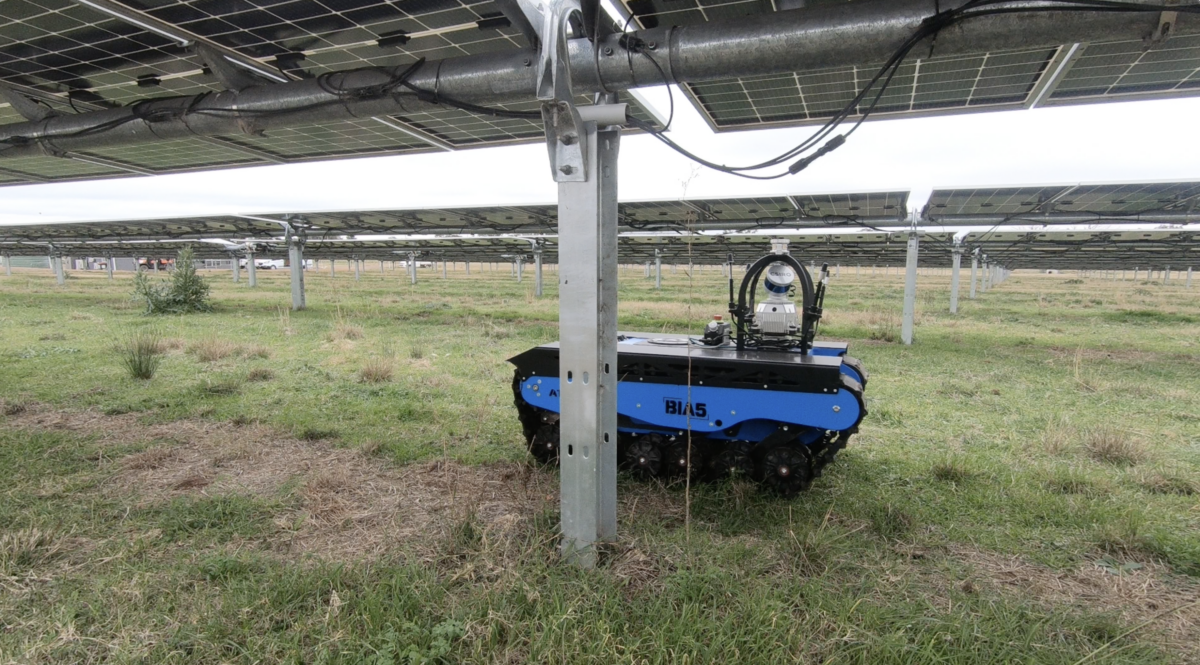





The Commonwealth Scientific and Industrial Research Organisation (CSIRO) has repurposed robots originally designed for the mining industry to undertake maintenance inspections at large-scale solar farms in Australia.
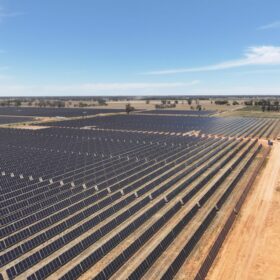
The CSIRO said the autonomous robots, that utilise cameras and sensors to create a digital map of a solar farm and artificial intelligence (AI) software to identify maintenance issues, have been successfully tested at utility-scale projects in Queensland and New South Wales.
Researchers at the science agency said the AI-driven robots are equipped with a suite of sensors including cameras for visual inspections, an infrared camera to detect hotspots and electrical faults, and Light Detection and Ranging (LiDAR) technology for accurate 3D perception and mapping.
They are programmed to autonomously navigate solar farms in all terrains and conditions, to build precise maps to digitise site conditions, avoids hazards and develop a holistic scene understanding.
CSIRO Senior Robotics Engineer Ross Dungavell said the AI-powered robots can automatically detect faults in the project’s PV panels, including dust build-up, insect nests or bird droppings, physical damage, loose nuts or bolts, hotspots in panels or electrical connectors, and wiring that needs repair.
“The robot logs and stores every piece of data it captures, its sensors are able to find any fault a panel might have,” he said.
Dungavell said the integration of robotics and AI technology into the solar farm space for predictive maintenance will lower maintenance costs, improve efficiency and safety, help maintain panel performance, enhance stability of energy output and extends asset lifespan.
The technology also reduces the need for people to undertake inspections on foot, shifting the focus from repetitive manual tasks to the creation of skilled jobs targeting technical work in solar farm maintenance, robotics support and data analysis.
“It’s good to fulfil a need in areas of the country where the labour is not attainable or reliably available,” Dungavell said. “Often you cannot get someone to go out there under such harsh conditions, for extended periods of time.”
CSIRO Senior Principal Research Scientist Peyman Moghadam said the introduction of robotics into solar operations is a game-changer for Australia’s large-scale solar sector.
“We are not just collecting images or 3D data,” he said. “We are building the foundations for intelligent solar operations, where data from robots, fixed sensors and field systems can be combined. This supports better proactive maintenance decisions and more resilient performance over time.”
The CSIRO said it is continuing to trial the robotic and AI systems across pilot sites and is planning to partner with industry to make the technology more broadly available.
This content is protected by copyright and may not be reused. If you want to cooperate with us and would like to reuse some of our content, please contact: editors@pv-magazine.com.



By submitting this form you agree to pv magazine using your data for the purposes of publishing your comment.
Your personal data will only be disclosed or otherwise transmitted to third parties for the purposes of spam filtering or if this is necessary for technical maintenance of the website. Any other transfer to third parties will not take place unless this is justified on the basis of applicable data protection regulations or if pv magazine is legally obliged to do so.
You may revoke this consent at any time with effect for the future, in which case your personal data will be deleted immediately. Otherwise, your data will be deleted if pv magazine has processed your request or the purpose of data storage is fulfilled.
Further information on data privacy can be found in our Data Protection Policy.