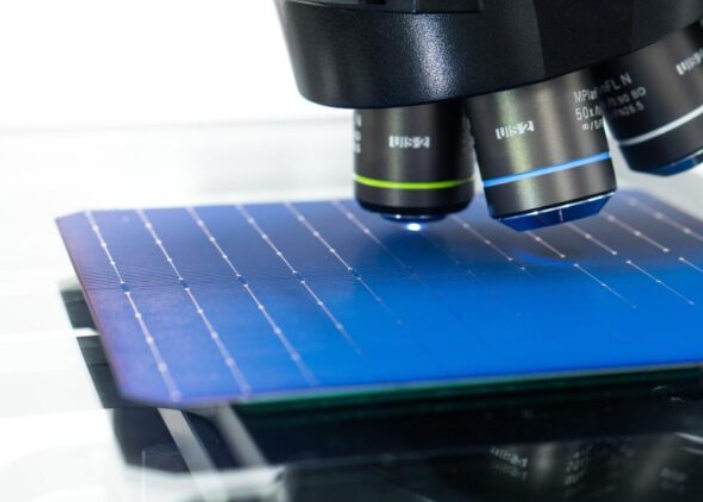





University researchers from Australia, the Netherlands, France, Canada, and the USA have issued a paper in Progress in Photovoltaics journal stating fundamental photovoltaics research is essential to ensure energy security.
Arguing that despite the commercial maturity of solar technology, continued innovation can guarantee future energy resilience and independence.
Included in the team are two researchers from the University of New South Wales (UNSW) School of Photovoltaic and Renewable Energy Engineering, Michael P. Nielsen and Executive Research Director of the ARC Photovoltaics Centre of Excellence Professor Gavin Conibeer.
The paper, The Need for Fundamental Photovoltaics Research to Ensure Energy Security outlines a future-oriented agenda for solar research, addressing challenges in materials, device architectures, characterisation, and system integration.
“Drawing on discussions from the 53rd IEEE Photovoltaic Specialists Conference (PVSC) in Montreal, we critically examine the narrative that PV is a “solved” problem,” the researchers say.
“We argue that deep scientific exploration is not only vital for unlocking next-generation technologies but also for training the skilled workforce required to maintain technological leadership and to support the reliable functioning of national energy infrastructure.”
The paper concludes with targeted recommendations for funding agencies and policymakers on how to structure research support to maximise long-term impact.
These include adopting a long-term, strategic view that recognises the critical role of foundational inquiry, and that sustained support for fundamental photovoltaics research “is a strategic necessity rather than an optional expense.”
The researchers also concluded that “funding agencies and investors should ensure rigorous vetting of project proposals by involving reviewers who understand thermodynamics and basic energy systems, preferably solar-trained scientists.”
“This avoids misdirected investments and promotes scientifically sound innovation,” they said.
University researchers collaborating on the paper are from the University of Twente MESA+ Institute, the Netherlands and the Institut Photovoltaïque d’Île-de-France (IPVF), Ecole Polytechnique – IP Paris, France.
From Canada they are from the Department of Electrical & Computer Engineering, Western University, London, Ontario, the SUNLAB, Nexus for Quantum Technologies Institute University of Ottawa, Ottawa, and the Electrical and Computer Engineering Department, University of Victoria.
Two United States universities are represented, being Stanford University, California, USA, and the University of Wisconsin-Madison.
This content is protected by copyright and may not be reused. If you want to cooperate with us and would like to reuse some of our content, please contact: editors@pv-magazine.com.




By submitting this form you agree to pv magazine using your data for the purposes of publishing your comment.
Your personal data will only be disclosed or otherwise transmitted to third parties for the purposes of spam filtering or if this is necessary for technical maintenance of the website. Any other transfer to third parties will not take place unless this is justified on the basis of applicable data protection regulations or if pv magazine is legally obliged to do so.
You may revoke this consent at any time with effect for the future, in which case your personal data will be deleted immediately. Otherwise, your data will be deleted if pv magazine has processed your request or the purpose of data storage is fulfilled.
Further information on data privacy can be found in our Data Protection Policy.