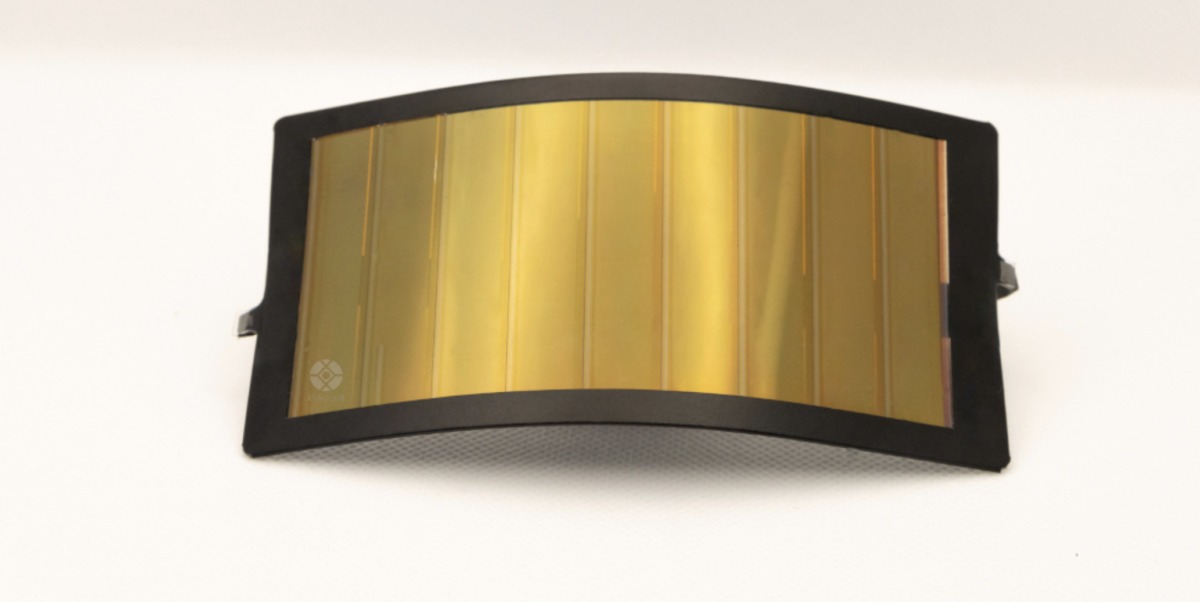





Solar cell developer Halocell Energy and United States-based startup Sofab Inks have found perovskite devices incorporating Sofab’s novel metal oxide nanoparticle inks demonstrate high levels of durability.
Wagga Wagga-headquartered Halocell and Sofab announced a strategic partnership in mid 2025 to accelerate innovation in perovskite PV technology, coinciding with the launch of Halocell’s Ambient Module series. The partnership sees Sofab supply Halocell with its nanoparticle inks, with Halocell also continuing to formulate and manufacture its own, proprietary perovskite inks.
Jack Manzella, Chief Operating Officer and co-founder of Sofab Inks, told pv magazine that since the partnership began, the University of Louisville spinoff has worked alongside the Halocell technical team to qualify and validate its material in Halocell’s devices.
Modules incorporating Sofab Inks’ Tinfab electron transport layer have demonstrated approximately 100% normalised efficiency after 1,300 hours under accelerated combined light and damp-heat testing of 1,000 lux illumination, 85% relative humidity and 65 C. Control devices using commercially available charge transport layers dropped by around 20% normalized efficiency under the same testing conditions.
“Stability remains a critical barrier to the commercialization of perovskite solar cells, so this represents a meaningful step forward,” Manzella said. “Halocell is one of the few perovskite companies actively selling modules today and the added stability benefits of our materials strengthen their commercial offering.”
Manzella said Sofab’s nanoparticle inks are designed to replace fullerene-based materials such as C60 as the electron transport layer, particularly in PIN architectures and tandem applications.
“They perform the same function but offer improved thermal and environmental stability, are compatible with scalable manufacturing techniques like slot die coating, and are based on lower-cost, abundant materials, making them better suited for commercial-scale manufacturing,” he said.
Halocell has now begun to ship modules using Sofab’s Tinfab electron transport layer to partners for evaluation, with current focus on uses in IoT devices, wireless sensors and small indoor electronics.
“Halocell plans to expand its offerings into terrestrial and drone applications and we are excited to grow alongside them,” Manzella said. “Looking ahead, we are focused on joint development efforts aimed at scaling to larger area modules and production volumes.”
In January, Halocell signed a memorandum of understanding with Queensland advanced materials company Lava Blue to collaborate on scalable, Australian-made specialty chemicals used in printing perovskite solar modules.
Last October, Sofab announced its tin oxide electron transport layer material was used in a 22.2%-efficient mini perovskite solar module measuring 30 x 30 cm.
This content is protected by copyright and may not be reused. If you want to cooperate with us and would like to reuse some of our content, please contact: editors@pv-magazine.com.




By submitting this form you agree to pv magazine using your data for the purposes of publishing your comment.
Your personal data will only be disclosed or otherwise transmitted to third parties for the purposes of spam filtering or if this is necessary for technical maintenance of the website. Any other transfer to third parties will not take place unless this is justified on the basis of applicable data protection regulations or if pv magazine is legally obliged to do so.
You may revoke this consent at any time with effect for the future, in which case your personal data will be deleted immediately. Otherwise, your data will be deleted if pv magazine has processed your request or the purpose of data storage is fulfilled.
Further information on data privacy can be found in our Data Protection Policy.