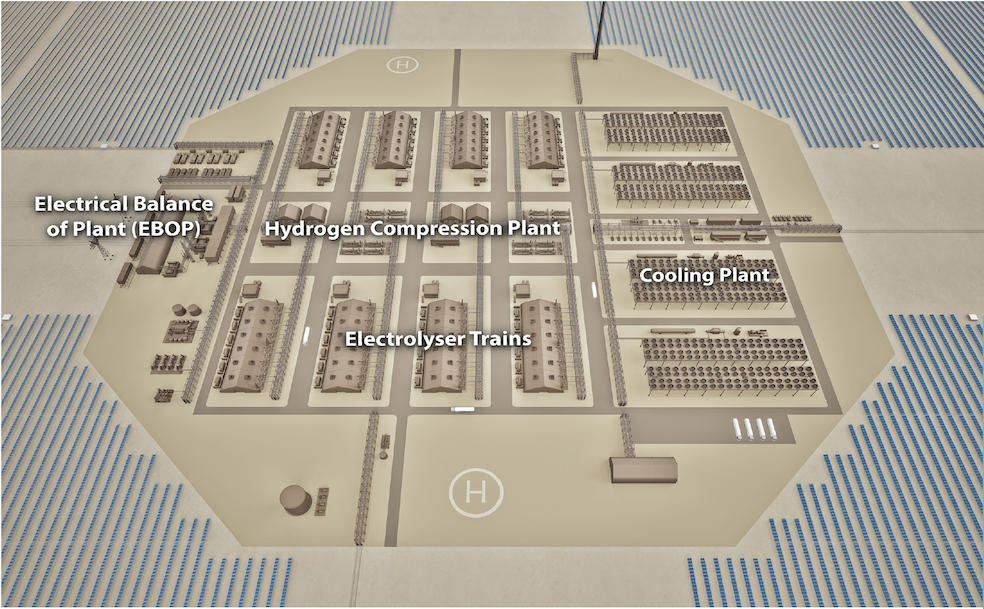





InterContinental Energy (ICE) announced it has secured up to $1.6 million (USD 1.14 million) in federal government funding to develop a digital twin for its P2(H2)Node (power to hydrogen node) that is designed to provide standardised architecture for large-scale green hydrogen production projects.
The Perth-based company said it has also signed the first licence for the modular system architecture, which will see the node deployed on an as-yet unidentified “large-scale renewable hydrogen project.”
While ICE did not identify the licence holder, the company’s head of engineering and innovation, Richard Colwell, said the agreement will provide an early reference case for the P2(H2)Node, paving the way for further agreements with developers globally.
“This first licence is a significant milestone, moving the node from concept to deployment,” he said. “We expect it to serve as a model for future licences, enabling developers to use a proven, optimised design rather than starting from scratch.”
The patented P2(H2)Node system is engineered to directly integrate giga-scale hydrogen production with large-scale solar and wind farms, eliminating long-distance transmission, cutting costs and boosting efficiency.
ICE has estimated that the modular architecture will cut capital expenditure by up to 10% and boost operational efficiency by as much as 10% compared to conventional hydrogen production models.
The company is now working to develop a standardised digital twin and licensable engineering design for the node after securing up to $1.6 million in funding from the Australian Renewable Energy Agency (ARENA) under its Advancing Renewables Program.
ICE said ARENA’s support will help create a Digital Twin Optimisation Framework that developers can use to plan large-scale green fuel hubs.
Colwell said standardising and simulating the nodal architecture across varying technology and site parameters, the framework will help developers plan renewable hydrogen projects with greater certainty on cost, performance and delivery timelines.
“We are advancing digital and engineering design work that gives developers and investors more certainty on cost, performance and timing, at a time when fuel security and AI power needs are front of mind,” he said.
The P2(H2)Node architecture, now patented in more than 50 countries, is set to serve as the mainstay of the proposed 70 GW Western Green Energy Hub (WGEH), being developed in southwest Western Australia by ICE in collaboration with CWP Global and Mirning Green Energy.
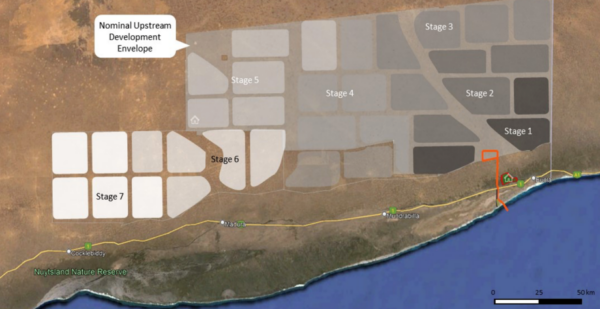
Image: Western Green Energy Hub Pty Ltd
Spanning 15,000 square kilometres, the WGEH would include up to 70 GW of solar and wind generation developed in stages to power electrolysers to produce up to 3.5 million tonnes of green hydrogen annually for both domestic consumption and export, positioning it among the largest green hydrogen projects in the world.
ICE recently announced that it has secured enough green ammonia offtake interest from Japanese and Korean customers to support an initial stage that would deliver a minimum 1.4 million tonnes per year online in 2033, which would be followed by subsequent phases until the full planned capacity is reached by 2050.
The developers have also signed a feasibility phase agreement with Chinese heavy equipment manufacturer Sany International Development and South Korean entities to advance Stage 1 development of the project. The agreement enables full feasibility and pre-FEED studies for Stage 1, which targets approximately 6 GW of solar and wind capacity producing up to 330,000 tonnes per year of green hydrogen.
ICE is also developing the Australian Renewable Energy Hub (AREH), a 26 GW solar, wind, and green hydrogen project planned for Western Australia’s Pilbara region. At full scale, AREH could produce up to 1.6 million tonnes of green hydrogen.
This content is protected by copyright and may not be reused. If you want to cooperate with us and would like to reuse some of our content, please contact: editors@pv-magazine.com.



By submitting this form you agree to pv magazine using your data for the purposes of publishing your comment.
Your personal data will only be disclosed or otherwise transmitted to third parties for the purposes of spam filtering or if this is necessary for technical maintenance of the website. Any other transfer to third parties will not take place unless this is justified on the basis of applicable data protection regulations or if pv magazine is legally obliged to do so.
You may revoke this consent at any time with effect for the future, in which case your personal data will be deleted immediately. Otherwise, your data will be deleted if pv magazine has processed your request or the purpose of data storage is fulfilled.
Further information on data privacy can be found in our Data Protection Policy.