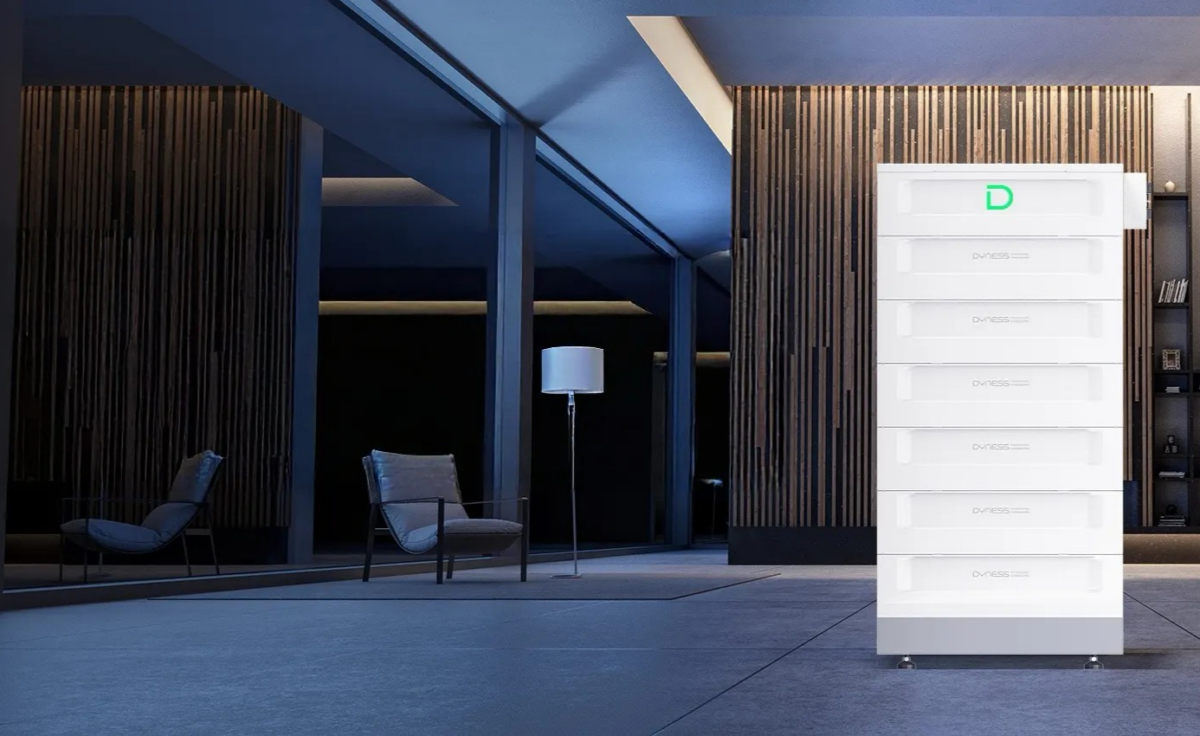





Dyness has announced its latest high-voltage residential and small commercial and industrial (C&I) battery energy storage solution, the Stack100 Pro, is now officially listed by the Clean Energy Council (CEC), ensuring it is eligible for all government grant and subsidy programs.
“With CEC approval, the Stack100 Pro is fully compliant for immediate deployment, providing installers and project partners with the assurance of meeting all local regulatory standards,” the company said.
The Stack100 Pro is built on 5.12 kWh battery units that installers can configure from 15.36 kWh up to 76.8 kWh with the modular and rackless system supporting up to 12 clusters in parallel, providing a maximum capacity of 921 kWh.
The IP66-rated system is based on lithium iron phosphate (LFP) chemistry and can operate across temperatures ranging from –20 C to 50 C. It has a nominal voltage of 51.2 V, with an operating range of 134 V to 864 V. Cycle life is listed at more than 8,000 cycles at 95% depth of discharge. Each battery module measures 657 mm x 460 mm x 193 mm and weighs 23.5 kg.
Dyness said the Stack100 Pro offers “extensive compatibility” with leading inverter brands in the Australian market, “ensuring a seamless integration experience for installers.”
The system’s plug-and-play, stackable design also aids rapid deployment, with Dyness estimating the architecture can reduce installation time to as little as 30 minutes for a single cluster unit.
Dyness Australia Sales, Marketing and Service General Manager Aaron Lee said the battery system has been specifically designed for the evolving needs of the Australian and New Zealand markets and serves as a versatile, all-in-one storage solution.
“The addition of the Stack100 Pro to our Australian portfolio is a significant milestone following strong interest from our local installer network,” he said, adding that it has been engineered to support a wide range of applications within a single unified system.
The company said applications including solar self-consumption and backup power, energy trading and grid-support services while the 1C charge and discharge capability makes it ideal for dynamic scenarios like peak shaving.
“The scalable architecture allows homeowners to expand capacity as their energy requirements evolve, while for commercial applications, the system delivers the flexibility required for complex energy strategies,” Dyness said.
This content is protected by copyright and may not be reused. If you want to cooperate with us and would like to reuse some of our content, please contact: editors@pv-magazine.com.


By submitting this form you agree to pv magazine using your data for the purposes of publishing your comment.
Your personal data will only be disclosed or otherwise transmitted to third parties for the purposes of spam filtering or if this is necessary for technical maintenance of the website. Any other transfer to third parties will not take place unless this is justified on the basis of applicable data protection regulations or if pv magazine is legally obliged to do so.
You may revoke this consent at any time with effect for the future, in which case your personal data will be deleted immediately. Otherwise, your data will be deleted if pv magazine has processed your request or the purpose of data storage is fulfilled.
Further information on data privacy can be found in our Data Protection Policy.