Transgrid to award 1 GW grid-forming battery contracts by 2026


Sydney-headquartered network owner and operator Transgrid is to offer contracts to grid-forming battery energy storage systems (BESS) configured in grid-forming mode, with initial request proposals from select battery owners for services expected to begin in the second half of 2026.
The initial tenders will seek proposals from BESS providing approximately 1 GW of stabilising services, with a long term goal of sourcing 5 GW of services, or the approximate equivalent strength of about 17 synchronous condensors.
Transgrid Executive General Manager of Network Jason Krstanoski said the company has received interest from the owners of more than 7.5 GW of batteries when it first developed a plan to maintain New South Wales’ system strength.
“We are finalising the technical analysis that will determine the battery capacity needed for our initial process, and we look forward to engaging further with battery owners in the coming months,” Krstanoski said.
“This will be followed by periodic tenders in 2026 and beyond, so that we can progressively add additional stabilising battery capacity to our system strength portfolio, eventually reaching the 5 GW of grid-forming batteries we put forward in our system strength plan.”
“At that threshold, grid-forming batteries owned by third parties will provide equivalent system strength support of 17 synchronous condensers, in terms of stabilising capacity for new renewable generator connections,” Krstanoski said.
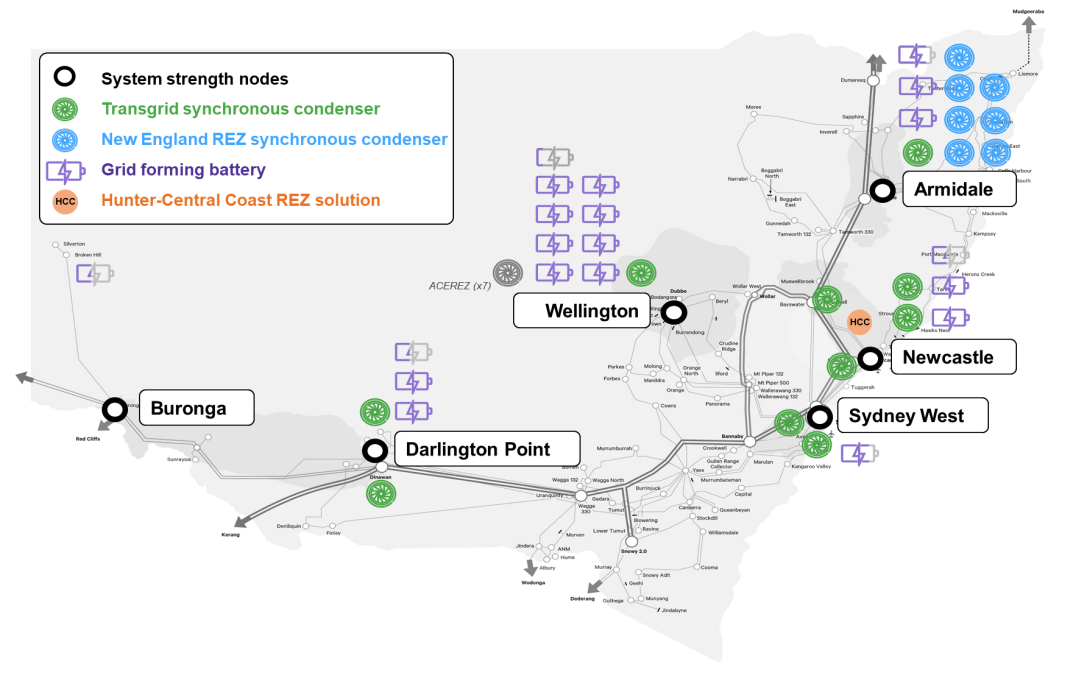
Image: Transgrid
The grid-forming batteries will make up about half of NSW’s portfolio of system strength solutions at a cost of about $8.8 billion (USD 5.8 billion).
Transgrid will register executed contracts with the Australian Energy Market Operator (AEMO) to enable the energy market dispatch process, and ensure stabilising measures are in place when they are needed in 2026.
Krstanoski said calling on grid-scale batteries to act as stabilisers means Transgrid can accelerate strengthening the renewable grid without increasing its footprint.
“That’s good news for consumers, because we do not need to purchase, own, install or significantly upgrade the network to operate these energy storage devices,” Krstanoski said.
“Giant batteries will complement the proven grid-strengthening role played by synchronous condensers to enable the NSW power system to operate at up to 100% instantaneous renewables.”
This content is protected by copyright and may not be reused. If you want to cooperate with us and would like to reuse some of our content, please contact: [email protected].

Please login to comment
[…] “Our initial procurement process is focused on batteries that already exist, or are in the advanced stages of development, in specific locations on our network to address gaps in system strength as they emerge,” he said. […]