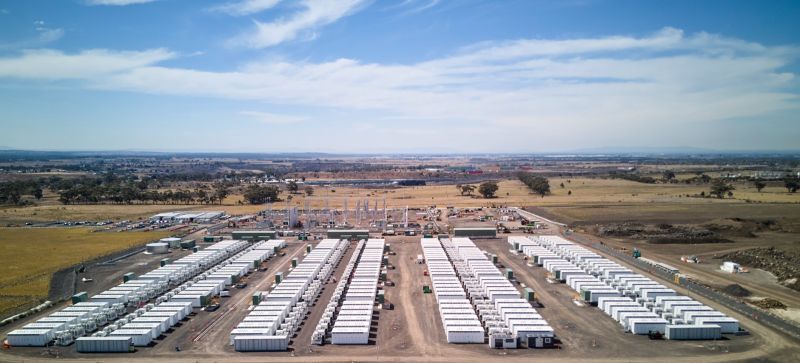





The 600 MW / 1.6 GWh Melbourne Renewable Energy Hub (MREH), co-owned by Singapore-headquartered clean energy investor Equis and the Victoria government-owned State Electricity Commission (SEC), has completed commissioning and has commenced operations.
Equis said the $1.1 billion (USD 730 million) battery had been delivered on time and on budget and features 444 Tesla Megapacks battery units, three Toshiba 500 kV transformers, and a “world-first” underground 500 kV cable that connects to the National Electricity Market’s (NEM) high-voltage transmission system.
“Melbourne Renewable Energy Hub is our first project to go live in Australia and the Equis team have delivered a world-leading project on schedule and on budget,” Equis Managing Director David Russell said.
“It has been impressive to watch the project take shape from Notice to Proceed in December 2023. [This] shows that when industry and government work together, we can deliver complex, large-scale infrastructure that strengthens the grid, creates jobs, and helps reduce power prices for consumers.”
The biggest battery project yet completed on Australia’s main grid, the MREH comprises three individual battery energy storage systems located at the same site – all with capacity of 200 MW, with two having two hours of storage and one with four hours.
With a combined 1.6 GWh of storage, the battery is capable of supplying electricity to up to 200,000 homes during Victoria’s evening peak demand period.
Located near Hillside about 28 kilometres northwest of Melbourne’s central business district, the MREH is positioned at the confluence of several of Victoria’s major electricity transmission routes, allowing it to support Melbourne’s metropolitan load as well as three of Victoria’s planned renewable energy zones.
SEC Chief Executive Officer Chris Miller said the project marks a significant advancement in the state’s battery energy storage capabilities.
“We know storage is critical for Victoria’s energy transition, and this project adds significant storage capability to the grid,” he said. “The Hub will soak up excess wind and solar power during the daytime and shift that energy to the evening peaks when we need it most.”
Miller said the MREH will also help unlock capacity for more renewable energy with the state government estimating the battery will enable an additional 1.8 GW of new generation to connect to the grid.
The battery, which was initially developed by Australia’s Syncline Energy and previously known as the Melton Renewable Energy Hub, was the first investment from the SEC’s initial $1 billion towards building 4.5 GW of new renewable energy generation and storage projects.
The MREH will also help deliver on the Victorian government’s target of installing at least 2.6 GW of energy storage capacity by 2030 and 6.3 GW by 2035.
This content is protected by copyright and may not be reused. If you want to cooperate with us and would like to reuse some of our content, please contact: editors@pv-magazine.com.




By submitting this form you agree to pv magazine using your data for the purposes of publishing your comment.
Your personal data will only be disclosed or otherwise transmitted to third parties for the purposes of spam filtering or if this is necessary for technical maintenance of the website. Any other transfer to third parties will not take place unless this is justified on the basis of applicable data protection regulations or if pv magazine is legally obliged to do so.
You may revoke this consent at any time with effect for the future, in which case your personal data will be deleted immediately. Otherwise, your data will be deleted if pv magazine has processed your request or the purpose of data storage is fulfilled.
Further information on data privacy can be found in our Data Protection Policy.