





Melbourne-headquartered network diagnostic technology business IND Technology, which provides infrastructure monitoring tech for electricity network operators to prevent power outages and bushfires caused by failing power grids, has raised $50 million (USD 33.18 million) in new growth funding.
Founded by RMIT Professor Alan Wong following the deadly Black Saturday bushfires that devastated parts of Victoria in 2009, IND has developed an Early Fault Detection (EFD) system that helps utilities detect the precursors to electric failures in energy grids. The system utilises internet-of-things sensors and machine learning to detect early signs of equipment failure in energy networks before they escalate into outages, incidents or fires.
IND’s system utilises sensors mounted on power poles up to five kilometres apart to capture radio-frequency signals emitted by stressed or failing components. These signals are analysed in real time, allowing operators to pinpoint anomalies to within 10 metres and intervene before failures occur.
The company said the approach enables utilities to move from periodic inspections to continuous, prevention-focused monitoring.
“For almost a decade, we’ve worked side-by-side with Australian utilities to prove that the EFD system can improve grid resiliency and reduce the risk of bushfires, with eight local pilots showing how valuable this technology can be when it’s deployed at scale,” Wang said.
“What matters most to us is making sure this technology reaches the places where it can make the greatest difference.”
IND said the new funding will accelerate the deployment of its EFD system in Australia and internationally as well as expand its machine-learning engineering team.
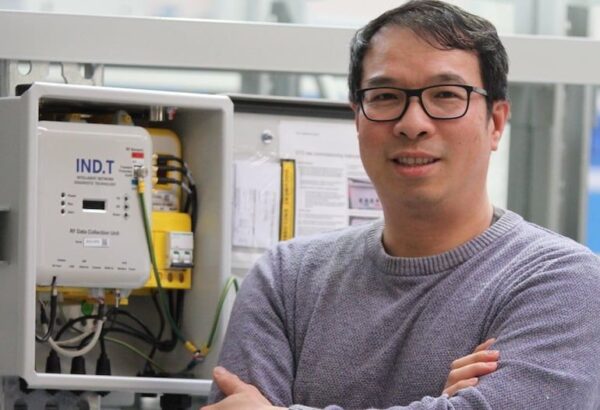
Image: Viriscent Ventures
“This investment gives us the ability to ramp up delivery, field support and installations at real scale, alongside the utilities and network operators we work with every day, and we’re excited to have our new partners on board for this next chapter,” the company said.
IND said it has already old about 15,000 EFD units to power infrastructure asset owners in six countries with major utilities in Australia and North America among its customers.
The raise was co-led by United States-based energy specialists Angeleno Group and Energy Impact Partners. Strategic investors Edison International, one of the world’s largest electric utility holding companies, and Australia-based climate investor Virescent Ventures also participated.
Virescent Managing Partner Kristin Vaughan said IND’s technology has enormous potential with grid reliability and resilience are among the most critical challenges and opportunities for the energy transition.
“IND Technology has already secured global traction and deep adoption with their proven, homegrown solution preventing fires and improving reliability across major networks in Australia and North America, but the potential is vast,” she said.
“This is exactly the kind of innovation needed to underpin the electrification of the global economy. It is smart, proactive, data-driven technology that delivers immediate benefits for communities, utilities, network operators and the broader economy.”
This content is protected by copyright and may not be reused. If you want to cooperate with us and would like to reuse some of our content, please contact: editors@pv-magazine.com.





1 comment
By submitting this form you agree to pv magazine using your data for the purposes of publishing your comment.
Your personal data will only be disclosed or otherwise transmitted to third parties for the purposes of spam filtering or if this is necessary for technical maintenance of the website. Any other transfer to third parties will not take place unless this is justified on the basis of applicable data protection regulations or if pv magazine is legally obliged to do so.
You may revoke this consent at any time with effect for the future, in which case your personal data will be deleted immediately. Otherwise, your data will be deleted if pv magazine has processed your request or the purpose of data storage is fulfilled.
Further information on data privacy can be found in our Data Protection Policy.