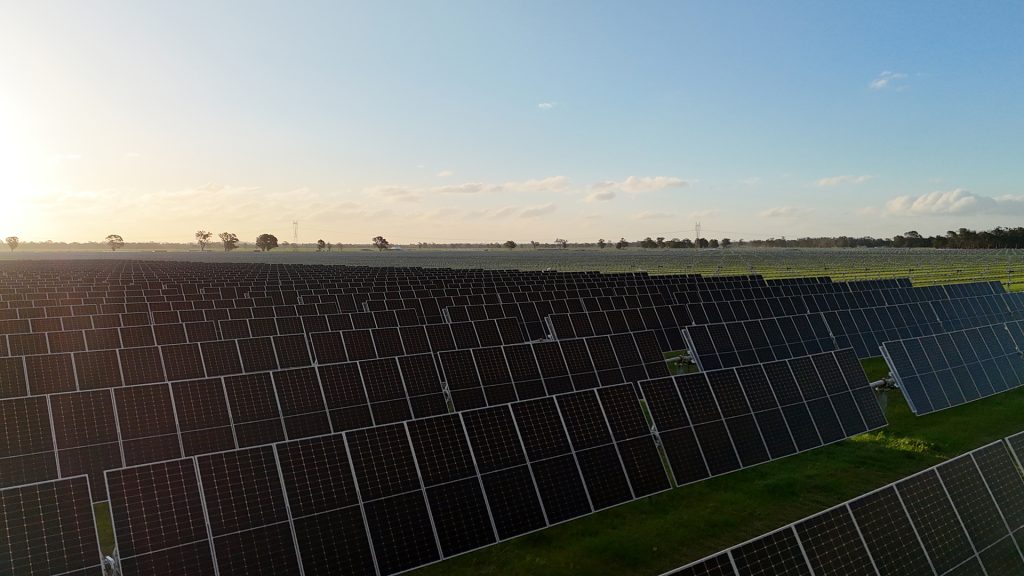





New data from the Australian Energy Market Operator (AEMO) shows two solar farms and seven battery energy storage projects totalling 1.8 GW of capacity reached full output in the National Electricity Market (NEM) in the December 2025 quarter.
AEMO’s latest Connections Scorecard shows the pipeline of new generation and energy storage projects going through the connection process in the NEM reached a record 64 GW in the last quarter, up 7.4 GW or 14%, on the previous quarter.
During the December quarter, 26 GW of new connection applications were submitted and 3.8 GW of applications across 18 projects were approved. In addition, 1.9 GW of plant across 10 solar, solar and battery hybrid, hydro, and standalone battery projects was registered and connected to the NEM, enabling them to move into the final stages of commissioning and operational readiness.
AEMO Onboarding and Connections Group Manager Margarida Pimentel said the standout result in the December 2025 quarter was the nine projects that achieved full output.
The 1.8 GW of new capacity commissioned to full output in the quarter takes the cumulative project capacity commissioned in the 2026 financial year to date (FYTD) to 3.8 GW, 89% more than the same time last year.
“These results highlight both the maturity of the pipeline and the sector’s increasing capability to deliver,” Pimentel said.
“Reaching 1.8 GW of new plant at full output this quarter is a significant achievement and underlines the collaborative effort between project proponents, network service providers and AEMO in progressing new infrastructure safely and efficiently.”
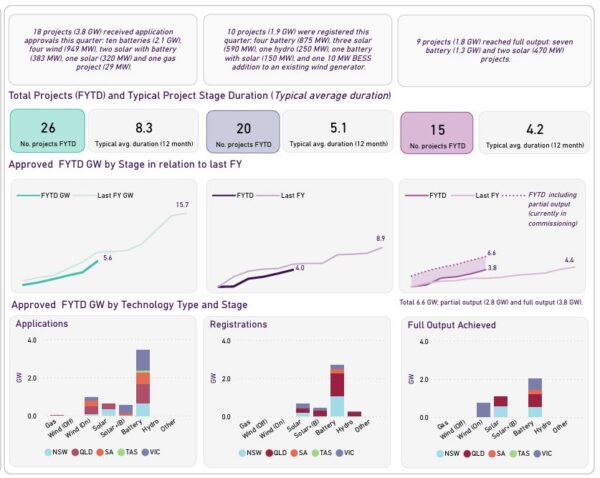
The nine projects to reach full output in the last quarter included Neoen’s 350 MW Culcairn Solar Farm in New South Wales (NSW) and Metlen Energy and Metals’ 120 MW Munna Creek Solar Farm in Queensland.
Seven battery energy storage projects also progressed through commissioning to reach full output during the quarter. These included the 600 MW Melbourne Renewable Energy Hub in Victoria, the 300 MW Tarong and 205 MW Brendale projects in Queensland, the 111 MW Templers battery in South Australia, and the 65 MW Smithfield battery project in NSW.
The Scorecard shows that battery storage continues to dominate the investment pipeline, accounting for 46% of all projects progressing through the connection process in the NEM.
Hybrid solar and battery projects account for 19.7% of projects in the pipeline, with wind (16%), solar (11.9%), hydro (4.7%) and gas (1.4%) making up the remainder.
“The growth in battery storage will complement renewable generation by storing low‑cost, low‑emissions electricity during the day for release to support demand during the evening peak,” Pimentel said, adding that the December quarter demonstrated strong progress across every stage of the connections process.
“The ongoing increase to 64 GW in the connections pipeline shows that confidence in Australia’s renewable energy transition remains strong,” she said.
This content is protected by copyright and may not be reused. If you want to cooperate with us and would like to reuse some of our content, please contact: editors@pv-magazine.com.




By submitting this form you agree to pv magazine using your data for the purposes of publishing your comment.
Your personal data will only be disclosed or otherwise transmitted to third parties for the purposes of spam filtering or if this is necessary for technical maintenance of the website. Any other transfer to third parties will not take place unless this is justified on the basis of applicable data protection regulations or if pv magazine is legally obliged to do so.
You may revoke this consent at any time with effect for the future, in which case your personal data will be deleted immediately. Otherwise, your data will be deleted if pv magazine has processed your request or the purpose of data storage is fulfilled.
Further information on data privacy can be found in our Data Protection Policy.