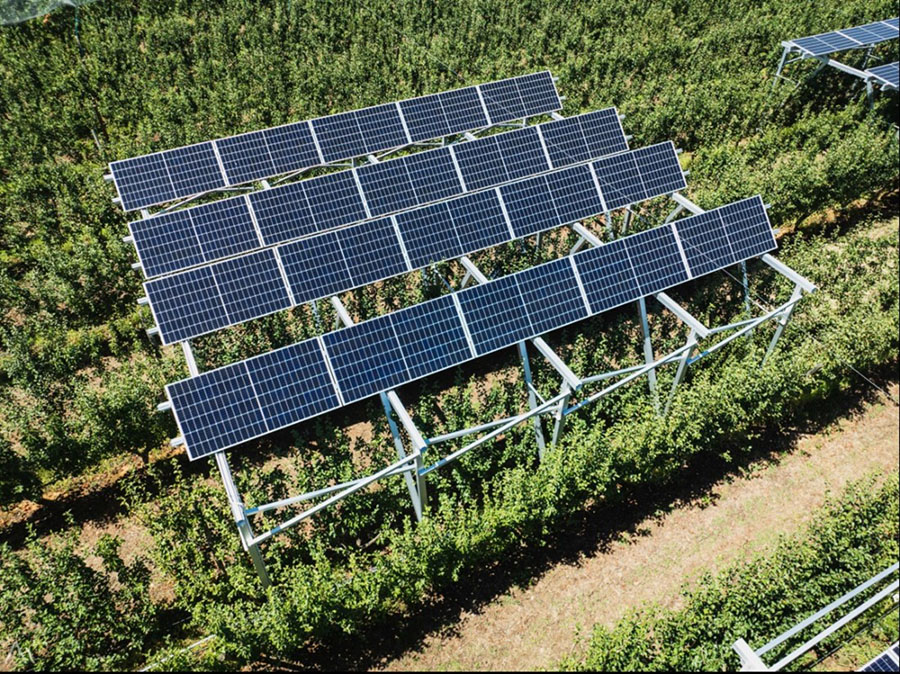





A research group at Agriculture Victoria Research has conducted a four-year analysis of the long-term impacts of agrivoltaics on the productivity and fruit quality of the Australian blush pear and has found that the solar panels mitigated sun and hail damage but also altered productivity.
“Our findings are very likely applicable to other fruit crops but more research needs to be carried out,” the research’s corresponding author, Alessio Scalisi, told pv magazine. “Other crops like apple and cherry might benefit more from overhead solar panels.”
The researchers conducted their tests at a pear orchard in Victoria’s Goulburn Valley, fitted with stainless-steel structures supporting above-canopy solar panels. Three treatments were tested, each with three replicates: Control, with no panels; 45°W with solar panels tilted 45° west; and 5°W with panels tilted 5° west. Each plot covered three adjacent tree rows over 10 m (105.5 m²), with an inner measurement area of 22.5 m². The central row provided measurement trees, and the two flanking rows served as buffers, with measurements being taken from the 5 central trees.
The two 52 kW solar facilities utilise 435 W solar module from Chinese manufacturer Longi and inverters from China-based Sungrow. A fraction of the systems’ energy powers the irrigation pump, with the excess fed back into the grid. The elevated fixed panels spanned multiple tree rows, creating differing shade levels above the canopy. Each treatment was replicated to compare effects on microclimate, energy production, and tree performance.
The analysis showed that, between 2021 and 2025, the three plots experienced clear seasonal trends in solar radiation and air temperature, with peak values during the summer months, while rainfall, relative humidity, and vapor pressure deficit varied more across seasons. The 2022–23 and 2023–24 seasons were influenced by La Niña, resulting in milder summers with increased cloud cover, rainfall, and humidity, whereas 2021–22 and 2024–25 were the driest and warmest seasons.
Furthermore, the measurements showed that the orientation of the PV panels had a notable effect on radiation interception. The 5°W arrays captured light more uniformly throughout the day, while the 45°W arrays intercepted considerably more light in the afternoon. Consequently, the 5°W arrays generated approximately 10% more energy than the 45°W arrays, with peak production occurring in December, mirroring expected seasonal patterns for the southern hemisphere.
The scientists also found that shading from the panels impacted tree productivity. Both the number of fruits and total yield per tree were reduced under shading, with the 5°W system causing the greatest reductions. Over four years, control trees achieved the highest cumulative yield of 137 t ha⁻¹, compared to 77–89 t ha⁻¹ for shaded treatments. Fruit quality was also affected: the red blush coverage declined under shading, green background increased, and soluble solids content decreased, though flesh firmness remained unaffected.
Shading was however also found to significantly reduce sunburn and hail damage, protecting fruit during high-stress conditions, with instrumental colour analysis confirming that shaded fruit was lighter and less red.
Shaded trees also exhibited enhanced trunk growth early in the season, likely due to higher water availability, while control trees grew more slowly during peak growth periods. Leaf water status, stomatal conductance, and transpiration were similar across treatments, but shaded trees maintained lower leaf temperatures and higher photosystem efficiency throughout the day.
Overall, agrivoltaic shading improved energy production and reduced stress-related damage, but these benefits came at the cost of fruit yield and coloration, highlighting the trade-offs of integrating photovoltaic arrays in orchards.
“Long-term economic analyses will be essential to determine the viability of agrivoltaics for fruit growers worldwide,” the academics said.
Their research work was introducted in “Long-term effects of agrivoltaics on yield and fruit quality performance of bi-color (blush) pears,” published in Scientia Horticulturae.
“In future research we should be pointing on tracker-based agrivoltaics, in addition to semi-transparent technology,” Scalisi said.
This content is protected by copyright and may not be reused. If you want to cooperate with us and would like to reuse some of our content, please contact: editors@pv-magazine.com.


By submitting this form you agree to pv magazine using your data for the purposes of publishing your comment.
Your personal data will only be disclosed or otherwise transmitted to third parties for the purposes of spam filtering or if this is necessary for technical maintenance of the website. Any other transfer to third parties will not take place unless this is justified on the basis of applicable data protection regulations or if pv magazine is legally obliged to do so.
You may revoke this consent at any time with effect for the future, in which case your personal data will be deleted immediately. Otherwise, your data will be deleted if pv magazine has processed your request or the purpose of data storage is fulfilled.
Further information on data privacy can be found in our Data Protection Policy.