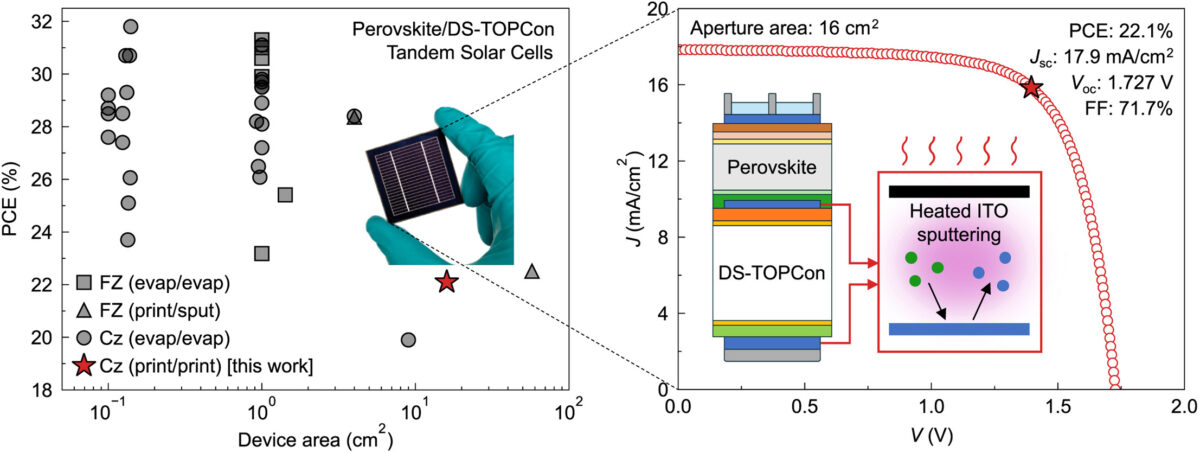





Researchers from the Solar Energy Research Institute of Singapore (SERIS) in Singapore have fabricated a perovskite-silicon tandem solar cell based on a bottom TOPCon device relying on double-sided (DS) thin polysilicon (poly-Si) layers.
In standard single-sided TOPCon (SS-TOPCon) solar cells, charge-carrier selectivity is achieved using a heavily boron-doped front surface layer and a rear stack made of a thin silicon oxide (SiOx) layer plus phosphorus-doped polysilicon (poly-Si). In double-sided TOPCon (DS-TOPCon), the front boron-doped emitter is replaced with a silicon oxide (SiOx) layer combined with boron-doped polysilicon (poly-Si).
Compared to SS-TOPCon, DS-TOPCon reduces recombination losses. This lower recombination enables higher open-circuit voltage and can improve overall efficiency. Carrier-selective contacts on both sides also enhance charge extraction, potentially increasing the fill factor. Its symmetric and fully passivated structure has potential to improve cell mechanical stability and makes it especially suitable for tandem and high-efficiency cell concepts.
Despite these advantages, DS-TOPCon is more complex and costly to manufacture, which is why SS-TOPCon remains dominant in industrial production today.
“At this stage, our priority has been to establish the technical potential of the approach. While we have not yet engaged with manufacturers, our process was developed with industrial compatibility in mind, and we have demonstrated this with a fully screen-printed 16 cm2 proof-of-concept device,” the research’s corresponding author, Erik Spaans, told pv magazine.
In the paper “Heated ITO depositions onto poly-Si passivated contacts enabling efficient 16-cm2 perovskite/silicon tandem solar cells,” published in Solar Energy Materials and Solar Cells, the scientists explained that the DS poly-Si layers were deposited through indium tin oxide (ITO) sputtering and low-pressure chemical vapour deposition (LPCVD), including an in-situ annealing step after the heated sputtering deposition.
They also emphasised that DS-TOPCon cell precursors showed improved performance when the ITO was deposited at elevated temperatures, but excessive heating can be harmful. This negative effect may result from hydrogen effusion, dopant deactivation, and the formation of a thin resistive layer between the poly-Si and ITO films.
The 16.7%-efficient bottom TOPCon cell was fabricated with an M2-sized Cz silicon wafer that were saw-damage etched, a 1.5 nm thermally grown SiOx layer, and in-situ doped hydrogenated amorphous silicon (a-Si:H). Solar cell precursors received p-doped a-Si:H on the rear and n-doped a-Si:H on the front, followed by annealing at 850 C to form poly-Si layers.
After annealing, excess SiOx was removed, and samples were hydrogenated using silicon nitride (SiNx) deposition and firing at 700 C. The SiNx was then etched off, and around 75 nm ITO was sputtered on both sides using industrial DC magnetron tools. For solar cell precursors, Ag contacts were screen-printed and cured at 200 C, completing the final structures.
Combining this TOPCon cell with a top perovskite device, the research team built a 16-cm2 tandem cell that achieved a power conversion efficiency of 22.1%, an open-circuit voltage of 1.727 V, a short-circuit density of 17.9 mA/cm2, and a fill factor of 71.7%.
“To the best of our knowledge, this is one of the largest DS-TOPCon-based PST reported in the literature, and the only one utilising both industrial Cz wafers and fully screen-printed metal contact,” the academics, said. “In this proof-of-concept device, the use of heated ITO and low-temperature metallisation on both contacts of the Si cell allows the direct integration into perovskite-silicon tandems, with the additional freedom to deposit the perovskite in either a nip or pin architecture.”
Looking forward, the research group is planning to use fire-through rear contacts with a thicker, more conductive poly-Si layer. “Our current focus is on urban applications, where the higher power density of perovskite/silicon tandem solar cells is particularly valuable given the space constraints,” Spaans concluded, referring to the potential applications of the solar cell.
This content is protected by copyright and may not be reused. If you want to cooperate with us and would like to reuse some of our content, please contact: editors@pv-magazine.com.






By submitting this form you agree to pv magazine using your data for the purposes of publishing your comment.
Your personal data will only be disclosed or otherwise transmitted to third parties for the purposes of spam filtering or if this is necessary for technical maintenance of the website. Any other transfer to third parties will not take place unless this is justified on the basis of applicable data protection regulations or if pv magazine is legally obliged to do so.
You may revoke this consent at any time with effect for the future, in which case your personal data will be deleted immediately. Otherwise, your data will be deleted if pv magazine has processed your request or the purpose of data storage is fulfilled.
Further information on data privacy can be found in our Data Protection Policy.