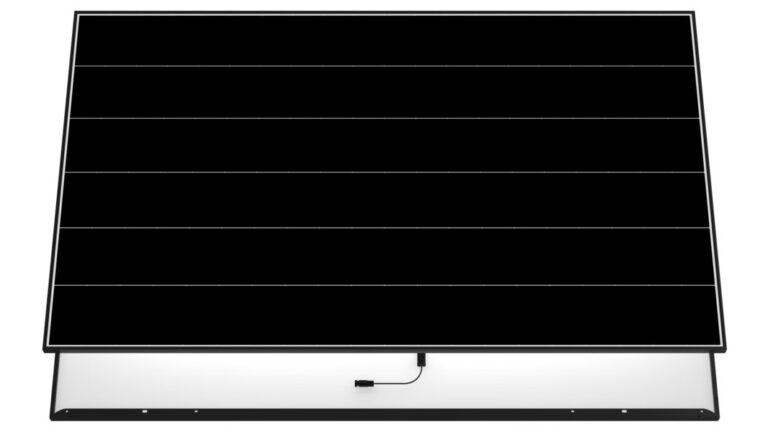





Chinese PV manufacturer Aiko has launched its third-generation all-back-contact (ABC) 60-cell solar module in Australia, targeting residential, commercial and industrial (C&I), and off-grid applications in a compact rooftop format.
According to a company, the new range delivers up to 545 W and boasts module efficiency above 25% in a 1,954 mm × 1,134 mm × 30 mm footprint.
The company says that its ABC design removes front-side busbars and combines a grid-free front surface with a zero-bap cell layout and invisible ribbon interconnection, allowing the module to produce up to 30 W more per panel than comparable TOPCon products and achieve roughly 15% higher lifetime energy yield/m2.
For the Australian market, Aiko positions the 60-cell format as a response to the growth of rooftop solar, larger average household system sizes, and rising interest in pairing PV with batteries. The smaller footprint aims to help customers maximise output on limited roof space, which becomes increasingly important as homes add electric vehicles, heat pumps, and other electrified loads.
The module features a temperature coefficient of -0.26%/C, compared with -0.29%/C for standard TOPCon, and long-term degradation is rated at 1% in year one and 0.35% annually thereafter, implying 90.6% output retention after 30 years. Hot-spot temperatures were found to be more than 30% lower than comparable TOPCon modules in testing, the manufacturer said.
The launch also targets C&I and off-grid segments. On a typical 660 m² commercial roof using 196 modules, replacing 510 W TOPCon modules with the new 545 W modules would increase system size from 100 kW to 107 kW without changing the footprint, according to the company.
For remote or bushfire-prone sites, mono-glass variants use 3.2 mm front glass and are certified for 35 mm hail impact under TÜV and PVEL standards, while dual-glass versions carry IEC Fire Class A certification.
Aiko said the Gen 3 60-cell range has received Australia’s Clean Energy Council (CEC) approval, enabling installations in the country. Models rated 535 W to 540 W are expected to be generally available from late April 2026, with 545 W modules available in limited quantities first, followed by additional dual-glass and full-black variants later in the year.
This content is protected by copyright and may not be reused. If you want to cooperate with us and would like to reuse some of our content, please contact: editors@pv-magazine.com.




By submitting this form you agree to pv magazine using your data for the purposes of publishing your comment.
Your personal data will only be disclosed or otherwise transmitted to third parties for the purposes of spam filtering or if this is necessary for technical maintenance of the website. Any other transfer to third parties will not take place unless this is justified on the basis of applicable data protection regulations or if pv magazine is legally obliged to do so.
You may revoke this consent at any time with effect for the future, in which case your personal data will be deleted immediately. Otherwise, your data will be deleted if pv magazine has processed your request or the purpose of data storage is fulfilled.
Further information on data privacy can be found in our Data Protection Policy.