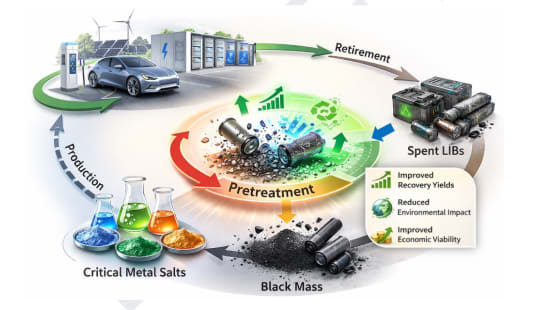





New research by Victoria-based Monash University identifies pre-treatment of lithium-ion batteries as an overlooked recycling strategy in the recovery of valuable metals lithium, nickel, and cobalt.
Pre-treatment is the first processing step, turning spent batteries into “black mass,” before valuable metals can be extracted.
The study compares three main industrial approaches – mechanical, thermal and chemical pre-treatments to identify clear trade-offs between environmental performance, recovery efficiency and operational complexity.
Published in Nature Sustainability, the Impacts of pretreatment routes on spent lithium-ion batteries recycling paper discusses how the pre-treatment stage can account for up to 38% of the environmental impact of recycling and significantly affects material losses, depending on battery type and processing method.
Monash University Department of Civil and Environmental Engineering Professor Victor Chang said lithium-ion battery recycling is not just a technical challenge but also a system design challenge.
“Pre-treatment shapes both recovery efficiency and environmental outcomes. Decisions made at this stage will affect system performance for decades, so it’s vital that they are guided by robust evidence,” Chang said.
“While many countries are planning to invest in and scale up battery recycling industries, our work highlights an important aspect of the process – the pre-treatment stage. This step is often overlooked, but it can be critical in determining the efficiency, safety, and overall effectiveness of downstream recycling processes.”
This content is protected by copyright and may not be reused. If you want to cooperate with us and would like to reuse some of our content, please contact: editors@pv-magazine.com.


By submitting this form you agree to pv magazine using your data for the purposes of publishing your comment.
Your personal data will only be disclosed or otherwise transmitted to third parties for the purposes of spam filtering or if this is necessary for technical maintenance of the website. Any other transfer to third parties will not take place unless this is justified on the basis of applicable data protection regulations or if pv magazine is legally obliged to do so.
You may revoke this consent at any time with effect for the future, in which case your personal data will be deleted immediately. Otherwise, your data will be deleted if pv magazine has processed your request or the purpose of data storage is fulfilled.
Further information on data privacy can be found in our Data Protection Policy.