




The latest data from international energy consultancy Rystad Energy shows that Australia’s large-scale PV assets generated a total of 1.82 TWh of solar energy in March 2026, up from the 1.58 TWh produced in March 2025.
Rystad senior renewables analyst David Dixon said solar farms in Queensland led the way, generating 676 GWh of renewable electricity to drive all Australian large-scale PV and wind generation to 4.7 TWh for the month, up 2% on the 4.6 TWh generated in March 2025 but down on the 5.0 TWh total recorded in February 2026.
Queensland was the biggest contributor to the month’s total with the state’s utility-scale solar assets generating 676 GWh of clean energy while its wind assets produced 624 GWh for a combined total of 1,300 GWh.
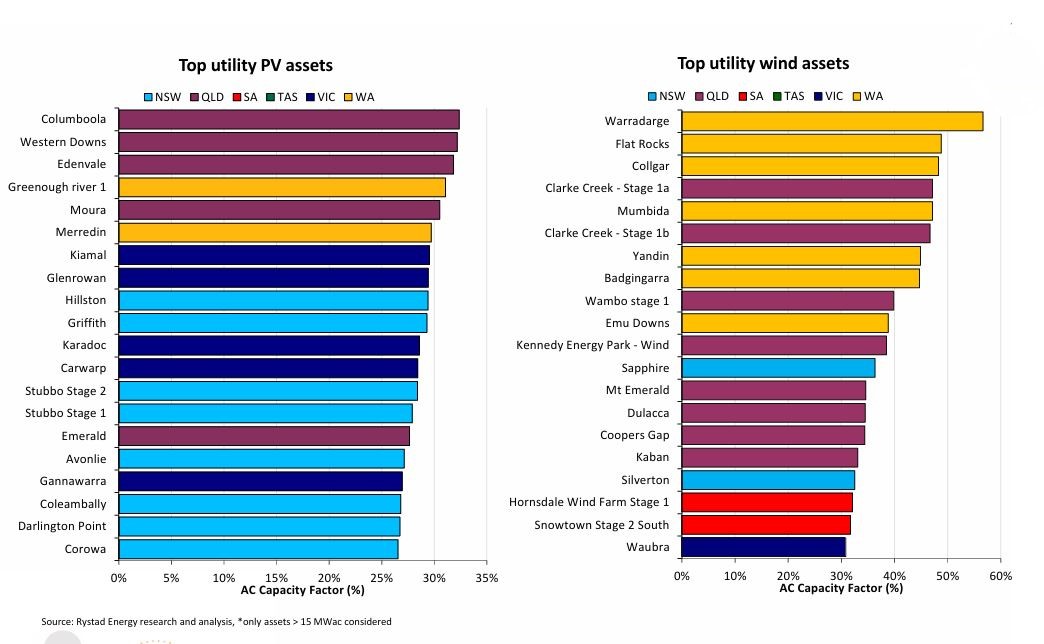
The state is home to four of the five best-performing utility-scale solar assets for the month with South Korea-based investment giant Hana Financial’s 162 MW Columboola Solar Farm in the state’s Western Downs region topping the table with a generating capacity factor (CF) of 32.4%.
French developer Neoen’s 400 MW Western Downs Solar Farm was a close second with a 32.2% CF, ahead of the 204 MW Edenvale Solar Park, co-owned by Japanese oil giant Eneos and Tokyo-based trading house Sojitz, with a 31.8% CF.
Sydney-headquartered developer Potentia Energy and Synergy’s co-owned 40 MW Greenough River 1 Solar Farm in Western Australia’s Wheatbelt region was fourth with Greek developer Metka’s 110 MW Moura Solar Farm in central Queensland rounding out the top five.
The top-performing wind assets were all in Western Australia with Potentia and Synergy’s co-owned Warradarge wind farm (56.7%) the top-performing wind asset, ahead Potentia’s Flat Rocks (48.8%) and Rest’s Collgar (48.3%) wind farms.
Dixon also noted that gas generation continues to decline on a year-on-year basis as large-scale battery energy storage systems and renewables continue to enter the National Electricity Market (NEM) and Wholesale Electricity Market (WEM).
“Utility battery capacity continues to enter the NEM, with 8.9 GW at various stages of commissioning or in operation,” he said, adding that utility batteries now “consistently dispatch” more energy than the open cycle gas turbine (OCGT) fleet.
Gas generation in the NEM dropped to about 540 GWh last month compared to 631 GWh in March last year.
This content is protected by copyright and may not be reused. If you want to cooperate with us and would like to reuse some of our content, please contact: editors@pv-magazine.com.



By submitting this form you agree to pv magazine using your data for the purposes of publishing your comment.
Your personal data will only be disclosed or otherwise transmitted to third parties for the purposes of spam filtering or if this is necessary for technical maintenance of the website. Any other transfer to third parties will not take place unless this is justified on the basis of applicable data protection regulations or if pv magazine is legally obliged to do so.
You may revoke this consent at any time with effect for the future, in which case your personal data will be deleted immediately. Otherwise, your data will be deleted if pv magazine has processed your request or the purpose of data storage is fulfilled.
Further information on data privacy can be found in our Data Protection Policy.