Germany’s new coalition wants to deploy 143.5 GW of solar this decade
The new plan would require the deployment of around 15 GW of new PV capacity each year to 2030. The agreement also includes the gradual phasing out of all coal power plants by the end of the decade.

Malaysia launches scheme enabling consumers to buy renewable energy
Through the Green Electricity Tariff (GET) program, the government will offer 4,500 GWh of power to residential and industrial customers each year. These will be charged an additional MYE0.037 (AU$0.012) for each kWh of renewable energy purchased.
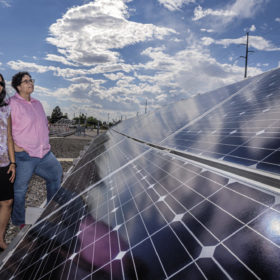
Sunday read: Forecast and prosper
At the risk of stating the obvious, PV performance will always be inextricably linked to the weather. Cloud cover significantly influences power output and severe weather events – including high winds, heavy snowfall, fire, and hail – can lead to module or structural damage. And with climate change making extreme weather events more common, the value of forecasting and understanding the worst Mother Nature can throw at a solar array is increasing.
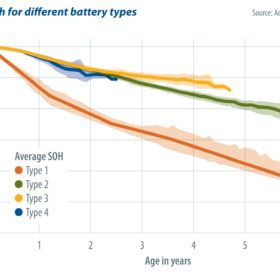
Saturday read: Battery performance, uncovered
Batteries are taking the energy world by storm. From residential home storage systems to large-scale installations, today’s society increasingly relies on powerful batteries. And, as we all know, with great power comes great responsibility. But, how can we ensure that our use of batteries today is responsible, cost-effective, or even safe? Kai-Philipp Kairies, CEO of Accure Battery Intelligence, shares some of his experience gained from monitoring more than 750 MWh of various storage applications.
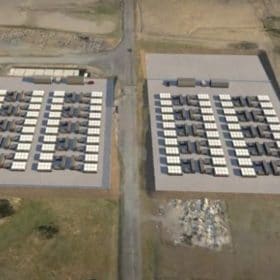
AGL secures planning approval for proposed Loy Yang big battery
Australia’s largest energy gen-tailer AGL says it has received approval for a 200 MW/800 MWh grid-scale battery to be developed at the site of its coal-fired Loy Yang power station in Victoria’s Latrobe Valley.
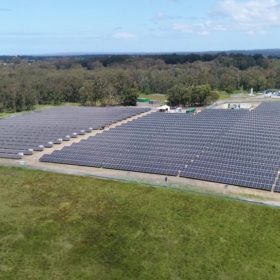
Shoalhaven solar farm serves as roadmap for others say developers
The developers of a $5 million community-driven solar farm in the New South Wales Shoalhaven region believe the 3.9 MWp facility can serve as a model for other communities looking to launch their own renewable projects.
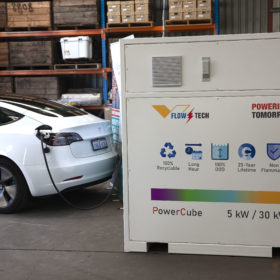
VSUN tests flow battery technology with standalone EV charger
Australian energy storage company VSUN Energy claims to have identified the ‘missing piece of the renewable energy jigsaw’ after successfully testing a standalone electric vehicle battery charger using solar PV supplied by a vanadium redox flow battery.
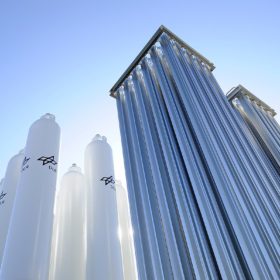
Utilities and financial investors are investing in renewables, especially hydrogen, like never before
A new Ernst & Young power and utilities overview report shows that utilities and other deep-pocketed investors are putting financial support behind their environmental, social and governance initiatives.
South Korea’s largest floating PV plant now online
The 41 MW facility was built by Korean developer Scotra with solar modules provided by South Korea-based manufacturer Hanwha Q-Cells. It was deployed on a water reservoir at the Hapcheon dam, in the South Gyeongsang province.

Renewables to drive down prices as fossil-fuel generators exit NEM
Ongoing growth in both renewable generation capacity, including rooftop solar, large-scale wind and solar, and dispatchable power in the form of big batteries is expected to drive down household power bills across the National Electricity Market in the coming years despite the impending closure of several of Australia’s ageing fossil-fuel fired power stations.