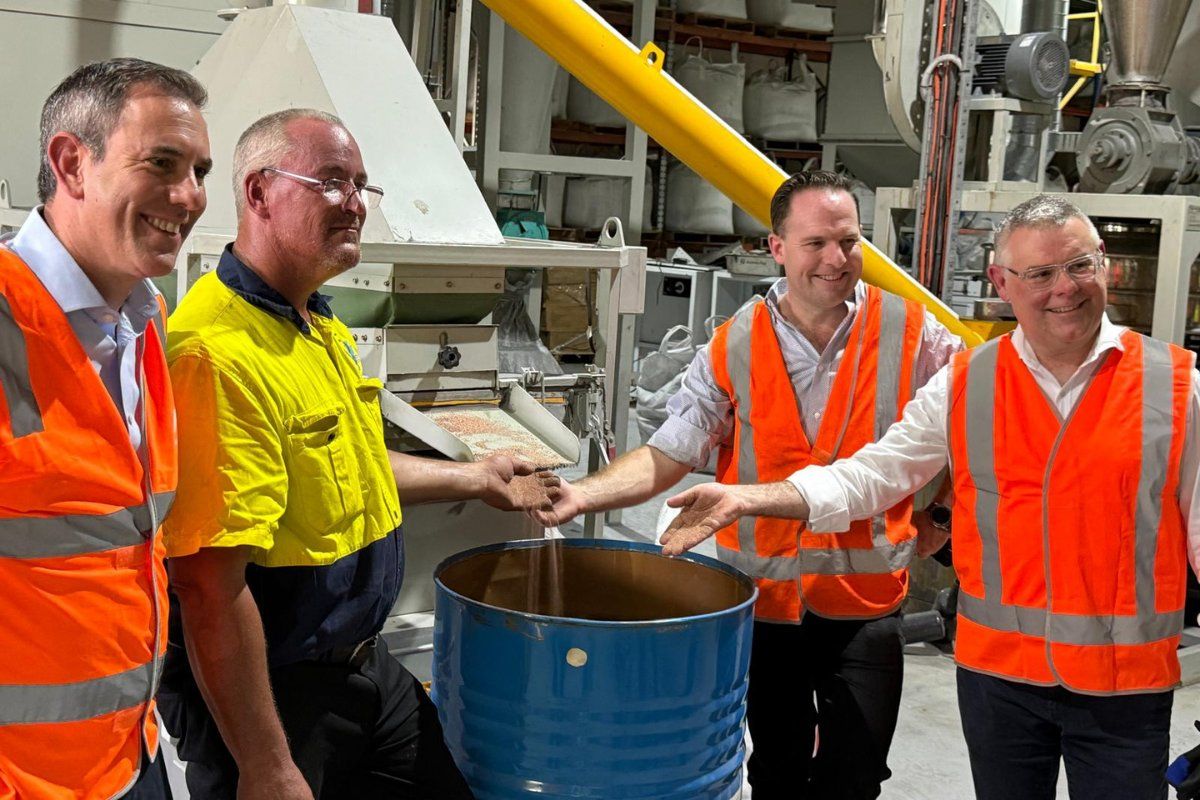





The federal government has announced it will invest $24.7 million (USD 16.5 million) over three years to deliver a national pilot for recycling solar panels that will help address the growing waste issues as they reach end of life.
The pilot program will establish up to 100 collection sites across the country, aiming to improve the management of end-of-life PV modules as Australia’s solar fleet continues to expand and mature. It will also support the development of a circular economy, allowing material and strategic minerals like copper, silver, silicon and aluminium to be recovered and reused rather than lost to landfill.
More than 4.2 million rooftop solar systems have been installed across Australia and an estimated 4 million panels are being decommissioned each year but government analysis shows only 17% of those panels are currently being recycled.
“Most panels are either stockpiled, dumped in landfill or exported for reuse,” federal Environment Minister Murray Watt said.
“These materials can be repurposed to support the clean energy transition and help reduce what we send to landfill.”
The government commitment comes after a Productivity Commission report into Australia’s circular economy recommended the government “urgently establish” a national recycling scheme for solar panels and investigate the merits of a similar scheme for electric vehicle (EV) batteries.
“Currently, neither solar PV systems nor EV batteries are managed in a consistent or comprehensive way once they are considered to have reached their end of life,” the report says.
“Though some private recycling services exist in Australia … only 17% of solar panel components are recycled with the remaining 83% of materials treated as waste.”
The Productivity Commission said the key barrier to the growth of a solar recycling industry is the cost of recycling the panels, which it estimated is about six times the cost of sending them to landfill.
Darren Johannesen, executive general manager of sustainability at the Smart Energy Council, said the program would transform a growing waste challenge into a major economic opportunity.
“Solar panels are not a waste problem, rather a critical resource,” he said. “They contain precious materials like silver, copper, aluminium, silicon and high-grade glass, commodities critical to our clean energy shift.”
“Implementing a national stewardship scheme, which we hope and expect will follow the pilot, will trigger an urban-mining boom, and a new wave of smart energy investment in jobs and growth.”
The Australian government estimates the creation of a national product stewardship scheme for small-scale solar PV systems could unlock up to $7.3 billion in economic benefits through reduced waste and reuse of materials.
This content is protected by copyright and may not be reused. If you want to cooperate with us and would like to reuse some of our content, please contact: editors@pv-magazine.com.


By submitting this form you agree to pv magazine using your data for the purposes of publishing your comment.
Your personal data will only be disclosed or otherwise transmitted to third parties for the purposes of spam filtering or if this is necessary for technical maintenance of the website. Any other transfer to third parties will not take place unless this is justified on the basis of applicable data protection regulations or if pv magazine is legally obliged to do so.
You may revoke this consent at any time with effect for the future, in which case your personal data will be deleted immediately. Otherwise, your data will be deleted if pv magazine has processed your request or the purpose of data storage is fulfilled.
Further information on data privacy can be found in our Data Protection Policy.